Mobile’s Continental Aerospace to Pay $11.77 Million in PPP Fraud Settlement, Whistleblower to Collect $1.7 Million
Continental Aerospace Technologies will pay roughly $11.77 million to settle PPP fraud claims tied to its Chinese-government ownership, with whistleblower GNGH2 Inc. collecting about $1.7 million.
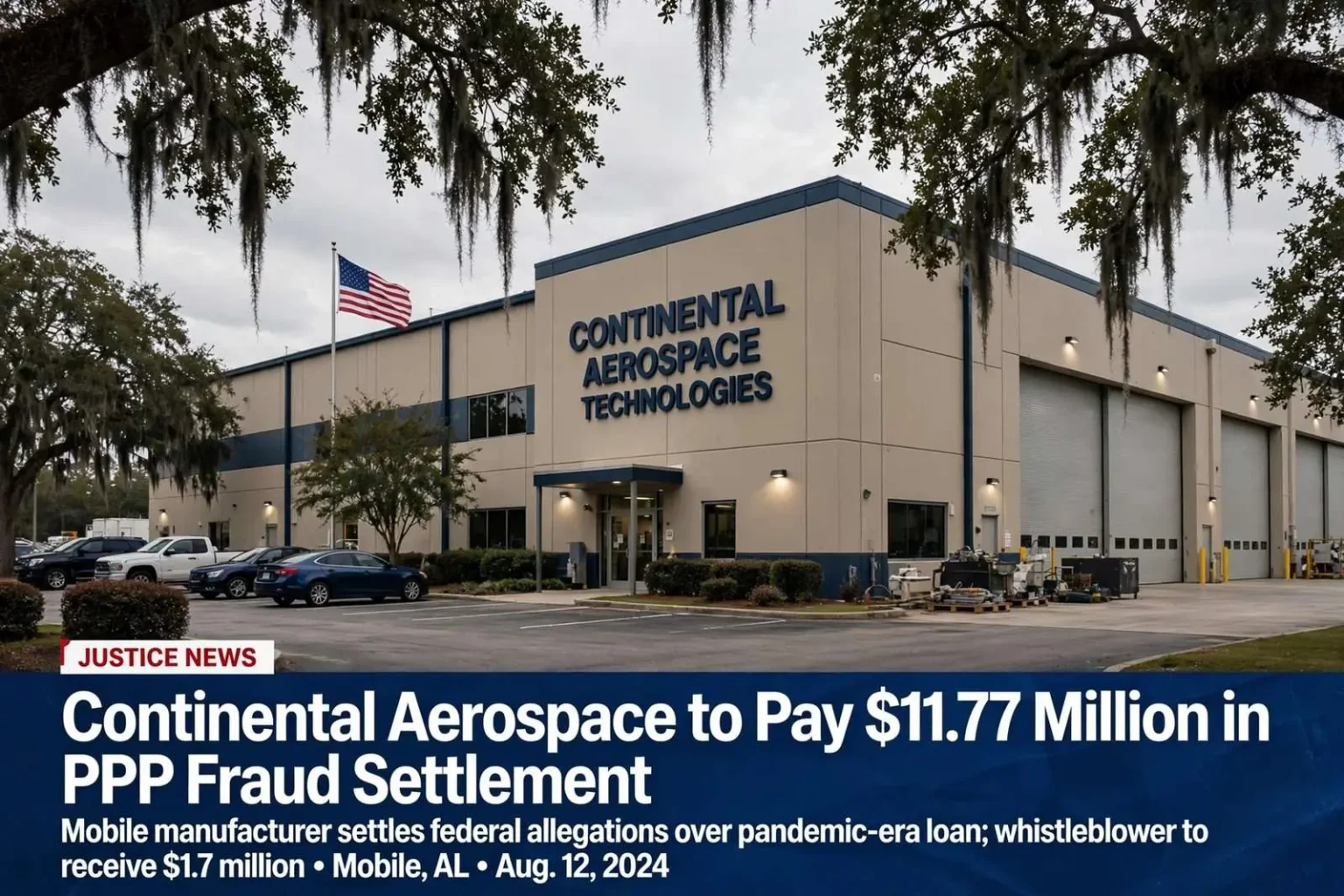
A Mobile-based aerospace manufacturer will pay roughly $11.77 million to settle federal allegations that it fraudulently obtained a pandemic-era relief loan for which it was never eligible, the U.S. Attorney’s Office for the Southern District of Alabama announced. The Justice Department announced the civil settlement, totaling $11,772,680.14, on Tuesday, Aug. 12.
Prosecutors accused Continental Aerospace Technologies of falsely certifying that it qualified for a Paycheck Protection Program (PPP) loan during the COVID-19 pandemic, in violation of the federal False Claims Act, an anti-fraud statute that imposes civil liability on people or companies that knowingly submit false or fraudulent claims for payment to the government.
The settlement is among the more consequential PPP enforcement actions to originate from south Alabama, and it closes a case built on one of the program’s most basic eligibility rules — the definition of what counts as a small business — applied to a company whose corporate family spanned two continents.
Chinese Government Ownership Cited
Federal prosecutors said that when Continental applied for its PPP loan, it was part of a larger multinational corporation partially owned by the Aviation Industry Corporation of China (AVIC). AVIC, in turn, is wholly owned by the State-Owned Assets Supervision and Administration Commission of the State Council (SASAC), an arm of the People’s Republic of China.
According to the U.S. Attorney’s Office, Continental certified it was eligible for the PPP when it applied — PPP records maintained by ProPublica show it was approved for a $7.4 million forgivable loan in April 2020, listing 476 jobs it intended to protect — but the government alleges the company was not eligible for two reasons: it was affiliated with other companies in the United States and China that, combined, employed more people than the Small Business Administration’s size standard allowed for its industry, and it was ultimately owned by a foreign government entity, in violation of SBA rules barring companies with significant foreign-government ownership from the program.
Those two deficiencies go to the heart of what the Paycheck Protection Program was designed to do. Congress created the program as a lifeline for genuinely small businesses facing closure during pandemic lockdowns, and the SBA’s affiliation rules exist precisely to prevent large enterprises from reorganizing themselves into small-looking units to collect benefits. A company whose ultimate parent was an instrument of a foreign government sat on the far side of both lines: it was not small, and it was not American-owned.
U.S. Attorney Sean P. Costello said the settlement reflects the government’s continued willingness to pursue companies that took advantage of pandemic relief programs. “This settlement demonstrates our office’s steadfast commitment to relentlessly investigating and resolving fraud against American taxpayers,” Costello said. “It also reflects the effectiveness of our collaborative False Claims Act investigations in holding companies and individuals accountable for fraudulent conduct and returning unlawfully obtained taxpayer funds to the United States, together with significant financial penalties.”
Continental did not admit to any wrongdoing as part of the agreement, and the settlement closes the case without a finding of liability. The Small Business Administration also weighed in: “The SBA is committed to rooting out every dollar of PPP fraud,” SBA General Counsel Wendell Davis said.
Whistleblower Company to Receive $1.7 Million
The settlement resolves two whistleblower lawsuits brought under the False Claims Act’s qui tam provisions. GNGH2 Inc., a for-profit professional whistleblower company that has targeted PPP borrowers with ties to China, filed in the Eastern District of Wisconsin. A second suit was filed in the Southern District of Alabama on May 10, 2024, by Andrew McCarley, naming AVIC, Continental Aerospace Technologies and CEO Karen Hong; that Mobile case remained under a protective order until Aug. 5, when Chief U.S. District Judge Jeffrey U. Beaverstock unsealed portions of it. Under the act’s provisions, whistleblowers who bring successful claims on the government’s behalf are entitled to a share of any recovery, and GNGH2 Inc. is set to receive $1,765,902.02, roughly 15% of the settlement.
The qui tam mechanism that produced the case is one of the federal government’s most productive fraud-fighting tools. Private parties with knowledge of false claims can sue on the government’s behalf, and the Justice Department may intervene and take over the litigation, as it does in the most substantial cases. The whistleblower’s share — here, a seven-figure recovery — is the statute’s incentive for insiders and specialists to come forward with evidence the government would otherwise never see.
Professional whistleblower companies like GNGH2 have become a distinct feature of False Claims Act practice. Rather than relying solely on employees with inside knowledge, these firms investigate public records — ownership filings, payroll data, program disclosures — and file targeted suits against recipients whose eligibility appears questionable. PPP enforcement, with its vast public dataset of loans and certifications, has proven fertile ground for that model.
What the Paycheck Protection Program Was
Congress created the Paycheck Protection Program in March 2020 as part of the broader federal response to the economic fallout of the COVID-19 pandemic, aiming to provide emergency financial assistance to American businesses and workers. Under the program, eligible businesses could receive loans guaranteed by the Small Business Administration that would be forgiven if the funds were used primarily for payroll and other approved expenses.
The program ultimately distributed hundreds of billions of dollars nationwide, and it has since become a frequent subject of federal fraud enforcement as investigators have worked through claims that some recipients misrepresented their eligibility, including their size, ownership structure or need for the funds.
The scale of the program made some level of abuse inevitable. Loans were processed at extraordinary speed through thousands of banks, with limited upfront verification, on the theory that speed mattered more than perfection during a nationwide shutdown. The trade-off was that eligibility questions — affiliation rules, foreign ownership limits, size standards — were resolved largely on the honor of the applicant’s certification, with enforcement arriving years later through audits and lawsuits like this one.
A Longtime Mobile Manufacturer in Transition
Continental Aerospace Technologies has deep roots in the Mobile area as a manufacturer of piston aircraft engines used in general aviation, tracing its lineage back to the historic Continental Motors brand. The company announced in June that a private equity firm would acquire it from its Chinese owners, a deal that would end the foreign-government ownership structure at the center of the federal case.
Hong Kong Stock Exchange disclosures in June showed Continental’s parent had agreed to sell the company’s U.S. and German operations in a proposed $535 million deal to Mobile Acquisition Co. LLC, a Delaware company tied to Arcline Investment Management, and estimated a Justice Department settlement of between $10 million and $20 million over the PPP allegations. German law firm Gleiss Lutz announced July 28 that it had advised Arcline on the purchase. The sale had not been finalized and remains subject to approval and foreign investment review. Phillip Mahoney, global strategy partner for Continental, has said the sale was unrelated to the settlement and denied that prosecutors proposed or discussed it in settlement negotiations.
The company’s history runs deep in Mobile’s industrial story. Continental Motors began producing engines in the early twentieth century, and its piston engines have powered generations of small aircraft — the Cessnas, Pipers and Beechcrafts that make up the backbone of American general aviation. Generations of Mobile workers built those engines at the company’s local plant, and the Continental name became one of the recognizable industrial brands in a city better known for shipbuilding and aerospace assembly.
The Chinese chapter of that history began when AVIC’s American subsidiary acquired the company, folding a storied Alabama manufacturer into a corporate structure that ultimately answered to the Chinese state. The arrangement drew little attention in the years when the company operated as usual, but the pandemic-era loan application brought the ownership structure into a federal courtroom’s worth of scrutiny, and the pending sale to a private equity firm would unwind it entirely.
The $11.77 million settlement resolves the federal government’s allegations without requiring the company to admit liability, a common resolution structure in False Claims Act cases.
What It Means Locally
For Mobile, the case is a reminder that pandemic fraud enforcement has reached into every corner of the country — and that the Southern District of Alabama, the federal district covering Mobile and the surrounding counties, has pursued such cases against employers of all sizes. The recovery returns nearly $12 million to the Treasury, with a $1.7 million share headed to the whistleblower that brought the case, and it closes the chapter on an eligibility question that followed the company through a period of ownership change.
The settlement also illustrates how the False Claims Act operates as a standing enforcement system rather than a one-time penalty. Certifications made in a two-page loan application in 2020 remained subject to scrutiny years later, and the ownership structure disclosed — or not disclosed — at the time of application proved decisive. For companies receiving federal funds, the message from the U.S. Attorney’s Office is that eligibility is verified against the full corporate family, wherever in the world its owners sit.
The affiliation rule at the center of the case deserves plain explanation, because it is where most PPP eligibility disputes were won or lost. SBA size standards are set by industry, typically measured in employee counts or annual receipts, and the agency’s regulations require an applicant to count not just its own payroll but the employees of any concern with which it is “affiliated” — companies that own it, that it owns, or that are under common control. A manufacturer might itself employ a few hundred people and look like a small business, but if its corporate siblings in other states or countries push the combined count past the standard, the exception is gone. That, according to the allegations, was Continental’s first disqualifier; the ownership by SASAC through AVIC was the second and the simpler one, since the program was never open to companies owned in meaningful part by foreign governments.
The resolution also follows the standard arc of a contested False Claims Act case: a complaint filed under seal, an investigation in which the government reviews the loan file and the corporate records, and a settlement that ends the litigation without either a trial or an admission. For the government, the result returns funds and establishes the enforcement precedent; for the company, it closes a liability without a finding that could complicate the ownership transition it had announced. The structure is neither a vindication nor a confession — it is the way federal fraud cases usually end.