Mobile’s Hourstruck Takes the Alabama Music Box Stage
Mobile hard-rock band Hourstruck, built from veterans of Apathy Ensues and Ashes of Scorn, plays the Alabama Music Box.
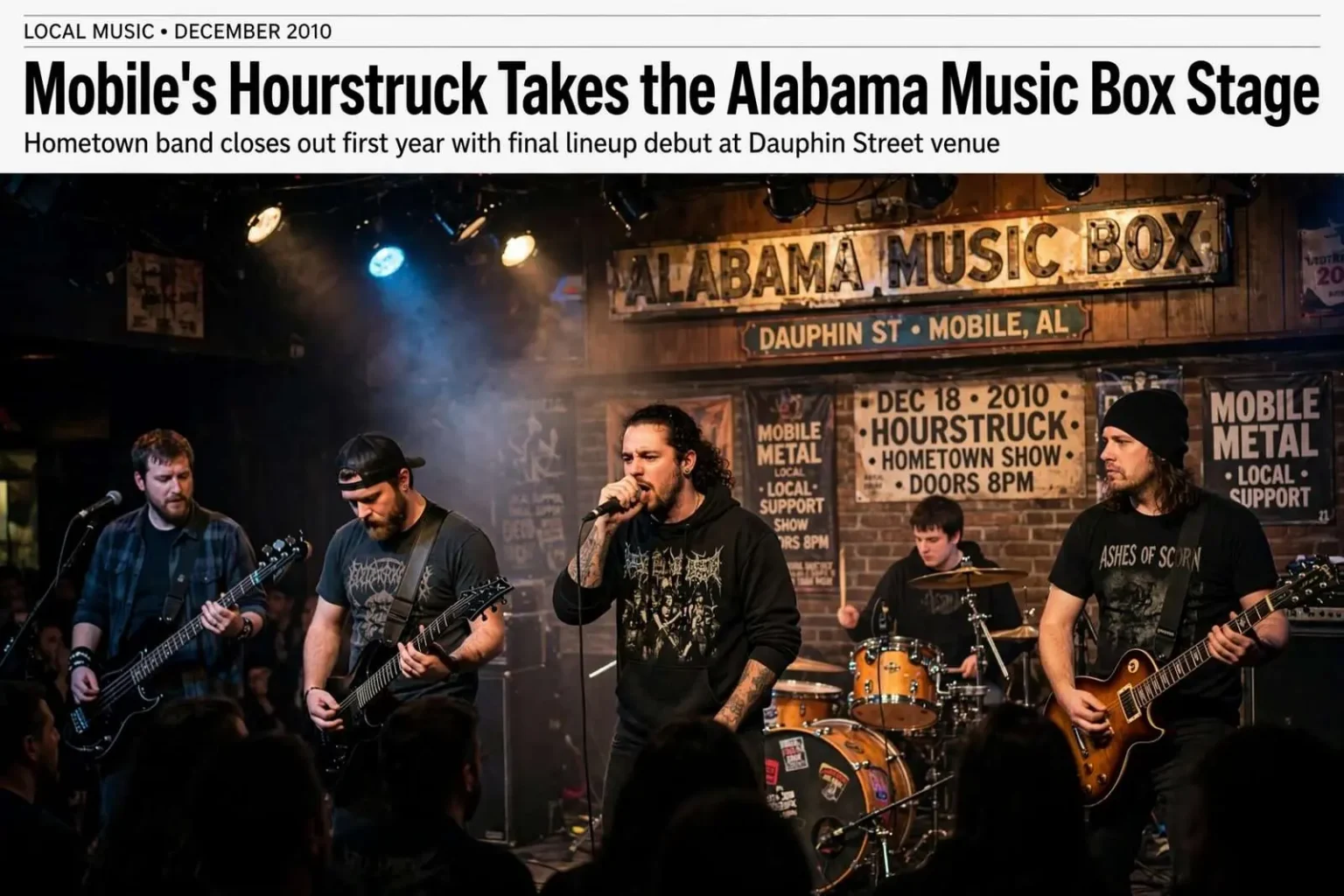
Mobile hard-rock outfit Hourstruck brought a lineup pieced together from some of the area’s best-remembered metal bands to the Alabama Music Box stage in December 2010, closing out a first year that had already reshaped the group’s roster more than once. For the members on stage, the night doubled as a hometown checkpoint — a chance to show the downtown crowd how a band assembled from Mobile’s metal lineage had settled into place after a season of changes.
The venue itself has long occupied a distinct place in downtown Mobile’s live-music landscape. Sitting along Dauphin Street, the club has served as a mid-size room where touring hard-rock, metal and alternative acts share the calendar with hometown bands, and it draws precisely the kind of audience that had followed Hourstruck’s players through their previous projects. A December slot there put a band barely a year old on one of the street’s central stages, in front of regulars who knew the members’ names long before the group existed.
Built from Mobile’s Metal Lineage
The band took shape in October 2009 around New Orleans native Brad Milliken, formerly of Apathy Ensues, a defunct metalcore act with Mobile roots. Milliken carried with him both the connections and the standards of the central Gulf Coast’s heavier musical corners, and Apathy Ensues had built a genuine following across the region before folding. Starting a new project meant, in effect, reassembling the best available talent from that same orbit.
He recruited former Apathy Ensues guitarist Jeff Reigns of Saraland, a suburb just north of Mobile, followed by guitarist Craig Penix, who had played with Ashes of Scorn. With two guitars anchored by players drawn from two different respected area acts, the project quickly took on the character of a scene collective rather than a simple restart of an old band. Each player arrived carrying a piece of Mobile’s recent metal history with him.
After a string of exacting tryouts, the vocal spot went to Ash Rester — another Ashes of Scorn veteran — who joined in February 2010. The search for a frontman had clearly mattered to Milliken and company; rather than settling for the first available singer, the band held auditions until it found a voice with the same pedigree as the rest of the roster. Rester’s arrival completed the core of the group and set its identity: a hard-rock unit built on seasoned players rather than newcomers.
The final piece came by way of an unlikely source. The band’s photographer, Lindsey Milton, recommended drummer Geoff Prill, a prodigy out of Lucedale, Mississippi, and the recommendation proved decisive. Finding a drummer through the person behind the lens was an unconventional path in a scene where word usually travels through other musicians, but it underscored how tightly knit the Gulf Coast music community remains — even its behind-the-scenes figures help shape the bands that eventually take the stage.
When Reigns departed that August, Todd Arrington of the defunct band Hafnium stepped in as the newest member. Losing a founding guitarist barely ten months into a band’s life is the kind of setback that ends most young acts, but Hourstruck simply turned again to the pool of Mobile-area veterans it had drawn from all along. Arrington’s arrival restored the twin-guitar attack and closed out the recruiting cycle that had defined the band’s first year.
By the time December arrived, the group had cycled through its final lineup change and reached the configuration it would carry onto the Alabama Music Box stage. For a young band, that kind of stability is hard-won; for a band whose members all came from established acts, it meant the December dates were the first true showcase of the settled roster in front of the home crowd.
A Scene That Keeps Rebuilding Itself
Hourstruck’s story is a familiar pattern in Mobile’s heavy-music community, where bands form, dissolve and recombine while the same network of players circulates among projects. The city and its surrounding suburbs have supported a committed hard-rock and metalcore circuit for years — basement shows, VFW halls, dive stages and mid-size clubs alike — and defunct bands like Apathy Ensues, Ashes of Scorn and Hafnium left behind both audiences and musicians who were ready for the next project.
Apathy Ensues had been a fixture of that circuit before its dissolution, with Mobile roots and a following that stretched across the area. Its breakup did not end its members’ involvement in the scene; it simply scattered experienced players back into the pool, waiting for someone like Milliken to pull them together again. The same held true for Ashes of Scorn, whose alumni populated the new band’s second guitar slot and its microphone.
Hafnium’s story fit the mold as well. The band was already defunct by the time Hourstruck needed a guitarist in August 2010, which meant Arrington was available precisely when the roster needed him. In a healthier scene, a band’s death is rarely the end of anyone’s playing career — it is a reshuffling — and Hourstruck’s first year is a case study in how that reshuffling works in practice.
What made the new band notable was not that its members had played before, but where they had played. Mobile’s metal acts tend to draw from the same neighborhoods, schools and friend groups, so a lineup like Hourstruck’s reads almost like a family tree of the local scene. Fans who followed Apathy Ensues or Ashes of Scorn did not need an introduction to the players; they needed only a reason to show up, and a hometown date at a central downtown venue supplied it.
A Roster Drawn From Across the Region
The band’s geography tells its own story about how the central Gulf Coast music scene operates. Saraland, where Reigns grew up, sits just north of the Mobile city line along U.S. 43, close enough that its musicians have always been fixtures of Mobile’s clubs rather than a separate scene. Lucedale, Prill’s hometown, lies farther afield — the seat of George County, Mississippi, roughly an hour’s drive northwest of Mobile — yet its proximity to the state line keeps it firmly inside Mobile’s musical orbit.
Milliken’s own background adds another thread, linking the scene to New Orleans, whose music community has always run up and down the Gulf Coast corridor. Bands book shows, borrow members and share bills across Mobile, Biloxi, New Orleans and the towns in between, and a drummer from Lucedale or a guitarist from Saraland appearing in a Mobile band surprises no one who has watched the circuit operate. Hourstruck’s roster was, in that sense, an accurate map of the region’s talent flow.
For the musicians themselves, drawing from a wide radius is practical as well as cultural. Smaller towns along the coast cannot sustain a dozen working metal bands apiece, so ambitious players inevitably gravitate toward Mobile’s stages while keeping their hometown identities. When a new project assembles, its reach becomes a competitive advantage: more former bandmates, more possible recruits, and a broader base of fans who will drive an hour for a show.
Hometown Stage
For a young band barely a year old, the Alabama Music Box date put Hourstruck on one of Dauphin Street’s central stages, in front of the downtown crowd that had watched its members come up through Apathy Ensues and Ashes of Scorn. That continuity mattered. Mobile audiences tend to track musicians across projects the way sports fans track trades, so the December show was less a debut than a reunion — the same familiar faces, reorganized into a new lineup and playing under a new name.
Dauphin Street itself functions as the spine of downtown Mobile nightlife, with clubs, bars and music rooms clustered within a few blocks of each other. On a weekend night the street fills with crowds moving from venue to venue, and a band holding a stage there reaches an audience that includes casual passers-by as well as dedicated showgoers. For a group still establishing its name, the location alone represents a step up in exposure.
The Alabama Music Box has historically bridged the gap between the neighborhood bar stage and the larger touring rooms, offering hometown bands professional sound and lights without requiring them to leave town. That middle tier is essential to any scene’s development, because it is where local acts learn to run a full headline set, to carry a room they have packed themselves, and to hold their own on a bill with visiting bands.
The show marked the Arrington era’s first run of hometown dates as the group settled its final lineup. First hometown shows with a new member carry a particular weight in a small scene: the audience is not only hearing the new material, it is auditioning the new member by ear, comparing what it remembers of the previous lineup with what stands before it now. By every account of how Mobile crowds operate, the December dates gave Arrington exactly that trial — a room full of people who knew Hafnium’s former guitarist by name, watching to see how he fit.
For Milliken, the December run also validated the method behind the band’s construction. The exhaustive tryouts, the network-driven drummer search and the willingness to replace a founding member mid-year all pointed toward a group built to last rather than a temporary collection of available players. The Alabama Music Box stage, with its history of hosting the region’s serious hard-rock acts, offered the right setting to make that case.
What the December Dates Represented
Every young band in a regional scene faces the same test: whether it can convert accumulated goodwill — fans inherited from former bands, respect earned in previous projects — into a following of its own. The December 2010 dates at the Alabama Music Box were Hourstruck’s first formal attempt at that conversion with its complete roster. The elements were all in place: a central downtown venue, a settled lineup of veterans, and a year of behind-the-scenes groundwork already behind them.
The band’s first year had unfolded like a condensed version of the Mobile scene itself — old acts ending, new ones forming from the wreckage, and players moving between them with the ease of longtime collaborators. Formed in October 2009, rebuilt in February, retooled again in August, and on a central Dauphin Street stage by December, Hourstruck spent 2010 doing in twelve months what many bands stretch across several years.
For the downtown crowd that filled the club, the night offered a straightforward proposition: the members of Apathy Ensues, Ashes of Scorn and Hafnium were back on a Mobile stage together, now under one name. For the band, it was the first full demonstration that the pieced-together roster had become an actual unit — one assembled deliberately from the best-remembered parts of the area’s metal scene, and finally playing for the hometown audience that knew every piece of its history.