Mobile’s Integrated Conde Explorers Krewe Still Welcoming 2011 Riders
Mobile's only integrated Mardi Gras krewe, the Conde Explorers, recruits riders for its Feb. 19, 2011 downtown parade.
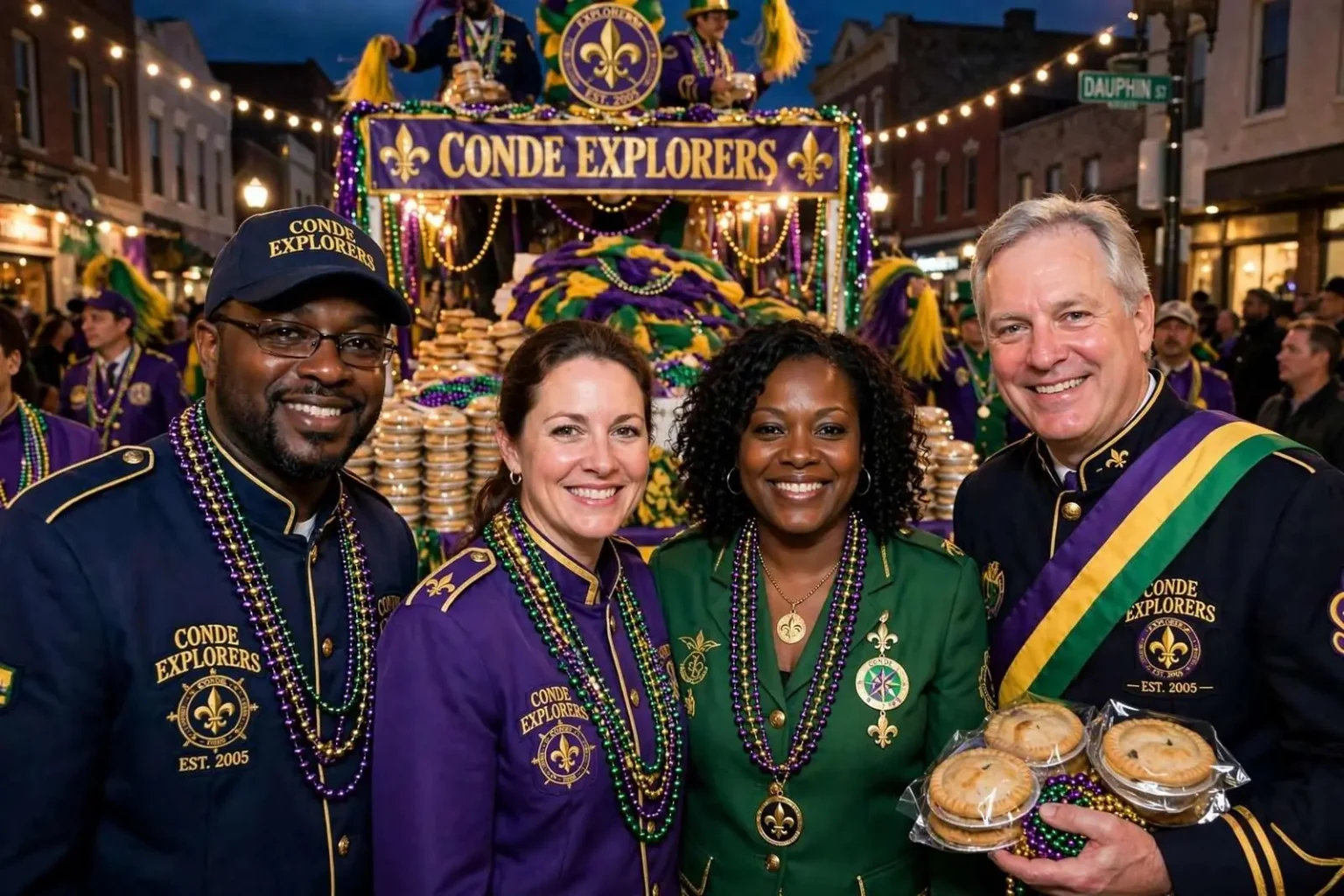
One of Mobile Mardi Gras’ most distinctive societies is recruiting: the Conde Explorers, the port city’s only integrated carnival krewe, are still signing up riders for the 2011 season. For a city whose carnival organizations have historically reflected the racial lines of the community that founded them, the krewe’s continued growth is a quiet marker of how much downtown parades have changed over the past decade.
The society made history in 2005 when it became the first integrated Mardi Gras organization to parade in downtown Mobile. It gained wider recognition through its appearance in The Order of Myths, the documentary examining race and tradition in Mobile’s carnival culture. The film, which followed the parallel worlds of Mobile’s oldest white and black mystic societies through a full carnival season, introduced audiences far beyond Alabama to the unusual arrangement by which the city’s celebratory traditions had long kept company but rarely merged.
Today the krewe counts about a hundred members and welcomes men and women of all races — a cross-section of Mobilians that runs from police officers to doctors to attorneys. Members of historic “Old Mobile” parades, both black and white, ride alongside them. That mix, unusual when the organization formed, has become part of its identity and its pitch to prospective riders: a krewe that looks like the city it parades through.
Beyond the parade season, the Conde Explorers hold a ball and several parties through the year, and members put in volunteer hours across the community. Like most carnival societies, the krewe functions as a year-round social organization as much as a parade unit, with the months between Mardi Gras filled with fundraisers, dances and the slow, collective work of building floats and ordering throws.
How Mobile Carnival Traditions Evolved
Mobile’s claim as the home of the first American Mardi Gras stretches back to 1703, when colonists at Twenty-Seven Mile Bluff celebrated the season years before New Orleans existed. The celebration grew through the nineteenth century into a network of mystic societies — secret social organizations that stage parades, present debutantes and hold formal balls. Over generations, those societies mirrored the city’s segregation, with separate organizations for white and black Mobilians, each with its own traditions, parading schedules and royalty.
By the 1990s and early 2000s, some residents had begun to question openly why the city’s signature celebration remained so divided. The Conde Explorers emerged from that conversation, founded by members determined to build a krewe where membership depended on willingness to work and ride rather than on race, family ties or social register. Their first downtown parade in 2005 broke a barrier that had stood since the earliest parades rolled down Government Street.
The Order of Myths, the 2008 documentary that followed the krewe and its counterparts, brought that story to a national audience and made the Conde Explorers one of its most visible examples of change. The film examined the ironies and friendships that persist within a two-track carnival culture, and the krewe’s riders became, for many viewers, the face of an integrated future for Mobile’s celebration.
For prospective riders, the practical requirements are modest by carnival standards. Dues are kept deliberately inexpensive — and as the society likes to note, throws can come straight out of your attic. Unlike krewes that require members to purchase elaborate costumes or commit to expensive float-building contracts, the Conde Explorers have structured membership so that teachers, city workers, small-business owners and young families can afford to participate.
The krewe parades on Route A in downtown Mobile on Saturday, February 19, 2011 at 7:30 p.m., with its ball following the parade. The evening parade slot places the society among the most visible processions of the season’s final weekends, when downtown streets fill with families who stake out the same corners year after year with barbecues, bleachers and nets ready for moon pies and beads.
Prospective riders can reach the society through condeexplorers.org or by contacting president Terrence Bridges. Recruitment typically runs heaviest in the fall and early winter, when float assignments are made and costume planning begins, but the organization keeps its door open to newcomers close to the season — a flexibility that reflects its founding mission of widening the circle rather than guarding it.
What Riding Actually Involves
First-time riders are often surprised by how much work a parade season takes. Beyond the night itself, members help load throws, ride the float-building schedule and put in the hours at the den that keep a krewe functioning. In exchange, they get a place in one of the city’s oldest continuous cultural traditions — and, in the case of the Conde Explorers, a spot in an organization that has spent years demonstrating that the two halves of Mobile’s carnival can share a route.
The krewe’s volunteer work across the community — from school events to neighborhood cleanups in the off-season — has helped it build relationships beyond the parade calendar. Carnival societies in Mobile have long served as civic engines for their members, raising money for causes and providing the social networks that many members count among the most durable friendships of their lives. The Conde Explorers have sought to extend those networks across the racial lines the city’s carnival culture once enforced.
Nearly a decade after its founding, the krewe’s place in the parade lineup is no longer remarkable to younger Mobilians, which veterans of the organization regard as its own kind of achievement. The society that had to argue its way onto the route in 2005 now appears in the season’s published schedules without commentary — one parade among dozens, its riders as varied as the crowds that line the route to catch their throws.
The 2011 season arrives with the krewe still sizing up its roster for February. About a hundred members currently ride, and organizers have said there is room for more — both for the parade itself and for the ball that follows, where members and their guests gather after the floats are parked. For families weighing a first carnival commitment, the society’s low dues and welcome-all stance have made it a common entry point into Mobile’s celebration culture.
That accessibility has broader significance in a city where some mystic societies maintain waiting lists measured in years and membership often follows family lines. The Conde Explorers’ model — sign up, pay modest dues, work the season, ride — has given Mobilians without inherited carnival connections a way into a tradition that can otherwise feel closed. It is part of why the krewe’s ranks have grown steadily even as some older organizations have struggled to replace aging memberships.
The organization’s integrated membership also reflects the direction of the city itself. Downtown Mobile has changed considerably since the krewe first paraded, with the entertainment district along Dauphin Street drawing mixed crowds every weekend and the Mardi Gras season itself becoming the city’s most visible showcase. A krewe whose riders cross every racial and professional line fits naturally into that evolving picture.
For 2011, the society’s leadership has kept its message consistent: the krewe exists for anyone willing to ride. The Feb. 19 parade gives prospective members a clear date to work toward, and the society’s officers — led by president Terrence Bridges — have encouraged interested Mobilians to make contact early enough to be fitted for costumes and briefed on float assignments before the season’s final preparations begin.
Two hundred years after Mobile’s first carnival celebration and six years after the Conde Explorers first rolled downtown, the city’s most integrated krewe will once again take Route A into a season that remains, in many corners, divided by tradition. The riders who follow them — black and white, young and old, from patrol cars and courtrooms and clinics — are the clearest sign yet of how Mobile’s celebration is slowly, deliberately, coming together.
Mobile’s carnival calendar makes room for the society each year alongside the mystic societies whose names — the Order of Myths, the Mystics of Time, the Infant Mystics — are shorthand for generations of Mobile history. The Conde Explorers’ Route A assignment places them in the heart of that lineup, parading through a downtown whose carnival infrastructure — the viewing stands, the string lights, the businesses that depend on the season — has been built up over more than a century of Februarys.
Riders who join for the first time tend to discover the same thing veterans already know: the throws matter less than the tradition. Moon pies, doubloons and beads have their place in every parade, but what keeps members coming back is the social fabric — the year-round calendar of parties and volunteer events, the friendships formed on float decks, the sense of belonging to a society that opened its arms on purpose.
The krewe’s founding generation has watched its gamble pay off in ways beyond membership rolls. Other organizations in Mobile’s carnival world have since faced their own questions about accessibility and inclusion, and the example of a successful integrated krewe — one that parades, holds its ball and thrives — has quietly reset expectations about what a Mobile society can look like. Change that once had to be argued is now, at least in one corner of the season, simply practiced.
For Mobilians considering a first ride in 2011, the Conde Explorers offer something the older societies cannot: a founding story that is still being written. The krewe is young enough that new members help shape its character, small enough that every rider is known by name, and established enough that its place in the parade schedule is secure. Those joining this season will be part of only the seventh class to ride downtown since that history-making first parade in 2005.
Applications and questions about membership can go through condeexplorers.org or to president Terrence Bridges directly. The society’s officers have asked interested riders to reach out well before the Feb. 19 parade date, when the season’s logistics — costume fittings, throw orders, float assignments and ball arrangements — are finalized. After that, the only thing left to do is what a hundred Mobilians will already be doing on that February Saturday night: rolling down Route A, throws in hand, as part of the city’s most integrated krewe.