University of South Alabama Mobile
Mobile’s The Ugli Stick Lands Mitchell Center Slot Opening for OneRepublic
Mobile band The Ugli Stick won a national Battle of the Bands contest and will open for OneRepublic and Fabolous when the Crocs Campus Tour stops at the University of South Alabama's Mitchell Center.
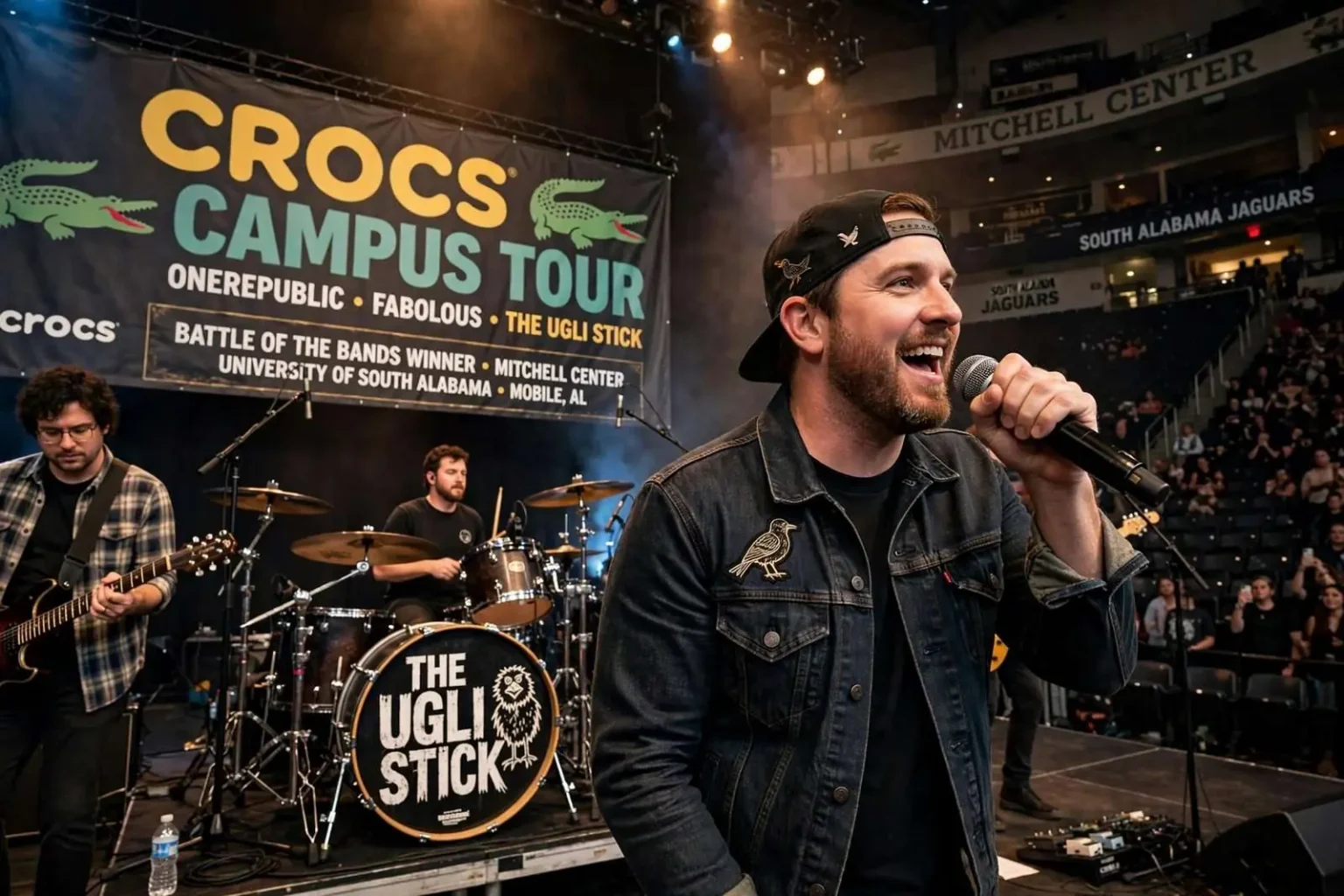
The Mitchell Center at the University of South Alabama is set to host a major stop on the Crocs Campus Tour, a national concert series that will bring OneRepublic and Fabolous to Mobile, along with a homegrown act sharing the stage: Mobile’s own The Ugli Stick. The booking gives the Port City a rare double bill pairing a chart-topping pop-rock act with one of hip-hop’s most durable names, and it hands a local band the kind of platform that Gulf Coast acts seldom get to stand on. For students at South Alabama and music fans across the region, the show turns the campus arena into the center of the concert map for a night.
The Ugli Stick earned its place on the bill the hard way, by winning the Crocs Campus Tour Battle of the Bands competition, a nationwide contest that pitted the group against other acts vying for a coveted opening slot on the tour. Victory did not come from a panel of judges in a distant office; it came from fans showing up and voting, a contest structure that rewards a band with a genuine base rather than just industry connections. The band’s win came courtesy of a strong showing of local support and organizing help from manager Kathy Kemp, whose backing helped push the band’s fan turnout past the competition. The result is a validation of the way Mobile audiences rally around their own, and a reminder that in the streaming era, a committed hometown crowd can still move a band onto a national stage.
For frontman Eric Erdman, known to fans as “The Birdman,” the booking carries personal significance beyond just a good gig. Erdman is a University of South Alabama alumnus, and playing the Mitchell Center will mark the first time he takes the stage in the same arena where he once sat in the crowd. “Playing the Mitchell Center will be special for me because I am a University of South Alabama Alumnus and this will be the first time I’ve had the opportunity to play there,” Erdman said. “It will be somewhat of a homecoming for me in that sense. I have watched many shows and events in that building, so I’m sure being on that stage for the first time will be surreal. And I’m going to love it. And lastly, I’m glad we won because we get to play with One Republic. And that means we can ask them if they can get us a discount on Timbaland producing the next Ugli Stick album.”
A homecoming on a stage he used to watch
The arc of Erdman’s journey, from spectator seats to stage lights inside the same building, mirrors the story the tour itself wants to tell. The Crocs Campus Tour has built a reputation for pairing major national acts with rising college-market talent, giving campus audiences a lineup that blends familiar radio names with regional bands trying to break through. Instead of routing every tour stop through downtown arenas in large metros, the series deliberately books university venues, the places where student audiences live and where a local band’s fan base is easiest to mobilize. The Ugli Stick’s win is exactly the mechanism the tour was designed to showcase: a battle of the bands decided by turnout, a Mobile act carried over the top by its own city.
The stakes for the band are considerable. For The Ugli Stick, sharing a stage with OneRepublic and Fabolous offers a rare shot at exposure well beyond Mobile’s local club circuit, in front of the kind of crowd a university arena can draw. A band that has spent years playing bars, festivals and small theaters across the Gulf Coast will suddenly perform for thousands of listeners, many of whom will be hearing its songs for the first time. Opening slots like this one have historically been the launch point for regional acts that later graduated to national tours, because they put a local name in front of an audience primed for live music and attached to headliners with real radio reach.
The headliners give that exposure real weight. OneRepublic, fronted by singer and songwriter Ryan Tedder, broke through in the late 2000s with “Apologize,” a ballad whose remixed version became one of the most-played songs on radio, and the band has since stacked up a catalog of hits that made it a fixture of pop radio and a reliable arena draw. Tedder’s second career writing and producing for other major artists has kept the band’s name circulating far beyond its own records, which matters here for an unusual reason: Timbaland, the producer Erdman jokingly referenced, was the collaborator whose remix version of “Apologize” turned the song into a worldwide smash. The joke in Erdman’s quote is a knowing one, a band member showing he understands exactly whose shadow he is about to share a bill under.
Fabolous brings the hip-hop side of the bill. The Brooklyn rapper emerged in the early 2000s and has remained a consistent presence on the touring circuit ever since, known for a string of radio singles and a longevity that few of his era’s peers have matched. Pairing a pop-rock headliner with a rap act of his standing is a common playbook for college-market tours, where the audience skews toward listeners who move freely between genres, and it widens the draw across the kind of mixed crowd a university arena pulls in. For Mobile, the stop represents the kind of nationally branded package that more often bypasses the Gulf Coast in favor of larger Southeastern markets.
What the show means for Mobile
The show underscores the role the Mitchell Center plays as one of the region’s largest indoor venues, capable of hosting touring acts that smaller clubs simply cannot accommodate. Built on the South Alabama campus and named for the Mitchell family, longtime Mobile civic backers, the arena serves as the home court for Jaguars basketball and as the city’s principal large indoor concert hall. Touring acts of OneRepublic’s caliber require staging, rigging and capacity that Mobile’s clubs and theaters cannot provide, which has often meant that big tours either route through the area rarely or skip it entirely for New Orleans or Pensacola. Every national booking that lands at the Mitchell Center keeps local spending and local attention inside the city, and it signals to tour promoters that Mobile can support a date of this size.
For the university, the concert fits the arena’s broader function as a gathering point for campus life. Students get a full-scale touring production without leaving campus, an experience that smaller schools in the region rarely manage, and the visibility of the Crocs brand on a college tour reflects how national companies now market directly to university audiences. The University of South Alabama, whose enrollment draws students from across the Gulf Coast, gains a signature event on its calendar at a moment when campuses compete for student attention beyond the classroom.
For South Alabama students and area music fans, the night offers a chance to see a local band earn a spot on a national stage. The Ugli Stick has spent years as a Gulf Coast favorite, building its following show by show, and the Battle of the Bands win converted that loyalty into the biggest booking of the band’s run. Whether the night becomes a stepping stone to larger tours or simply a milestone evening for the hometown crowd, the formula behind it is a story Mobile can recognize: a local band, a loyal fan base, a manager who organized the push, and an arena where the frontman once bought a ticket and will now stand at the mic.
The economics behind a booking like this also explain why the Battle of the Bands route matters. Touring packages live and die on ticket turnout, and a promoter weighing a Mobile date looks at whether the local market will fill the seats. A local act with a demonstrated ability to mobilize fans reduces that risk, which is precisely what the contest measured. The Ugli Stick did not simply get lucky with an open slot; it supplied proof, in the form of votes and turnout, that Mobile audiences will show up. That proof benefits the venue and the promoters as much as the band, and it makes future national bookings easier to argue for.
The local music scene has watched acts like this before, and the pattern is consistent: a Gulf Coast band builds a regional following through years of steady club dates, festival stages and beach-town summer gigs, and the leap to a national bill is the moment that following gets counted at scale. The Ugli Stick’s long residency in the Mobile area’s bars and festival circuit gave it exactly the kind of organized, vocal base that a fan-voted contest rewards. Manager Kathy Kemp’s role in organizing the push reflects the other half of that equation, the unglamorous work of coordinating voters, promoting rounds of the contest and keeping a fan base engaged week after week while the competition ran.
A model for other Gulf Coast acts
There is also a lesson in the win for other regional musicians watching from the outside. National tours increasingly fill out their bills through open contests, submissions and fan-voting rounds rather than solely through label connections, and the Crocs Campus Tour’s structure put the decision in the hands of audiences. A band in Mobile, Pensacola or Biloxi that can organize its listeners has a genuine path onto these bills, and every local success story raises the odds that promoters keep routing college-market tours through Gulf Coast campuses. The Ugli Stick’s victory is a template as much as it is a triumph: show up for years, build a base that will vote, and the national stage becomes reachable without leaving home.
When the lights go down at the Mitchell Center, the evening will run on two tracks at once. On one track, OneRepublic and Fabolous deliver the national production that justifies an arena show, and the crowd gets the full-scale concert experience the building was built for. On the other, a Mobile band steps onto the biggest stage of its career in front of the city that voted it there, and a University of South Alabama alumnus walks out under the lights of an arena he used to sit in as a student. Both tracks tell the same story about what a campus arena and a national tour can do for a Gulf Coast music scene, and Mobile will get to watch them play out together.