Monarchs Bring Birmingham-Austin Indie Rock to Mobile’s Alabama Music Box
Birmingham and Austin indie rockers Monarchs, led by Celeste Griffin, played Mobile's Alabama Music Box with Business, Blvd. and A Love Alive.
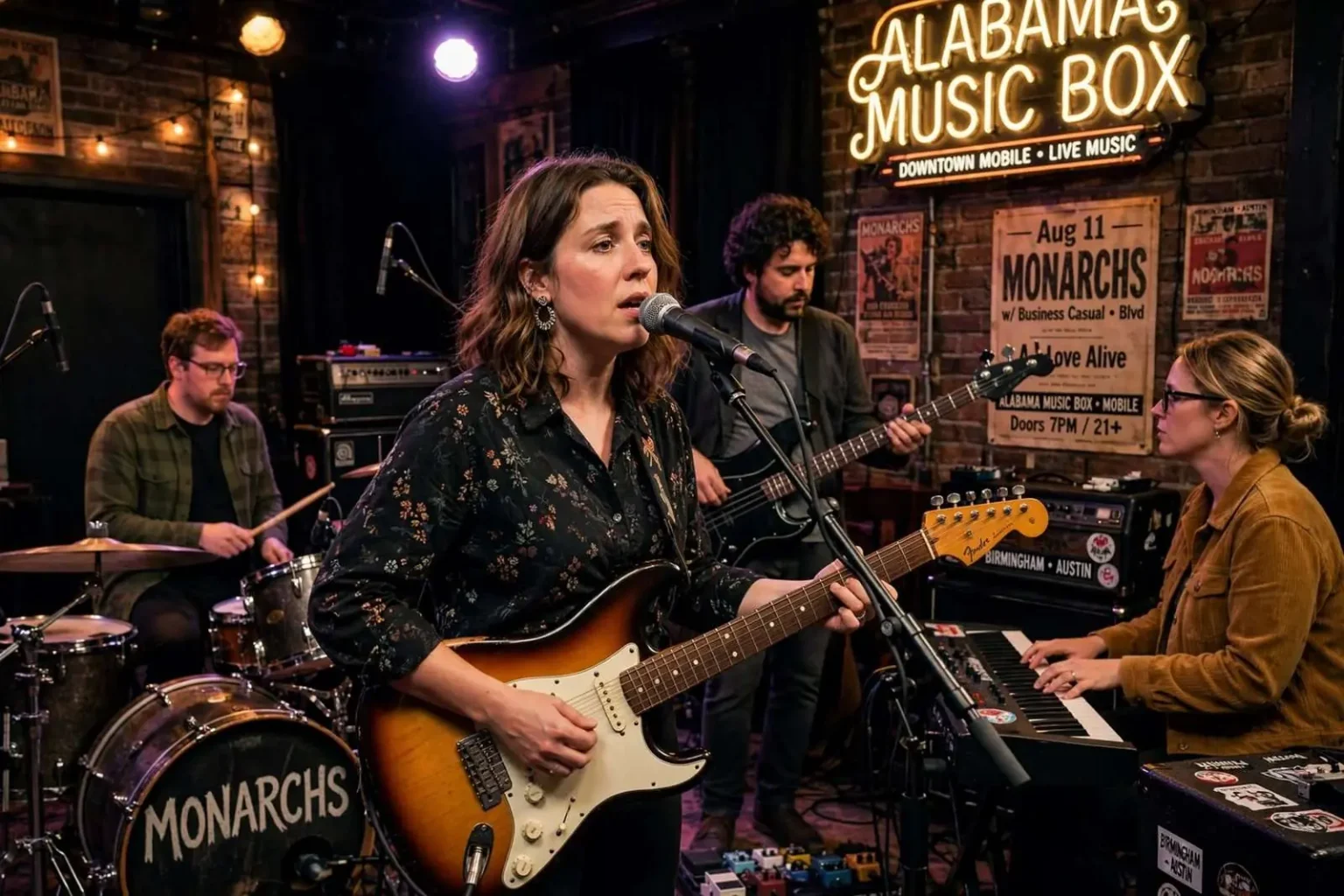
Mobile’s Alabama Music Box played host to Monarchs, the Birmingham and Austin-based indie rock outfit led by singer and guitarist Celeste Griffin, in a show that brought a distinctly Alabama take on dreamy, guitar-driven indie rock to the Port City. The Aug. 11 bill also featured three Birmingham bands — Business Casual, Blvd. and A Love Alive — making the evening a showcase for the state’s indie rock community as much as a stop on a touring band’s itinerary.
Monarchs is fronted by Griffin, a veteran of both the Birmingham and Austin music scenes whose songwriting sits at the center of the band’s sound. Griffin has also collaborated with Alabama songwriter Taylor Hollingsworth, the guitar player and songwriter known for his work in his own projects and his long association with the Birmingham and Tuscaloosa music communities, a connection that ties Monarchs directly into the web of musicians who have made central Alabama one of the Southeast’s most productive breeding grounds for indie bands.
The lineup behind Griffin is drawn almost entirely from that same community. Van Hollingsworth of The Magic Math, Alex Mitchell of Great Book of John, Anna Carrigan of Andy’s Tea Party and Josh Cannon of Jon Black round out the band, each bringing a resume from a respected regional act. That kind of side-project supergroup is common in Birmingham’s scene, where players move between bands, guest on each other’s records, and recombine into new configurations, but it is rarer to see the result tour under one name, which made the Mobile date a chance to hear the collaboration live.
The Alabama Music Box’s role in the Port City scene
The Alabama Music Box, located in downtown Mobile, has long been a home base for touring and regional acts playing the Port City. The venue has built its reputation as a room where original music comes first, hosting national touring indie and alternative acts on their way between New Orleans and the Florida panhandle while also booking the local and regional bands that form the backbone of the Gulf Coast scene. For downtown Mobile, the club has been an anchor of the nightlife district, drawing music fans on weeknights as well as weekends and giving bands from Birmingham, New Orleans, Pensacola, and beyond a reliable stage in the city.
Rooms like the Music Box matter to bands at Monarchs’ stage of development. Regional touring runs on clubs willing to book out-of-town acts with a local undercard, and the Aug. 11 bill followed exactly that formula, pairing the headliner with three Birmingham acts that could draw their own followers and introduce themselves to a Mobile audience. For local fans, the benefit is the chance to see several rising bands on one bill for the price of one show, and nights like this one have historically been where Mobile audiences discover the bands they follow for years afterward.
The Birmingham connection
Three of the four acts on the bill call Birmingham home, a reminder of how productive that city’s scene has been. Birmingham’s indie rock community has generated nationally known acts across genres for decades, supported by venues, recording studios, college radio, and a dense network of musicians who collaborate across projects. Bands like Business Casual, Blvd. and A Love Alive represent the continuing pipeline of that scene, working musicians who write, record, and tour regionally while holding down the kind of schedule that keeps a scene alive between the breakthroughs.
The Birmingham-to-Mobile corridor is a well-worn route for Alabama bands. The drive runs about four hours down I-65, long enough to make Mobile the logical southern terminus of a weekend run through Huntsville, Birmingham, Montgomery, and the coast. Mobile audiences, in turn, get regular exposure to bands from the state’s largest music city, and the exchange has enriched both scenes. Many Mobile-based musicians have Booking histories and friendships that run through Birmingham venues, and Birmingham bands count the Port City among their most reliable out-of-town stops.
Austin’s role in the band’s identity adds another layer. Griffin’s time in the Austin scene placed Monarchs in conversation with one of the country’s most competitive music markets, where the standards for songcraft and live performance are famously demanding. Musicians who split time between Birmingham and Austin carry influences from both, blending the Southeast’s guitar-band tradition with Austin’s genre-crossing sensibility, and that dual background is audible in the band’s approach to melody and atmosphere.
What indie rock audiences heard
Monarchs’ material centers on Griffin’s singing and guitar work, supported by a band assembled to fill out the arrangements with the texture and dynamics the songs call for. The collaborative construction of the lineup means the players are seasoned performers rather than assembled sidemen, each having spent years fronting or supporting acts of their own. Live, that experience typically translates into the kind of confident, well-rehearsed delivery that separates a working band from a pickup group, and the Alabama Music Box stage gave the Mobile audience a full picture of what the collaboration can do.
The supporting acts added range to the evening. Business Casual, Blvd. and A Love Alive each brought their own take on the Birmingham sound, giving the crowd a cross-section of the city’s current indie output. Multi-band bills of this kind serve a second purpose for the visiting musicians as well: sharing a stage and a van builds the informal networks that produce future tours, split releases, and collaborations, the invisible infrastructure on which regional scenes depend.
Original music and the health of a local scene
Nights like the Aug. 11 show are the visible surface of what keeps an original-music community alive. Venues take a risk booking touring acts without mainstream names; bands invest in rehearsals, travel, and gear for modest door splits; and fans commit an evening to bands they may know only from streaming. When all three come together, the result is the ecosystem that produced Alabama’s rich popular-music history, from Muscle Shoals and the Shoals scene’s studio legacy to Birmingham’s punk and indie generations and Mobile’s own long line of local favorites.
For the Alabama Music Box, hosting Monarchs and three Birmingham bands fit the venue’s enduring formula: bring in the region’s best original music, keep the cover reasonable, and let the room do the rest. For Monarchs, the Mobile stop extended the band’s reach into a city that has always shown up for guitar-driven indie rock. And for the fans who filled the downtown club on Aug. 11, the show offered a snapshot of Alabama indie rock in motion, with a frontwoman whose Birmingham and Austin roots run deep and a backing band assembled from some of the best players the state’s scene has produced.
Downtown Mobile as a touring stop
Mobile occupies a strategic spot on the Southeast’s club circuit. Sitting on the route between New Orleans and Pensacola, the city offers touring bands a market they can reach without a long detour, and downtown venues like the Alabama Music Box have historically made the most of that geography. A band finishing a New Orleans show can load in to Mobile the next evening, then continue along the coast toward Florida, building a tour route that works without ever leaving the Gulf Coast corridor. That geography has kept the Port City on itineraries even when the city’s population alone might not justify a stop.
For Mobile musicians, the benefit runs the other direction: the steady flow of touring acts through the Music Box gives local bands opening slots and exposure to out-of-town audiences and bookers. Many local acts have built their followings one opening slot at a time, and the venue’s willingness to pair regional headliners with local openers has been part of that pipeline for years.
The musicians behind the music
The individual resumes in Monarchs tell the story of the region’s scene better than any single band could. Great Book of John, Alex Mitchell’s home band, has been a fixture of Birmingham indie rock, known for its layered songwriting. Andy’s Tea Party, Anna Carrigan’s project, has contributed to the city’s lineage of bands with dedicated regional followings. Jon Black, Josh Cannon’s band, and The Magic Math, Van Hollingsworth’s, round out a roster of acts that represent the everyday excellence of Alabama’s music community, the working bands that sustain venues, studios, and audiences between the scene’s bigger national moments.
Bringing players like these together under Celeste Griffin’s leadership reflects how serious projects get built in regional scenes. Rather than assembling a band of hired guns, the group drew on musicians with existing creative identities, and the collaboration with Taylor Hollingsworth further roots the project in Alabama’s songwriting tradition. The result, as the Music Box audience saw on Aug. 11, is a band whose members arrive with years of stage experience and a shared musical vocabulary built in the same clubs and studios across the region.
Why the show mattered locally
Every touring date in Mobile by an Alabama act carries a little extra weight, because the audience arrives knowing the players are neighbors. That dynamic gives shows like this one a hometown feel even when the headliner tours from out of town, and it reinforces the connections that keep Alabama musicians playing Alabama cities rather than skipping them on national tours. The Aug. 11 show gave Mobile fans four bands for one night, gave the Birmingham acts a new room of listeners, and gave Monarchs a stop in a city whose downtown venue has been one of the state’s most reliable stages for original music.
The night also served as a reminder of the Alabama Music Box’s continuing role in downtown Mobile’s cultural life. As the district’s restaurants and nightlife have evolved, the club has remained the place where the Gulf Coast goes for touring indie rock, and bills like this one — a Birmingham-Austin collaboration fronted by a veteran songwriter and backed by three of her city’s best bands — are exactly the kind of programming that has earned the venue its reputation across two decades of the region’s original-music scene.