Monroeville and Frisco City See Downtown Revivals in Monroe County
Private investment is bringing new businesses to downtown Monroeville and Frisco City as Monroe County pairs revival with flood readiness.
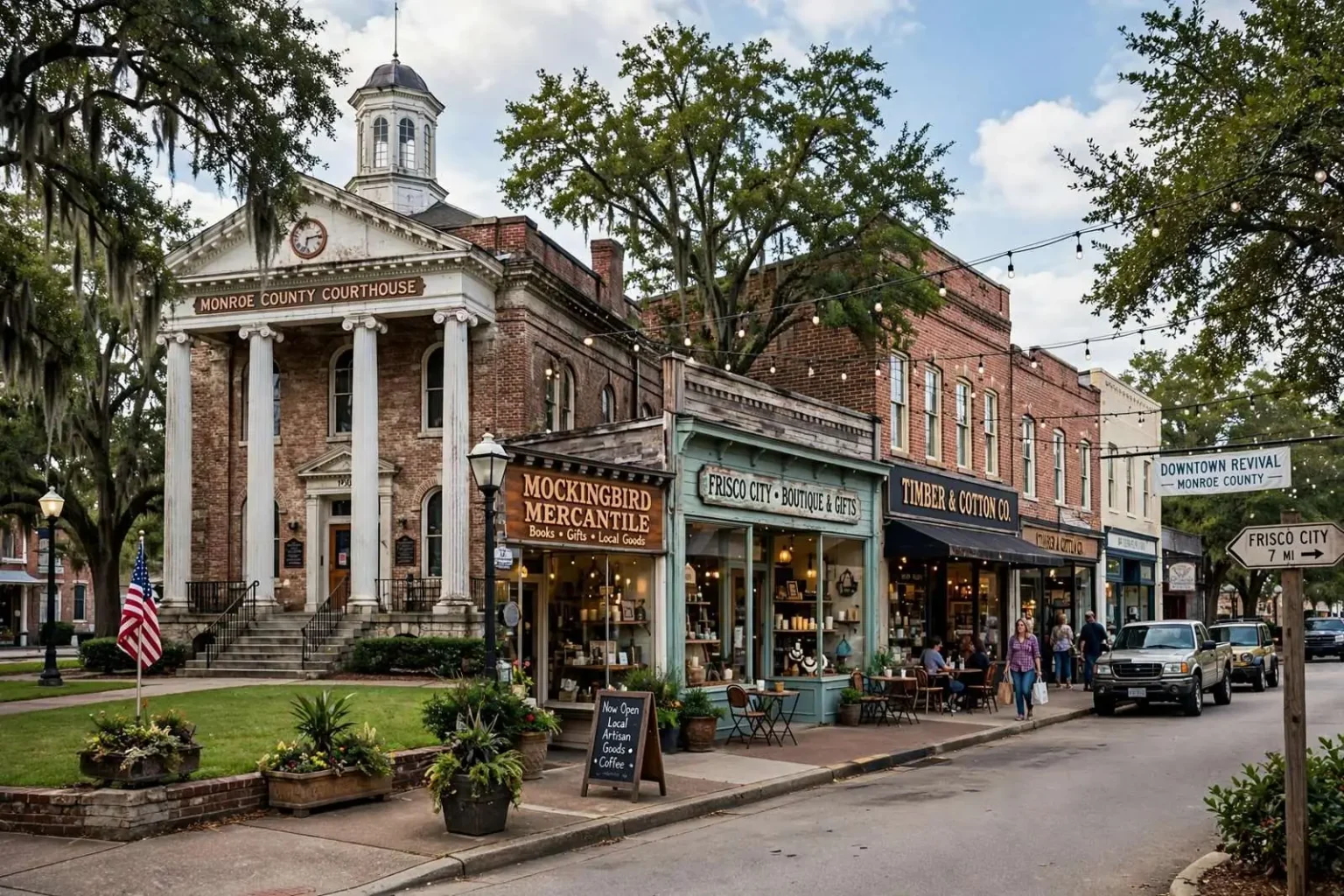
Monroe County’s two downtowns are quietly coming back. In Monroeville — famous worldwide as the setting of Harper Lee’s “To Kill a Mockingbird” — new businesses are popping up along Main Street, fueled by private investment that is boosting expansion across the historic courthouse square district.
The courthouse square is the anchor of Monroeville’s identity. The Monroe County Courthouse, the 1930s building ringed by the town’s historic commercial blocks, is immortalized as the model for the courtroom at the center of Lee’s novel, and the restored courtroom inside is now a museum drawing literary pilgrims from around the world. That steady stream of visitors — tourists retracing the novel, students on school trips, fans arriving for the town’s celebrated stage adaptations — has long made the square the natural center of gravity for local commerce, and the new businesses filling storefronts along Main Street are the latest sign that the district is building on it.
Small-town downtowns across Alabama have spent decades fighting the same battle: the flight of retail to highway strips and big-box centers, the empty storefronts that follow, and the slow erosion of the foot traffic that keeps a square alive. The communities that have reversed the trend have generally done it the same way — private owners rehabbing old buildings, local entrepreneurs opening shops and restaurants that chains won’t bother with, and a community that deliberately chooses to spend its time and money downtown. Monroeville’s revival follows that playbook, with investment spreading block by block across the historic district.
The revival isn’t limited to the county seat. Frisco City, down the road in southern Monroe County, is seeing its own resurgence, with an uptick in small boutiques and shops opening downtown. Like Monroeville, Frisco City leans on a rich local history that continues to interest residents and visitors alike.
Frisco City’s Own Story
Frisco City’s history runs deeper than its size suggests. The town, once known as Jones Mill, took its modern name from the railroad era — a nod to the St. Louis-San Francisco Railway, the “Frisco” line whose arrival turned a lumber and farming crossroads into a commercial center for southern Monroe County. Cotton, timber and trade built the town’s main street, and generations of farm families from the surrounding countryside did their banking and buying there. The name of one of its most famous sons, Hank Williams Sr., whose family roots run through nearby Georgiana and whose early years were shaped in this corner of south Alabama, is part of the same regional story that Frisco City’s downtown revival is now reclaiming.
The boutiques and shops opening in Frisco City’s downtown follow a pattern familiar across rural Alabama: a handful of committed local owners, often women-led startups and second-career ventures, taking leases in inexpensive historic buildings and building customer bases through social media, weekend traffic and word of mouth. Each new storefront makes the next one easier — more open shops mean more reason to drive downtown, and more reason to stay. For a small town whose commercial strip had thinned over the years, the uptick is both an economic signal and a visible statement that the town intends to keep a downtown worth visiting.
Preparing for the Next Storm
Like many South Alabama communities, Monroe County knows heavy rain as well as it knows literary fame. Monroe County EMA director Chuck Downing has detailed how the county prepares for flooding when severe weather moves through — planning that becomes especially important as more people and businesses settle into revitalized downtown blocks.
Flood preparedness is a year-round discipline in south Alabama. The region’s storms can drop several inches of rain in a few hours, and small-town downtowns — often built around low ground near creeks and railroad grades, with aging drainage — are frequently the first places water collects. The county emergency management agency’s work includes monitoring creek and river gauges, coordinating with the National Weather Service office in Mobile when warnings are issued, pre-positioning barricades and pumps, and keeping the road department ready to clear culverts and low-water crossings before and after storms. Downing’s office also works with residents on the practical basics: knowing whether a property sits in a flood zone, keeping insurance current, and having a plan for the flash-flood warnings that arrive with little notice.
The connection to the downtown revival is direct. Every storefront that reopens and every building that is rehabilitated represents more inventory, equipment and livelihoods exposed to the same flood risk the county has always planned around. Revitalization done right pairs with mitigation — drainage improvements, flood-aware renovation, and businesses that know their risk and their coverage — and Monroe County’s experience with severe weather means the subject stays on the agenda even as the excitement over new openings grows.
Rodeo Country
A few miles away in Frisco City, the Monroe County Rodeo remains one of the area’s signature events. Rodeo announcer Clint Allemand has walked crowds through the action — from barrel racing, where horse-and-rider teams carve quick cloverleaf-shaped turns around barrels, to crowd favorites like Muttin’ Bustin’ for young riders.
The rodeo is rural south Alabama culture distilled into an evening. Barrel racing opens the arena to some of the fastest competition on the card — horse and rider sprinting a cloverleaf pattern around three barrels, where a knocked barrel costs precious seconds and the clock decides everything. Around the featured events, a rodeo is also a family gathering: concession stands, kids lining the fences, and traditions like Muttin’ Bustin’, in which young children climb aboard sheep and hold on for as long as they can, giving the smallest riders their first taste of the sport and the crowd its loudest laughs.
Events like the Monroe County Rodeo do more than entertain — they pull people into town from across the county and beyond, filling restaurants and gas stations and giving visitors a reason to see the downtown districts that are working to come back. The rodeo, the courthouse square, and the new shops on Frisco City’s main street are all part of the same ecosystem: small-town traditions that give people a reason to come, and revitalized blocks that give them a reason to stay.
Holding On and Building New
Together, the storefronts filling in on two main streets and the crowds still turning out for courthouse-square traditions tell the same story: rural Monroe County is holding onto its past while building something new around it.
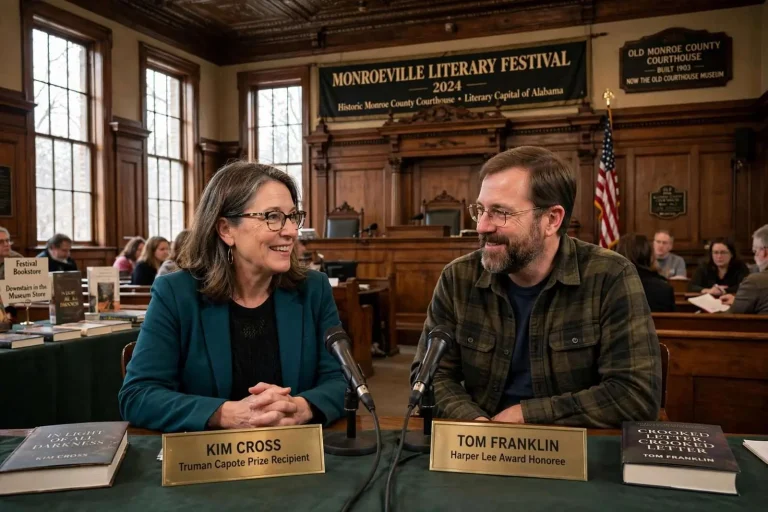
Monroeville’s literary economy is a foundation most towns its size would envy. The town’s connection to Harper Lee and Truman Capote — childhood neighbors and lifelong friends whose work drew on the same Monroeville streets — has made the courthouse square a destination for decades, and each wave of new businesses downtown adds places for those visitors to eat, shop and linger. The annual stage production of “To Kill a Mockingbird,” performed for years in the historic courthouse, turned the town’s most famous story into a recurring event that brings hundreds of visitors each spring, and the museum and heritage tourism infrastructure around it keeps the square busy outside festival weekends too.
For Frisco City, the opportunity is different but real. The town’s railroad and timber history, its location on the route between Monroeville and the communities to the south, and its own traditions — the rodeo chief among them — give it a story to build on. Downtown revivals in towns of a few thousand people are never headline news, but they are how rural Alabama towns survive: one building re roofed, one shop opened, one event that brings the crowds back each year.
What’s happening in Monroe County, in the end, is a reminder that revival in small-town Alabama rarely arrives all at once. It shows up as a new boutique where a storefront sat empty, as private money rehabbing a building on the square, as a county emergency manager planning for the next storm so the progress lasts, and as families filling the grandstands at the rodeo. In Monroeville and Frisco City, all of it is happening at once — and both downtowns are better for it.
The mechanics behind downtown revivals like these are worth understanding, because they explain why some towns turn the corner and others don’t. In Monroeville, the private investment noted along Main Street typically works hand in hand with the town’s existing assets: a courthouse district already on the National Register of Historic Places, a steady flow of heritage tourists, and a local government that understands the square’s value to the tax base. Historic commercial buildings are inexpensive to buy relative to their potential, and each successful renovation raises the confidence of the next buyer. The result is the pattern now visible on Main Street — expansion that compounds block by block rather than arriving in a single project.
County-wide, the connection between the two downtowns and the rest of Monroe County’s economy runs through the schools, the courthouse and the highway corridors. Monroeville sits at the junction of Alabama’s east-west and north-south rural routes, and Frisco City anchors the southern part of the county along the roads that connect to Monroeville and onward toward the river counties. When both downtowns are healthy, the county keeps more of its residents’ spending at home — and gives young families one more reason to stay or come back.
The severe-weather dimension deserves its own emphasis for anyone new to south Alabama. Monroe County sits in the heart of the state’s tornado alley as well as its flash-flood country, and the same warm, humid air that makes the region green makes it storm-prone from late winter through hurricane season. An EMA director’s job in a rural county means wearing every hat at once: warning coordination, shelter logistics, debris management, damage assessment and the steady work of grant applications that fund safe rooms, generators and drainage fixes. Downing’s detailed public explanations of the county’s flood preparations give residents a picture of what actually happens when warnings go out — who monitors the gauges, who closes which roads, and where residents can turn for help.
That planning undergirds everything else in this story. A downtown revival is an act of optimism about a town’s future, and in south Alabama that optimism has to be storm-proofed. Monroe County’s approach — investing in its downtowns while keeping its emergency preparedness sharp — reflects a community that has learned to do both at once, building for the good seasons while staying ready for the bad ones.