Monroeville Man, 20, Drowns at DeSoto State Park in Second Park Death in a Week
Franklin Banks, 20, of Monroeville drowned at DeSoto State Park in June 2019 — the second death at the Lookout Mountain park in one week.
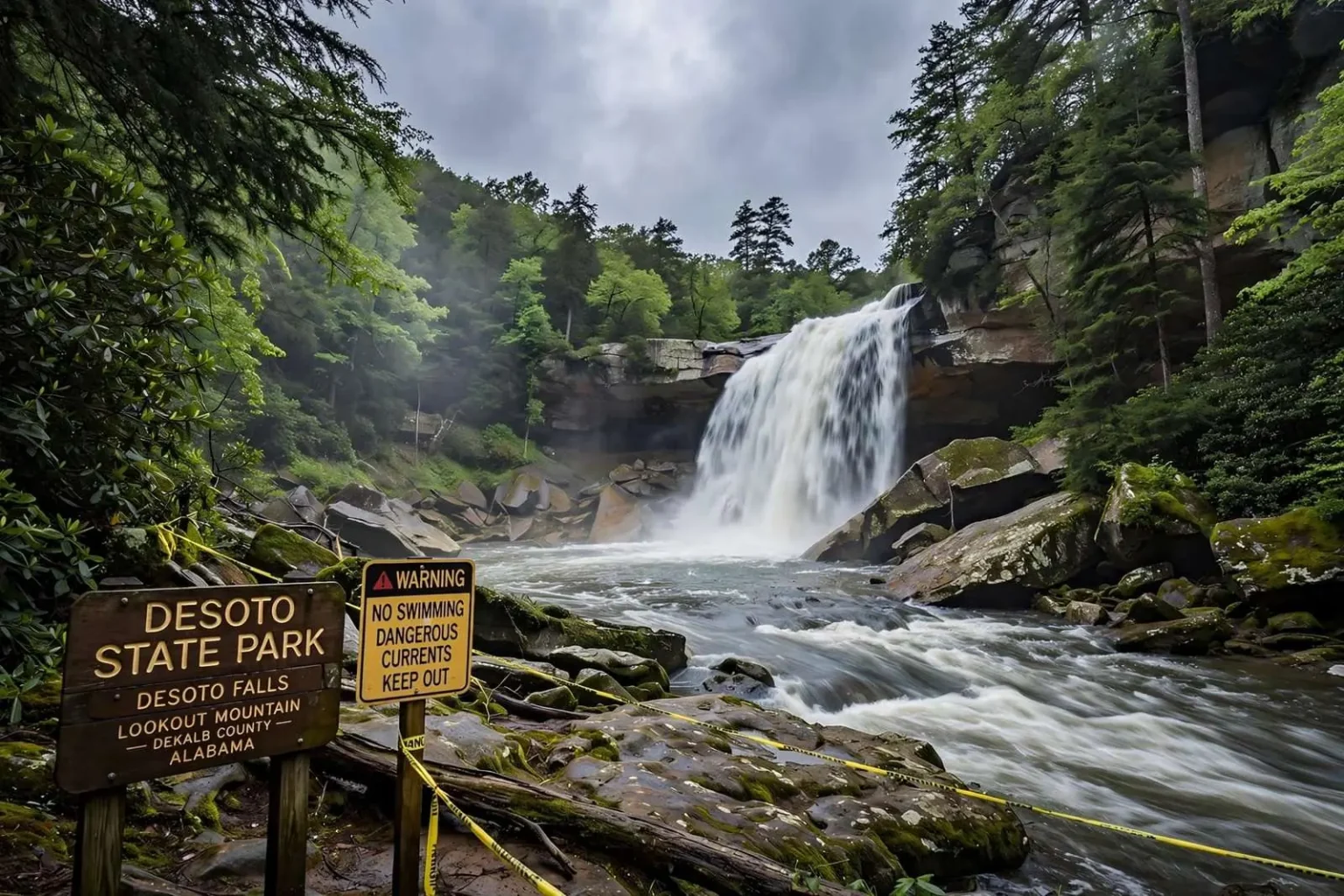
DESOTO STATE PARK, Ala. — A 20-year-old Monroeville man drowned at DeSoto State Park in early June 2019, becoming the second person to die at the northeast Alabama park within a single week. Authorities identified the victim as Franklin Banks of Monroeville. The drowning occurred on a Friday evening, according to reports confirmed by park and emergency officials, adding a second name to a stretch of days that rescuers and park staff will not soon forget.
The death came less than a week after 40-year-old Joseph Nicolas Cantrell of Georgia drowned at the park’s falls on Memorial Day. Witnesses told rescue crews that Cantrell jumped from a cliff into the water below the falls and never resurfaced. His body was recovered after an extensive search by dive teams and rescue personnel working the pools and currents below the falls, a recovery that unfolded over hours while holiday crowds watched from the overlooks.
Back-to-back fatalities in seven days drew renewed attention to the hazards the park’s waters can pose for visitors. DeSoto State Park is one of Alabama’s most beloved outdoor destinations — a plateau landscape of waterfalls, boulders and whitewater on the West Fork of the Little River — but the same features that make it beautiful make it unforgiving for swimmers who misjudge the water. Park officials and rescue crews have long warned that the pools below the falls hide strong currents, cold temperatures and underwater obstacles that can defeat even strong swimmers.
What happened at the falls
The circumstances of the two drownings shared a grim outline: both men entered the water in the most dangerous stretch of the park, the churning basin below DeSoto Falls, where the river drops over rock ledges into pools that never look as violent from the shore as they are in reality. Cantrell, according to witnesses, jumped from a cliff into the water below the falls — a practice that draws thrill-seekers every summer despite warnings, signage and the visible power of the current. Once he went under, he did not come up, and the rescue response shifted within minutes from a swim rescue to a recovery effort.
Banks’s drowning came during the following weekend, on a Friday evening, in the same general stretch of the park. Details of exactly how he entered the water were not immediately released, but the proximity in time and place turned the week into a pattern that officials could not ignore. Two drownings in seven days at a single park prompted renewed calls for visitors to respect barriers, heed warning signs and think carefully before entering natural water features — calls that rescuers make every summer and that rarely seem to reach the people who most need to hear them.
DeSoto State Park sits atop Lookout Mountain in DeKalb County, where natural falls and swift water attract swimmers and cliff jumpers throughout the warm months. The park, developed in the 1930s by the Civilian Conservation Corps, draws campers, hikers and families from across the Southeast, and its waterfall country is part of a corridor that includes nearby Little River Canyon and its own notorious swimming hazards. The Little River’s West Fork runs through the park, and its currents below the falls are driven by the volume of water coming over the ledges — a force that changes with rainfall and that can pin a swimmer against rock or pull them under recirculating currents.
Why the water is so dangerous
Rescue professionals describe waterfall basins with a blunt vocabulary: hydraulics, recirculating currents, foot entrapment, cold shock. When water pours over a falls, it drives into the pool below and boomerangs back on itself, creating a churning zone that can hold a swimmer underwater in a loop that is nearly impossible to swim out of. The water at the base of a falls is also aerated — mixed with air — which makes it less buoyant, so swimmers sink faster and float worse than they would in a calm lake. Beneath the surface, boulders and ledges create strainers and foot traps where a swimmer’s legs can lodge in the current. And the water itself, fed by springs and mountain runoff, stays cold enough even in June to trigger gasping and muscle cramps in the unwary.
Cliff jumping compounds every one of those hazards. A jump from a rock ledge offers no control over where the water’s currents have moved since the last jumper; it risks impact with submerged rock that may be invisible from above; and it puts a person into the most turbulent water in the pool at the moment they are least able to react. Emergency crews across the region respond to cliff-jumping accidents every summer — broken backs and necks from bad landings, and drownings from swimmers who jumped in fine and could not get out.
Memorial Day weekend, when Cantrell drowned, marks the traditional opening of the South’s swimming season, and the parks of northeast Alabama fill with visitors for whom the water’s danger is easy to underestimate. DeSoto’s falls are photographed, shared and celebrated — the park’s signature scenery — which draws visitors to the very spots where the current is strongest. Officials walk a difficult line between promoting the park’s natural wonders and convincing guests that the same water demands respect.
A community mourns two men
The deaths rippled through two communities separated by half the state. In Monroeville, the Monroe County seat best known as the home of Harper Lee, friends and family of Franklin Banks mourned a 20-year-old whose death came at the start of the summer, hours from the town where he grew up. In Georgia, the family of Joseph Nicolas Cantrell grieved a 40-year-old whose Memorial Day outing ended in the water below the falls. Neither man’s story is unusual in the way drowning victims’ stories are told — a warm day, beautiful water, a moment of misjudgment — which is precisely what makes the park’s two-death week so hard to shake.
Park and emergency officials used the occasion to repeat the guidance they offer every season: swim only in designated areas, never swim alone, keep children within arm’s reach of an adult in any natural water, and stay out of the currents below waterfalls entirely. Rescue crews also remind visitors that reaching 911 from remote sections of the park can be difficult — cell service on the mountain is inconsistent — and that minutes matter when someone goes under.
The week of back-to-back drownings ended with DeSoto State Park still open and still full of summer visitors, its falls as photogenic and as perilous as ever. The hope, expressed by the rescuers who recovered the two men, is that the memory of what happened there will outlast the news cycle: that the next visitor standing on the rocks above the falls will pause, look at the water, and choose the trail instead.
The park and its waterfall country
DeSoto State Park covers thousands of acres of Lookout Mountain in DeKalb County, and its landscape is defined by water. The West Fork of the Little River threads through the park, dropping over a series of falls and riffles that have made it one of Alabama’s most photographed natural areas. DeSoto Falls itself, a short drive from the main park, plunges more than a hundred feet in its longest drop, and its overlooks draw visitors year-round. The park’s trail network — built in part by the Civilian Conservation Corps in the 1930s, whose stone and timber buildings still serve campers today — follows the river through laurel and hemlock hollows, past smaller cascades with names like Lost Falls and Indian Falls.
The geography explains both the park’s appeal and its peril. Lookout Mountain’s sandstone cap sheds rain quickly into narrow canyons, so the river rises fast after storms and runs hard even in dry weeks. The pools between the falls are deep and cold, ringed by rock ledges that look like invitations to swimmers and jumpers. On summer weekends, the areas near the falls fill with families wading at the edges and, despite years of warnings, with visitors climbing the rocks for better views or a jump into the current below.
Rescue crews in DeKalb County know the park’s waters intimately. Drownings and water rescues there have occurred repeatedly over the years, and the area fire departments and county rescue squads train for the specific challenges of swift-water work: rope systems along the gorge walls, downstream spotters, dive teams for the deep pools and helicopters for transport. A water emergency in the park can draw responders from across the county and beyond, as the searches for both Cantrell and Banks demonstrated.
Staying safe in Alabama’s waterfall country
Safety officials offer consistent advice for the park’s visitors, and it applies across the waterfall corridor of northeast Alabama, from DeSoto to Little River Canyon. Never swim below a waterfall: the hydraulics at the base are the single most dangerous water in any river system, and no swimming ability overcomes them. Wear a life jacket whenever entering natural water — a step rescuers credit with saving countless lives in swift-water settings. Assume the water is colder and the current stronger than it looks. Watch children constantly, since natural water offers no lifeguards and no gradual entry. And after heavy rain, stay out entirely, because the river that seemed tame at noon can double its flow within an hour.
The two deaths in a week at DeSoto State Park were, for the rescue community, an all-too-familiar lesson delivered twice in seven days. The park will remain what it has always been — a place of extraordinary beauty where the water demands as much caution as the cliffs demand courage. For the families of Franklin Banks and Joseph Nicolas Cantrell, the falls are now part of a story no one wants to be in; for everyone else, their deaths are the warning that the scenery can kill, and that the wisest visitors are the ones who enjoy it from the shore.