Monroeville Mayor Charles Andrews to Step Down Aug. 30, Citing Family and Health
Monroeville Mayor Charles Andrews will resign Aug. 30 over family and health concerns, setting off a state-mandated process for the City Council to fill the vacancy.
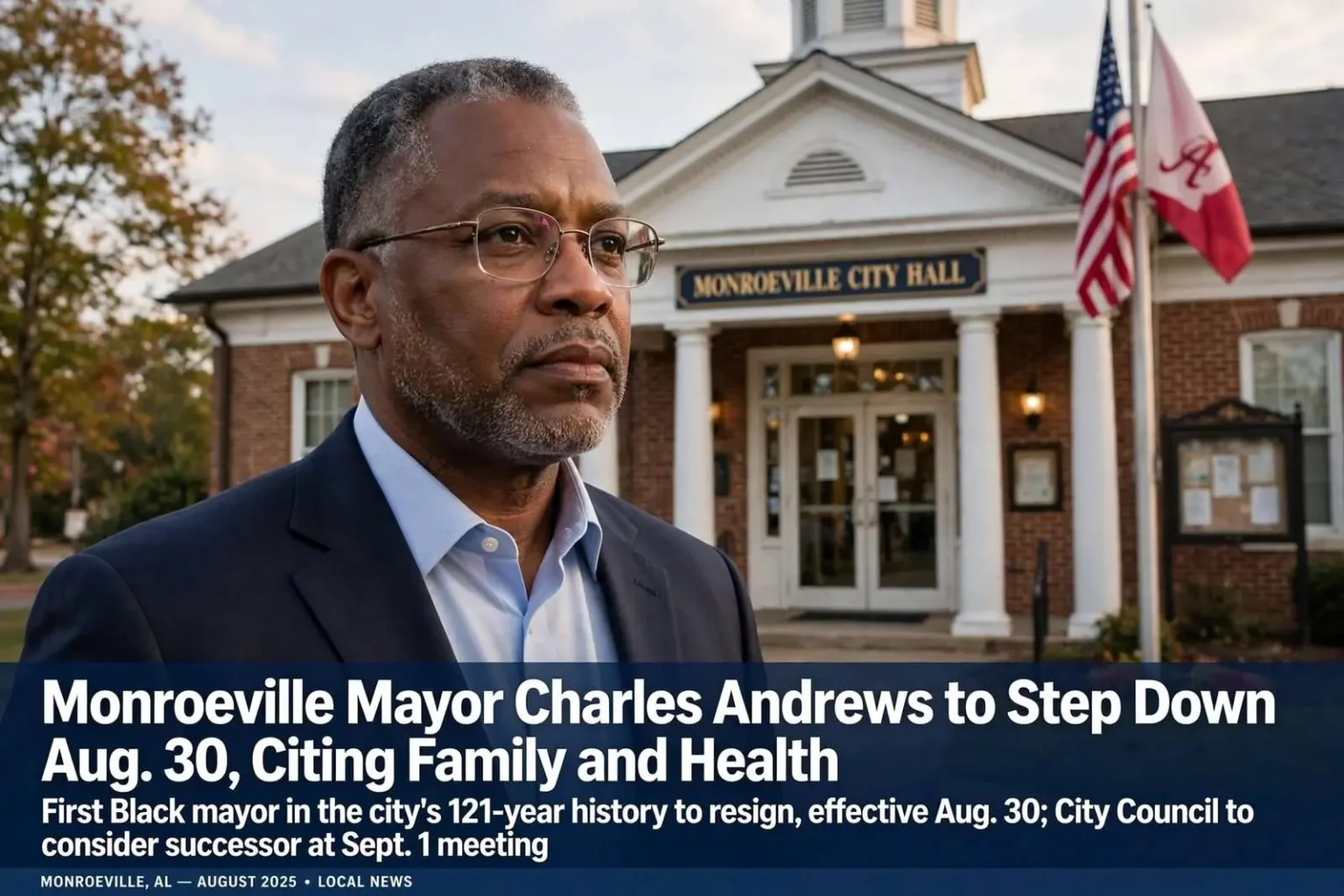
Monroeville Mayor Charles Andrews has informed the City Council that he intends to resign his position effective Aug. 30, citing family and health concerns. The announcement ends a tenure that broke a historical barrier in one of Alabama’s most famous small cities and sets in motion a succession process that will unfold over the coming weeks. Andrews delivered the news to his colleagues in a special-called meeting rather than waiting for a regular session, a sign of how quickly he wanted the city’s leadership to begin planning for the transition.
The council learned of the decision during a special-called meeting held Wednesday evening of last week. Andrews made history when he was first elected mayor in August 2020, at the outset of the COVID-19 pandemic, defeating then-incumbent Mayor Sandy Smith to become Monroeville’s first Black mayor in the city’s 121-year history. He won a second term in August 2025, defeating former City Clerk Toni McKelvey, and was serving in a term set to run through August 2029.
Andrews’s two elections bookend a period of unusual turbulence for municipal governments everywhere. He took office just as the pandemic forced cities into emergency operations, remote meetings and constant public health decision-making, then led the city through the recovery years that followed. His second-term mandate, delivered in Alabama’s municipal elections of August 2025, was cut short before its halfway point — a reminder that personal circumstances can end a political term as decisively as an election can.
Council Weighs Next Steps
During the council’s regularly scheduled meeting Tuesday evening at city hall, Mayor Pro Tem Al Brewton said Monroeville residents interested in finishing out Andrews’s unexpired term should contact City Clerk Lisa Phillips. Phillips, in turn, asked Brewton whether any sitting council members might be interested in stepping into the role. Brewton said that question will be taken up at the council’s first meeting in September, scheduled for Sept. 1 at 5 p.m.
The two-step recruitment — an open invitation to residents and a private sounding of the council’s own members — reflects how vacancies in small-city government actually fill. Monroeville’s mayor’s office is not a career steppingstone; it is a demanding part-time job in a city of fewer than 6,000 people, where the successful candidate will need both the community’s trust and the willingness to absorb the daily weight of municipal problems for the remainder of a term that ends in 2029.
The mayor’s post in Monroeville is a part-time position with a current annual salary of $36,000. Under state law, that salary can only be adjusted no sooner than six months before the city’s next municipal election, which is set for August 2029. The restriction prevents a council from changing the compensation of an office it is simultaneously trying to fill — a protection written into Alabama’s municipal code to keep appointments and pay raises from becoming entangled.
How Alabama Law Handles the Vacancy
Alabama law lays out a clear process for filling a mayoral vacancy in cities with a population below 12,000, a category that includes Monroeville. The City Council is authorized to elect a qualified replacement by majority vote, either from among its own members or from outside the council entirely. If the council does not fill the seat within 60 days, members may submit candidates to the governor for consideration. Should the governor decline to appoint anyone from that list, the city would then be required to hold a special election to determine who finishes the remainder of the term.
The 60-day clock gives Monroeville’s council a hard deadline once Andrews’s resignation takes effect at the end of August. A council appointment made within that window — at the Sept. 1 meeting or shortly after — would allow the city to avoid any state involvement entirely, and small-city councils across Alabama have generally preferred that path, since a sitting member elevated to mayor keeps the transition local, immediate and free of appointment politics at the state level.
Whoever takes the office will inherit both its duties and its context. The mayor presides over council meetings, represents the city in regional and state bodies, oversees municipal administration and serves as the public face of a city whose identity is inseparable from its literary fame. Monroeville — the hometown of Harper Lee and the childhood neighbor of Truman Capote, and the model for the fictional Maycomb of “To Kill a Mockingbird” — draws visitors from around the world to its historic courthouse and the amateur theatrical production that runs each spring. The mayor’s office is, in practice, part city manager and part ambassador.
The Significance of the Andrews Years
Andrews’s 2020 election was a milestone in a city whose history mirrors the South’s complicated story. Monroeville, the seat of Monroe County, had gone 121 years without a Black mayor despite a substantial Black population, and the 2020 campaign unfolded amid a national reckoning over race that gave the result significance well beyond the city limits. Local observers noted the election’s symbolism for a city that literally sells itself to the world as the home of America’s most famous novel about justice.
His second victory in 2025 confirmed that the first was no aberration, making Andrews the city’s twice-elected choice across two election cycles five years apart. The brevity of that second term — roughly half of the four-year term the voters handed him — will now pass to whoever the council selects, with the appointee serving the rest of the term until the August 2029 municipal election, when voters will choose a mayor for the following term.
For residents, the coming weeks offer a rare window into how Alabama’s small-city democracy works. The succession process under state law is short, public and largely local: a resignation takes effect, the council deliberates, a qualified citizen steps up, and government continues without an election. The Sept. 1 meeting will be the public’s first look at how Monroeville’s council intends to exercise that responsibility.
What Comes Next
Brewton’s invitation for interested residents to contact City Clerk Lisa Phillips means the pool of candidates is still forming. Council members weighing whether to seek the appointment themselves must decide quickly, since the council’s first September meeting is where Brewton said the question of internal candidates will be taken up. Either way, the appointment requires a majority of the council, meaning the decision will be made in public session where residents can watch it happen.
Andrews, for his part, exits with the distinction of two election victories and a historical first that cannot be repeated. Family and health considerations are among the most commonly cited and least disputed reasons for mid-term resignations, and they allow a departing official to leave without the cloud of scandal that sometimes accompanies a mid-term exit. The city’s task now is to honor that legacy with a transition that is orderly, transparent and true to the same democratic promise his elections represented.
By the time the council gavels in on Sept. 1 at 5 p.m., Monroeville will have a short list of names, a 60-day statutory clock ticking and a city hall audience that has learned, over six remarkable years, to pay attention to its own history as it happens.
Monroeville’s city government operates on the mayor-council form common to Alabama’s smaller municipalities, in which the part-time mayor shares a council chamber with five part-time council members and the city relies on a small professional staff for day-to-day administration. The mayor votes on council matters and carries the city’s executive responsibilities, a structure that makes the mayor’s office both less powerful than a big-city chief executive and more personally demanding, since the same individual handles administration, presides over meetings and fields residents’ concerns directly.
A part-time salary of $36,000 a year reflects that balance — meaningful compensation for a small-city office, but a figure that assumes the mayor maintains other employment or income. Candidates weighing an appointment to the seat must factor that reality into their decision, along with the knowledge that the appointed term runs more than three more years, through August 2029.
The Law Behind the Transition
The vacancy statute Andrews’s resignation activates has served Alabama’s small municipalities for generations, and its design favors speed and local control. The council’s authority to appoint anyone qualified — not merely one of its own members — means the Sept. 1 deliberation could produce a mayor who has never held municipal office, provided the council sees the qualifications and the votes. Requiring only a majority keeps the decision from stalling in a divided council, and the 60-day outer limit prevents a city from drifting without leadership while factions negotiate.
The escalation to the governor’s office, and then to a special election, exists as a backstop rather than an expectation. In the great majority of small-city vacancies across Alabama, the council appoints a replacement well within the deadline, and Monroeville’s early start — beginning its candidate search before the resignation even takes effect Aug. 30 — suggests the city intends to resolve the matter in its own chamber on the first try.
Whoever is appointed will serve the remainder of a term won by a different politician under different circumstances, a dynamic Alabama’s municipal law accommodates without special treatment. The appointee will face the 2029 election as an incumbent if he or she seeks the office in their own right, standing before voters who will judge the balance of the Andrews term alongside the appointee’s own record.
A City Accustomed to Attention
Monroeville’s transition will unfold, as everything in the city does, under a brighter spotlight than its size would suggest. The town of roughly 5,300 anchors Monroe County in Alabama’s Black Belt, and its literary tourism — the Old Courthouse Museum, the Lee-era landmarks, the springtime stage production that draws audiences from across the country — keeps the city in contact with a global audience rare for its size. A mayoral transition in Monroeville is a civic event, and the council’s Sept. 1 deliberation will be watched by residents who have grown accustomed to their city making history.
Andrews leaves office Aug. 30. The council meets Sept. 1 at 5 p.m. Between those two dates, the city’s future leadership will take shape — through phone calls to the city clerk, conversations among council members and decisions that Alabama’s statutes have already mapped. The framework guarantees continuity; the people will determine whether it also delivers the kind of leadership a twice-elected barrier-breaking mayor leaves behind.