
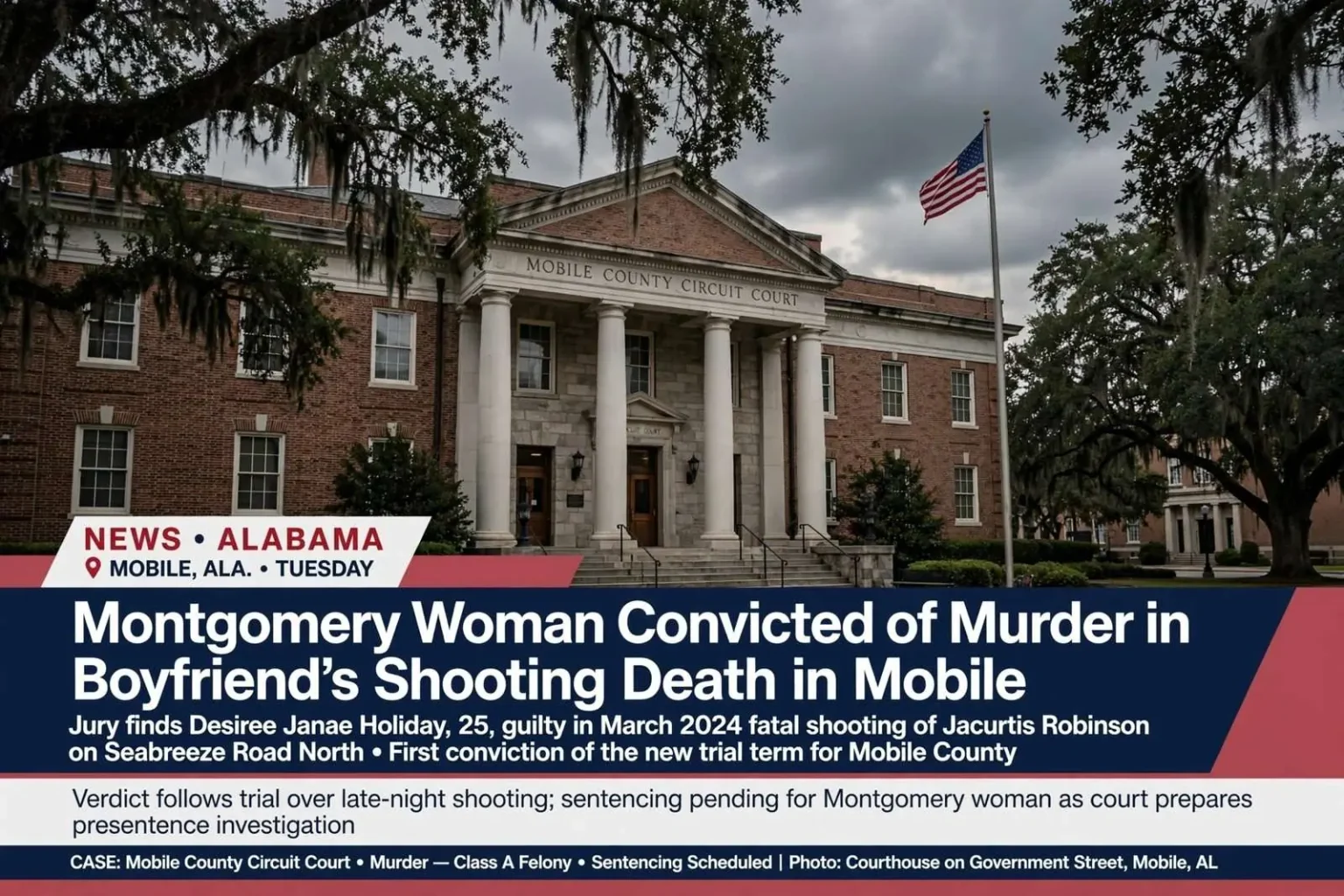
MOBILE, Ala. — A Mobile County Circuit Court jury convicted a Montgomery woman of murder Tuesday in the fatal shooting of her boyfriend, marking prosecutors’ first conviction of the new trial term. Jurors found Desiree Janae Holiday, 25, guilty of murder in the March 2024 shooting death of Jacurtis Robinson. The verdict came after a trial in which the two sides told starkly different stories about the same late-night encounter outside a west Mobile-area residence, and it now moves the case from the courtroom floor to the judge’s sentencing calendar.
Prosecutors presented evidence that Holiday shot Robinson in the 4000 block of Seabreeze Road North, a residential street in an area of west Mobile that sits off Airport Boulevard between major commercial corridors. Robinson died from his injuries, and investigators built the case around the circumstances of the shooting rather than any dispute about who fired the shot. From the outset, the defense did not contest that Holiday pulled the trigger; it contested why.
The defense argued that Holiday was carrying $4,837 in her purse that night and acted to prevent a robbery, framing the shooting as an act taken in fear of a crime rather than an act of malice. That theory put the purse and its contents at the center of the trial, with lawyers on both sides asking jurors to weigh what a reasonable person in Holiday’s position would have believed at the moment she fired.
Jurors rejected that framing, returning a murder verdict after weighing the evidence against Alabama’s legal standard for the offense. Under state law, murder does not require proof of a plan to kill; intentional conduct that causes a death, committed without legal justification, is enough. A claim that a shooting was necessary to prevent a robbery must overcome that standard, and juries in Mobile County have historically been asked to sort through exactly these competing accounts in cases where shooter and victim knew each other well.
A Significant Win for the Trial Term’s First Weeks
The conviction carried added weight for the prosecution because it was the first secured in the new trial term. Mobile County operates one of the busiest circuit court systems in Alabama, with criminal divisions that cycle through dockets of homicides, robberies and violent assaults across the year. Trial terms open with a backlog of cases drawn from months of investigations, and an early conviction is watched within the courthouse as a signal of how the term may go.
Mobile County Circuit Court convenes in the historic courthouse complex on Government Street in downtown Mobile, a few blocks from the county jail where most criminal defendants in the system are held or processed. Cases assigned to its criminal divisions are heard by circuit judges elected from the county, and the pace of a docket often depends on how many defendants choose trial over plea negotiations. Trials of this kind typically draw from a large jury pool of county residents, selected through a multi-day process that screens for bias and knowledge of the case.
For the Montgomery woman’s family and for Robinson’s, the trial capped more than a year of proceedings that began with a shooting in a quiet residential block. Seabreeze Road North is lined with modest homes in a part of the city that has seen steady suburban growth in recent decades, and homicides there are uncommon enough that the March 2024 shooting drew attention well beyond the immediate neighborhood. Residents of such areas often learn details of a case only when it reaches trial, months or years after the initial reports.
A Bond Fight That Foreshadowed the Trial
The case had already produced a contentious sideshow months before jurors were seated. A judge declined to revoke Holiday’s bond in April after prosecutors alleged she had violated its terms by leaving her Montgomery home on three days in March and had failed to pay fees for her electronic monitoring.
The allegation meant that Holiday, who had been released pending trial with conditions, was accused of stepping outside the confinement her bond required while awaiting trial in Mobile County. Electronic monitoring programs of that kind rely on ankle devices that log a defendant’s movements against an approved perimeter, typically the person’s residence, with alerts routed to a monitoring vendor and then to the court. Missed payments for the service are treated as violations too, because the equipment only functions when the fees are current.
At the April hearing, prosecutors asked the court to revoke the bond outright, which would have meant jail until trial. The judge declined, a decision that left the conditions in place but put Holiday on notice. Such rulings are inherently discretionary. Judges weigh the seriousness of the violations, whether they suggest flight risk or danger, and the practical reality that revoking bond before trial can upend a defendant’s ability to assist in preparing a defense.
Bond conditions in Alabama felony cases commonly include residence restrictions, no-contact orders, surrender of firearms and payment of monitoring costs, and violations are frequent enough that revocation hearings are a routine part of the criminal calendar. When a defendant is later convicted, the history of compliance or noncompliance can surface again at sentencing, where prosecutors may cite it as evidence of disregard for the court’s authority and the defense may argue that the violations were minor or administrative.
What Comes After the Verdict
With the murder conviction entered, the case moves to sentencing, where the judge alone decides the term. Murder is a Class A felony under Alabama law, the state’s most serious category short of capital offenses, punishable by a sentence that can run from a decade to life in prison. The exact range available to the judge depends on the defendant’s criminal history and the sentencing framework applied by the court, and both sides will file materials arguing where within it the sentence should fall.
Before the sentencing hearing, the court will typically order a presentence investigation, prepared by a probation officer, that assembles the offense facts, the defendant’s background and any victim impact statements from Robinson’s family. Those statements give relatives a formal place in the record to describe what the loss has meant, and judges in Mobile County customarily allow family members to address the court directly at the hearing.
Holiday’s defense team is expected to raise the same themes it pressed at trial: the money in her purse, the fear of a robbery, and the circumstances that led to a fatal encounter between two people in a relationship. Mitigation arguments in cases like this often include the defendant’s age, lack of prior record and family circumstances, and they can influence a sentence even after a conviction.
An appeal is also a standard next step in convictions of this kind, and the route runs through the Alabama Court of Criminal Appeals in Montgomery. Appeals in murder cases commonly challenge evidentiary rulings made during trial, the sufficiency of the indictment, or instructions the judge gave the jury, though a conviction stands unless a reviewing court finds error that affected the outcome.
A Case That Reflects Broader Patterns
Cases in which a romantic partner is charged in a shooting are among the most difficult that homicide prosecutors handle, because the relationship history cuts both ways. It can supply motive for the state and, at the same time, supply the fear and desperation the defense needs for a justification argument. Jurors are asked to reconstruct a moment of crisis with no witness to it except the surviving shooter, and verdicts in such trials often turn on which account of the encounter the panel finds more credible.
The Mobile County District Attorney’s Office prosecutes these cases out of its downtown offices, working with Mobile police investigators who handle the initial response and evidence collection. A shooting on a residential street sets in motion a well-defined sequence: patrol officers secure the scene, detectives canvass for witnesses, forensic units process for shell casings and other physical evidence, and the file is eventually presented for prosecution. By the time a case reaches a jury, months of that work sit behind the lawyers at the tables.
For residents of the neighborhoods where these cases originate, the trial process is the point at which the justice system becomes visible. Verdicts do not undo the underlying loss, but they close out the uncertainty that follows an unsolved or untried killing, and they give families a definitive answer to the question of legal responsibility. That is the role the Tuesday verdict played in the death of Jacurtis Robinson, more than two years after the shooting on Seabreeze Road North.
The case also illustrates the practical machinery that surrounds felony trials in Alabama, from electronic monitoring vendors to the jury assembly room to the presentence report writers who take over after a verdict. Each stage has its own rules and its own record, and each one generated a paper trail in this case long before jurors heard opening statements. Holiday remains in the custody arrangements set by the court pending sentencing, where the judge will determine the term her conviction carries.


