Moss Point Native Tom Johnson Receives $475,000 Settlement in Police Misconduct Case
Former NFL lineman and Moss Point native Tom Johnson will receive $475,000 from Minneapolis over a 2014 police misconduct incident that ended his civil.
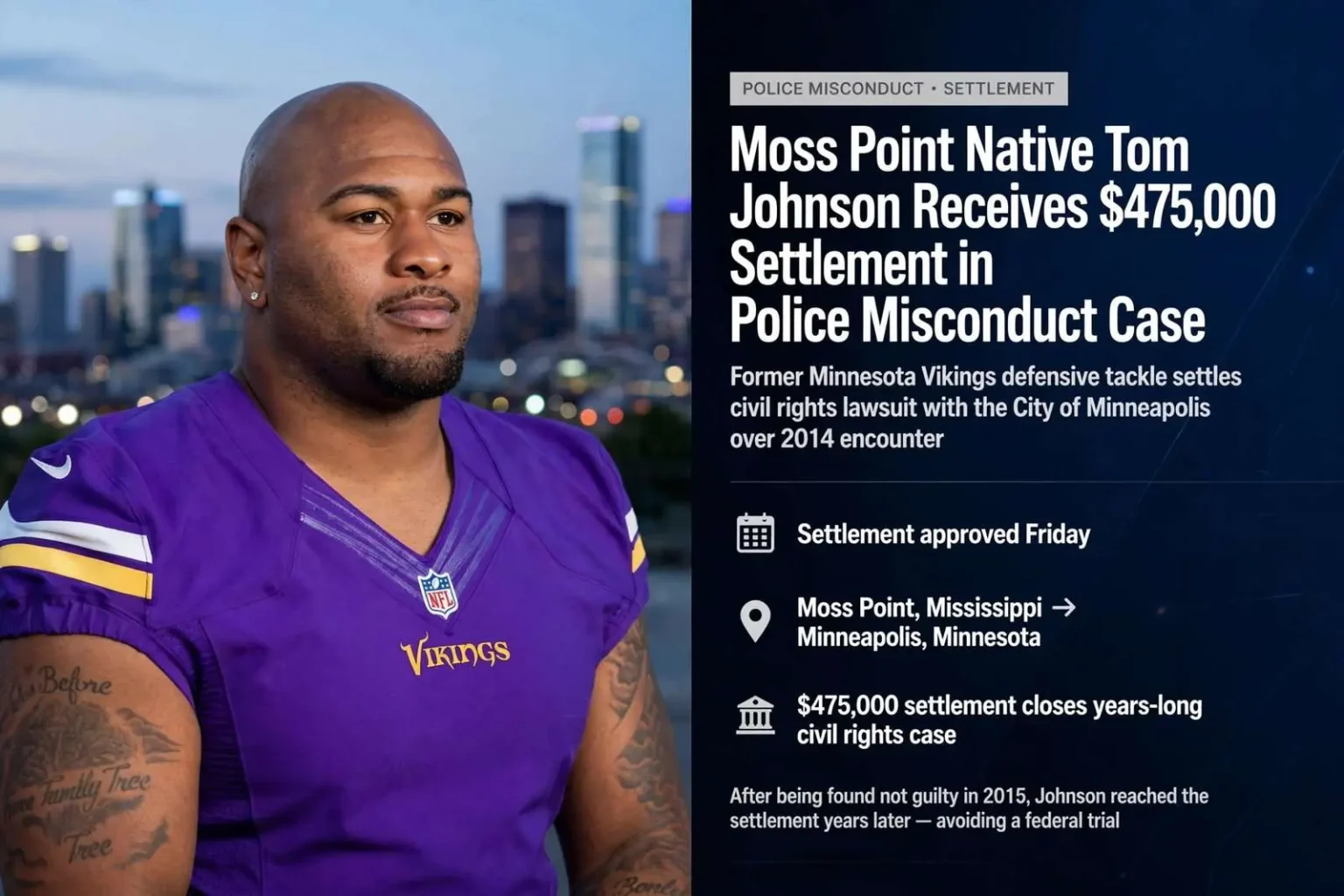
Former NFL defensive tackle and Moss Point native Tom Johnson will receive $475,000 after settling a lawsuit against the City of Minneapolis over a 2014 police encounter. The Minneapolis City Council approved the settlement Friday, avoiding a federal civil rights trial.
Johnson, who played for the Minnesota Vikings at the time of the incident, accused two officers of violating his civil rights during an altercation outside a downtown restaurant. He had been found not guilty in June 2015 on trespassing and disorderly conduct charges stemming from the same night — an acquittal that became a central pillar of the civil case that followed. The settlement, approved years after the encounter itself, closes one of the more closely watched police misconduct cases involving a professional athlete in the city.
For Johnson, the resolution marked the end of a legal fight that outlasted his playing career. For Minneapolis, it avoided a federal trial in which jurors would have heard dueling accounts of a night that began with a valet pickup and ended with pepper spray, a taser, and a broken phone in the street.
What Happened in 2014
According to the account in court filings and press reports, Johnson left the Seven restaurant at closing time on October 5, 2014, to retrieve his car from valet. After returning inside briefly, he was told by an off-duty officer working security to leave. The encounter escalated from there: Johnson said he was pushed and pepper-sprayed in the face, and when he pulled out his phone to record the confrontation outside, he says an officer knocked it from his hand, breaking it, before a second officer used a taser on him. He was arrested and spent the night in jail.
The criminal charges that followed — trespassing and disorderly conduct — did not hold up. Johnson was found not guilty in June 2015, and his legal team later used the acquittal to argue that the encounter had no lawful basis from the start. The video Johnson had tried to record, and the broken phone itself, became part of the narrative that his attorneys presented in the civil litigation.
Neither officer was disciplined over the incident. One of the two died in 2018, before the case reached its settlement. The absence of internal consequences is a common thread in civil rights suits against municipalities, and it is often the reason such cases proceed to trial or settlement even after criminal charges fail — the civil track asks a different question, not whether a defendant broke a criminal law but whether the city’s officers violated constitutional protections.
‘Vindication’
“I feel good about it,” Johnson told the St. Paul Pioneer Press. “The officers and the city actually had to be accountable for something that went on at the end of the day that was very unprofessional.”
His attorney, Eric Hageman, said “Tom got the vindication he was looking for.” The word captures the odd arithmetic of civil rights settlements: the money matters, but for many plaintiffs the larger prize is a public record that the city accepted responsibility, however carefully worded, for what its officers did.
Johnson officially retired from the NFL shortly before the settlement, closing a career that had already bridged the incident and the lawsuit. By the time the Minneapolis City Council voted, he had moved from active player to retired veteran, watching the conclusion of a case that began while he was in the middle of a season.
From Moss Point to the NFL
Johnson’s path to that moment ran through the Mississippi Gulf Coast. A Moss Point native, he came up through a coastal Mississippi football culture that has produced a striking share of professional talent, playing at a school with a long athletic tradition in one of the state’s most football-rich regions. From there he went to the University of Southern Mississippi, the Hattiesburg program whose Conference USA teams of that era regularly sent defensive linemen to the NFL.
His route to a long professional career was anything but direct. Johnson spent time in NFL Europe, the Arena Football League and the CFL before eight NFL seasons with the New Orleans Saints, Vikings and Seattle Seahawks. Journeys like his are a reminder of how many roads exist into the league: players who go undrafted or unheralded often rebuild their prospects in developmental leagues overseas and in indoor and Canadian football before an NFL roster spot opens.
He found that spot with the New Orleans Saints, the franchise closest to his Gulf Coast roots, and later established himself with the Minnesota Vikings, the team he was playing for when the 2014 encounter occurred. He finished his career with the Seattle Seahawks, giving him stops in three NFL cities across his eight seasons.
Police Misconduct Cases and City Settlements
Settlements of the kind approved by the Minneapolis City Council follow a well-worn legal pattern. Civil rights claims against a municipality typically allege violations of the Fourth Amendment — unreasonable seizure — or Fourteenth Amendment due process protections, and they are litigated in federal court against both the individual officers and the city that employs them. Cities frequently settle such cases to cap their exposure and avoid a trial, with the council’s approval required because public money is being paid out.
The $475,000 figure lands in a range that cities routinely pay to resolve cases that carry litigation risk — large enough to reflect the strength of the plaintiff’s evidence, small enough to avoid the cost and unpredictability of a jury. In Johnson’s case, the not-guilty verdicts from June 2015 gave his attorneys a powerful foundation: if the criminal charges lacked merit, the arrest that produced them was harder to defend.
Case outcomes like this one also feed a broader public conversation about accountability in policing, particularly around the use of force — pepper spray, tasers, and physical contact — in encounters that begin as minor disputes. The question of whether officers face internal discipline, separate from what a city pays a plaintiff, is one that settlements themselves do not answer, since they typically come with no admission of wrongdoing by the individuals involved.
What the Settlement Means
For Johnson, the council’s vote delivered the resolution he described to the Pioneer Press: accountability, however belated, for a night that cost him a night in jail, a broken phone, and years of litigation. His retirement from the NFL shortly beforehand meant the settlement arrived as he was already transitioning into the next chapter of his life, free of the playing-career considerations that had complicated the earlier years of the case.
For Minneapolis, the payment closed out a case that had lingered since 2014 — and added to the record of police misconduct settlements that the city, like many large American municipalities, has paid out over the years. The officers themselves were never disciplined, and one did not live to see the resolution. What remains is the settlement itself and Johnson’s own summary of what it represented: not a windfall, but a judgment, years in the making, that what happened outside the Seven restaurant on an October night in 2014 was, as he put it, very unprofessional.
The Timeline of the Case
From the night of the encounter to the settlement vote, the case stretched across the better part of a decade. The events themselves unfolded on October 5, 2014. Criminal charges were resolved first, with the acquittal in June 2015 clearing Johnson of trespassing and disorderly conduct. The federal civil rights lawsuit came later, moving through litigation while Johnson continued his NFL career, until the Minneapolis City Council’s Friday vote finally put a number on the city’s resolution of the claim.
That timeline illustrates a reality of civil rights litigation: these cases move slowly, often slower than the careers and lives of the people who bring them. Evidence has to be gathered through discovery, motions have to be fought, and settlement talks tend to accelerate only when both sides can finally see how a trial is likely to go. Johnson’s willingness to press the case for years was, by his own account and his attorney’s, about the principle as much as the payout.
Off-Duty Officers and Downtown Security
The officer who first told Johnson to leave was working security at the restaurant as an off-duty job — a common arrangement in downtown entertainment districts, where restaurants and clubs hire police officers for busy closing hours. Those arrangements place officers in private venues while still carrying police authority, and encounters at their boundary — who may enter, who must leave, what happens when a patron refuses — are a recurring source of use-of-force disputes in cities across the country.
Civil rights attorneys have long noted the complications these arrangements create. When an off-duty officer working private security uses force, questions arise about whose policies governed the encounter and how the conduct is reviewed. In Johnson’s case, the city itself stood behind the settlement, meaning the municipal treasury — and ultimately Minneapolis taxpayers — covered the cost of resolving the claim.
A Gulf Coast Career
For readers along the Mississippi Gulf Coast, Johnson’s story carried local weight in both directions: a hometown athlete from Moss Point who reached the highest level of his sport, and a case that put his name in national headlines for reasons that had nothing to do with football. The settlement does not restore anything from that night in Minneapolis, but it closes the legal chapter with the city paying for what happened — and with Johnson able to say, in the end, that he feels good about it.