
Mother Charged After Infant Found Alone Near Mobile Waffle House Ordered to Stay in Jail
Myeisha Walker remains jailed on a child endangerment charge after her infant was found alone near a Mobile Waffle House; trial set for March 7.
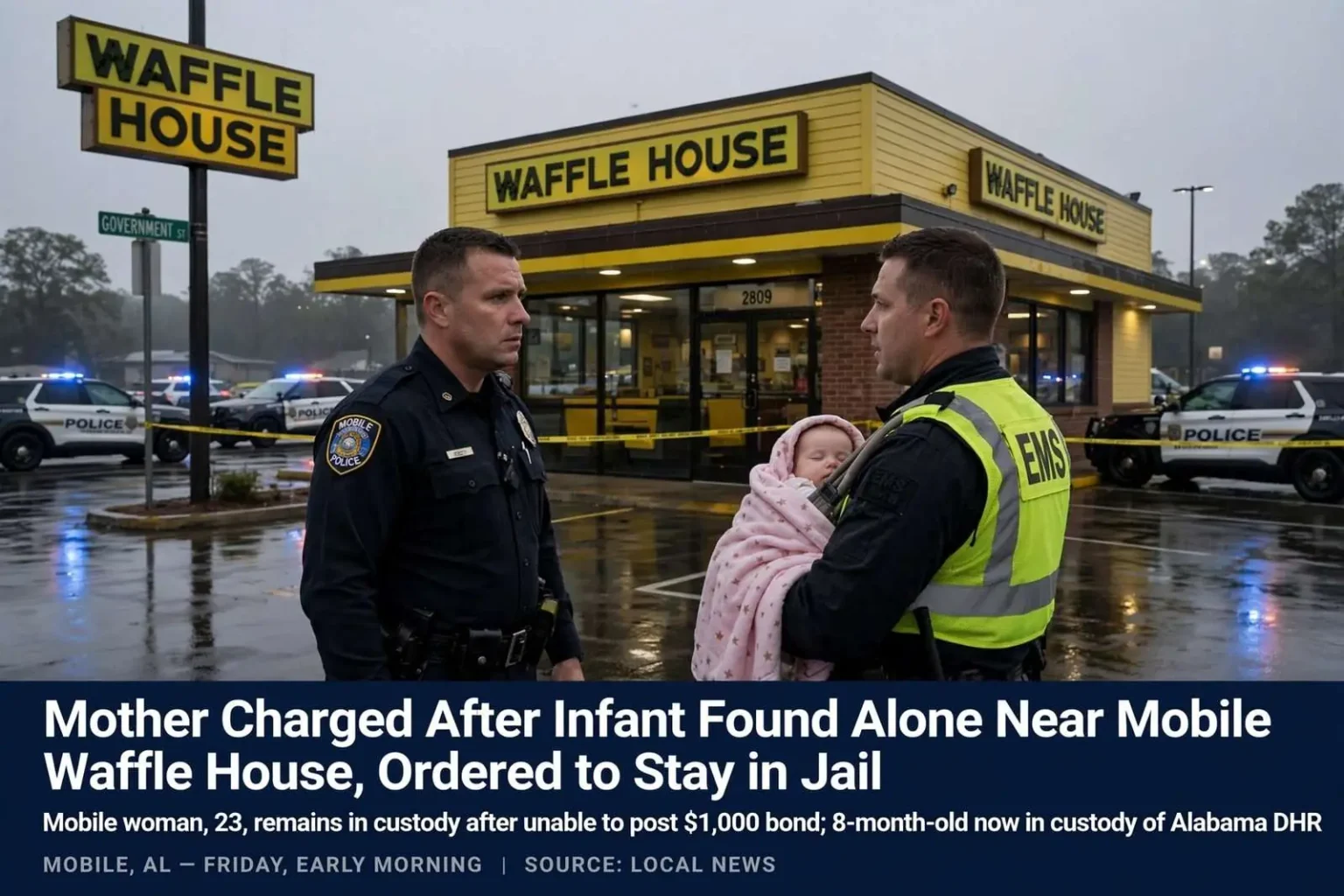
A Mobile woman charged after her baby was found alone near a Government Street Waffle House will likely remain behind bars after telling a judge she could not make even a modest bond.
Myeisha Walker, 23, appeared in court days after an 8-month-old child was discovered unattended early Friday morning. A passerby carried the child into the Waffle House while police were called, setting in motion the case that brought Walker before a judge the following week.
An assistant district attorney reading the charge told the court Walker was found “naked dancing in the middle of Dauphin Island Parkway,” apparently under the influence of an unknown substance. Police said the mother was located in the 500 block of Dauphin Island Parkway, some distance from where the child had been found.
Walker was assigned an attorney and given a $1,000 bond on the misdemeanor child endangerment charge, but said in court she couldn’t post that amount. The judge also ordered her to have no contact with the child, who was taken into custody by the Alabama Department of Human Resources.
The case is set for trial March 7. Walker had missed an earlier hearing date after court officials said she became ill.
How the morning unfolded
The sequence began before dawn on a Friday, when a passerby spotted an unattended 8-month-old near the Waffle House on Government Street and carried the child inside while calling police. Officers responded and took custody of the infant, who was not injured as far as authorities disclosed, and began working to determine where the child belonged.
The search for the child’s caretaker led police to the 500 block of Dauphin Island Parkway, where they located Myeisha Walker, the child’s mother. The assistant district attorney’s account of her condition when found — naked, dancing in the middle of the roadway, apparently under the influence of an unknown substance — became the central detail of the charge read in court.
Police did not announce what substance, if any, was later identified, and authorities have not detailed the timeline of how long the child was alone before the passerby intervened. The distance between the Government Street Waffle House and the Dauphin Island Parkway location left unanswered questions about how the child traveled from her mother’s side to where she was found.
The child, 8 months old, was placed into the custody of the Alabama Department of Human Resources, the state agency responsible for child welfare, pending the outcome of the criminal case and any dependency proceedings.
The charge and the bond
Walker faces a misdemeanor child endangerment charge, which under Alabama law covers the reckless endangerment of a child’s welfare by a person responsible for the child’s care. As a misdemeanor, the charge carries a maximum penalty measured in months rather than years, though prosecutors may file additional or amended charges as the case develops.
The court assigned Walker an attorney and set her bond at $1,000 — a modest figure by the standards of the local bond schedule. But in court she told the judge she could not post that amount, and the judge’s finding that she would likely remain in custody reflected the reality that even small bonds keep defendants jailed when they have no resources.
Her detention pending trial means the criminal case will unfold with her in jail, unless the bond situation changes through a subsequent motion or a reduction. Defense attorneys routinely challenge initial bonds, and Walker’s assigned counsel may revisit the amount as the case proceeds toward the March 7 trial date.
The courtroom scene
Walker’s appearance came days after the Friday morning discovery, in one of the preliminary proceedings where Mobile County defendants hear their charges, learn their bond amounts and are assigned counsel. The assistant district attorney’s recitation of the facts — including the account of Walker found dancing in the middle of Dauphin Island Parkway — was read into the record as part of establishing the charge.
Court officials said Walker had missed an earlier hearing date after becoming ill, a detail that added a delay to proceedings already moving quickly in a case involving an infant. When she did appear, the judge moved through the standard questions: whether she understood the charge, whether she had counsel, and whether she could meet the bond.
Her answer — that she could not post $1,000 — set the terms of her coming months. Alongside the bond decision, the judge ordered her to have no contact with the child, a standard condition in cases where a child has been removed to state custody, meant to protect the child and any dependency proceedings running in parallel.
The no-contact order will remain in force unless modified by the court, and it applies regardless of the criminal case’s eventual outcome.
The child’s path through the welfare system
With the child in the custody of the Alabama Department of Human Resources, the case now runs on two tracks. The criminal case will determine Walker’s guilt or innocence on the endangerment charge; separately, a juvenile court dependency case will determine where the child lives and under what conditions the parent might regain custody.
DHR placements typically begin with a search for relatives who can care for the child — grandparents, aunts, uncles or other family members vetted through home studies and background checks. If no suitable relative is available, the agency turns to licensed foster homes while the dependency case proceeds.
Parents in Walker’s position are generally offered a path toward reunification that can include substance abuse treatment, parenting classes, stable housing requirements and supervised visitation. The child’s young age — 8 months — places the case on an accelerated timeline under state and federal law, which prioritizes permanency for the youngest children.
Substance abuse and child welfare on the Gulf Coast
The case echoes a pattern that child welfare workers across Alabama handle routinely: infants discovered alone or endangered by a caretaker’s apparent intoxication. The “unknown substance” described in Walker’s case was not identified publicly, but the circumstances — a parent incapacitated on a roadway while a baby waited nearby — fit the profile of cases that strain the state’s foster system.
Mobile County’s courts and agencies have developed specialized dockets and treatment programs aimed at parents whose cases involve substance abuse, seeking to balance accountability with treatment. Whether Walker’s case becomes part of such a process will depend on the disposition of the criminal charge and the recommendations of the agencies involved.
The passerby who carried the child into the Waffle House is, in the account authorities provided, the reason the story ended without injury. Bystander intervention of that kind — securing the child and calling police immediately — is what child welfare officials consistently ask of the public when an unattended infant is found.
What comes next
Walker remains in custody pending trial unless her bond circumstances change, and her case is set for trial March 7. The District Attorney’s office will present the evidence gathered by Mobile police, and Walker’s assigned attorney will represent her through the proceedings.
The child remains with DHR, and the dependency case will proceed in juvenile court on its own calendar. Officials have not said whether additional charges are possible, and the police department has not released further details about the investigation into the Friday morning discovery.
Until the courts resolve both tracks, the case stands as a small, sobering file in Mobile’s docket — an infant carried to safety by a stranger, a mother telling a judge she cannot afford her freedom, and a legal process now charged with deciding what happens to both of them.
Inside the misdemeanor endangerment law
Alabama’s child endangerment statute, under which Walker was charged, targets conduct by a person responsible for a child’s care who recklessly endangers the child’s welfare. Prosecutors use it in a range of cases — leaving children unattended, exposing them to drug activity, failing to provide supervision — and it serves as the state’s workhorse charge for situations that fall short of more serious abuse counts.
The misdemeanor classification means the potential sentence is limited, but the collateral consequences extend well beyond the courtroom. A conviction on a child endangerment charge appears in background checks, can affect future custody proceedings and becomes evidence in the dependency case that will determine the child’s placement.
Prosecutors in Mobile County also retain the option of amending charges if the investigation develops — for instance, if toxicology results or witness accounts support more serious counts. No such developments have been announced, and the case currently stands on the single misdemeanor charge.
Bond, bail and inability to pay
Walker’s case illustrates the mechanics of a modest bond in practice. A $1,000 bond typically requires a defendant to pay a bail bond company a nonrefundable fee — often around 10 to 15 percent — or to post the full amount in cash to be returned after court appearances. For a defendant with no income and no family able to help, even that threshold is out of reach.
Defendants who cannot make bond remain in jail until trial, a period that in misdemeanor cases can stretch to months. That detention affects everything about the case: the defendant meets with counsel through jail channels, cannot work, and faces pressure to resolve the case quickly regardless of the evidence.
Courts have faced increasing scrutiny over bonds set without regard to a defendant’s ability to pay, and defense attorneys increasingly move for bond reductions on that basis. Whether Walker’s counsel takes that route has not been announced, and the judge’s statement that she would likely remain in custody reflected the arithmetic of her situation as presented in court.
What the neighborhood saw
The Friday morning discovery left its mark on the businesses around Government Street, where staff and customers of the Waffle House became witnesses to an infant’s arrival in a stranger’s arms. Incidents of that kind linger in the memory of the people involved, particularly restaurant workers who found themselves holding a baby and dialing 911 before the breakfast rush.
Mobile police have not named the passerby, whose quick action placed the child with responsible adults and launched both the police response and the welfare process. Cases of this kind often turn on exactly such interventions — the bystander who stops rather than drives on.
The Dauphin Island Parkway location where Walker was found sits in a south Mobile corridor of homes and businesses, several miles from the Government Street restaurant. Investigators did not publicly explain the gap between the two locations, and the answer to how the child made that journey — or whether the mother did — remains among the case’s unanswered questions.
The road to March 7
With the trial set for March 7, the coming months will fill with the routine machinery of a criminal case: discovery, motions, witness preparation and the parallel dependency proceedings. Walker will experience it from the county jail unless her bond is resolved; the child will experience it from whatever placement DHR secures.
The court’s no-contact order means the outcome of both cases will determine when, or whether, mother and child see each other again. For now, the file carries the essentials authorities have made public: an 8-month-old found unattended near a Government Street Waffle House, a mother found in the middle of Dauphin Island Parkway, a $1,000 bond she could not pay, and a trial date on the calendar.


