MPD Seeks Robbery Suspect Wanted in Mobile, Spanish Fort and Fairhope
Mobile Police are seeking 33-year-old Julien De Mone Hardin, wanted for robberies at businesses in Mobile, Spanish Fort and Fairhope, considered armed.
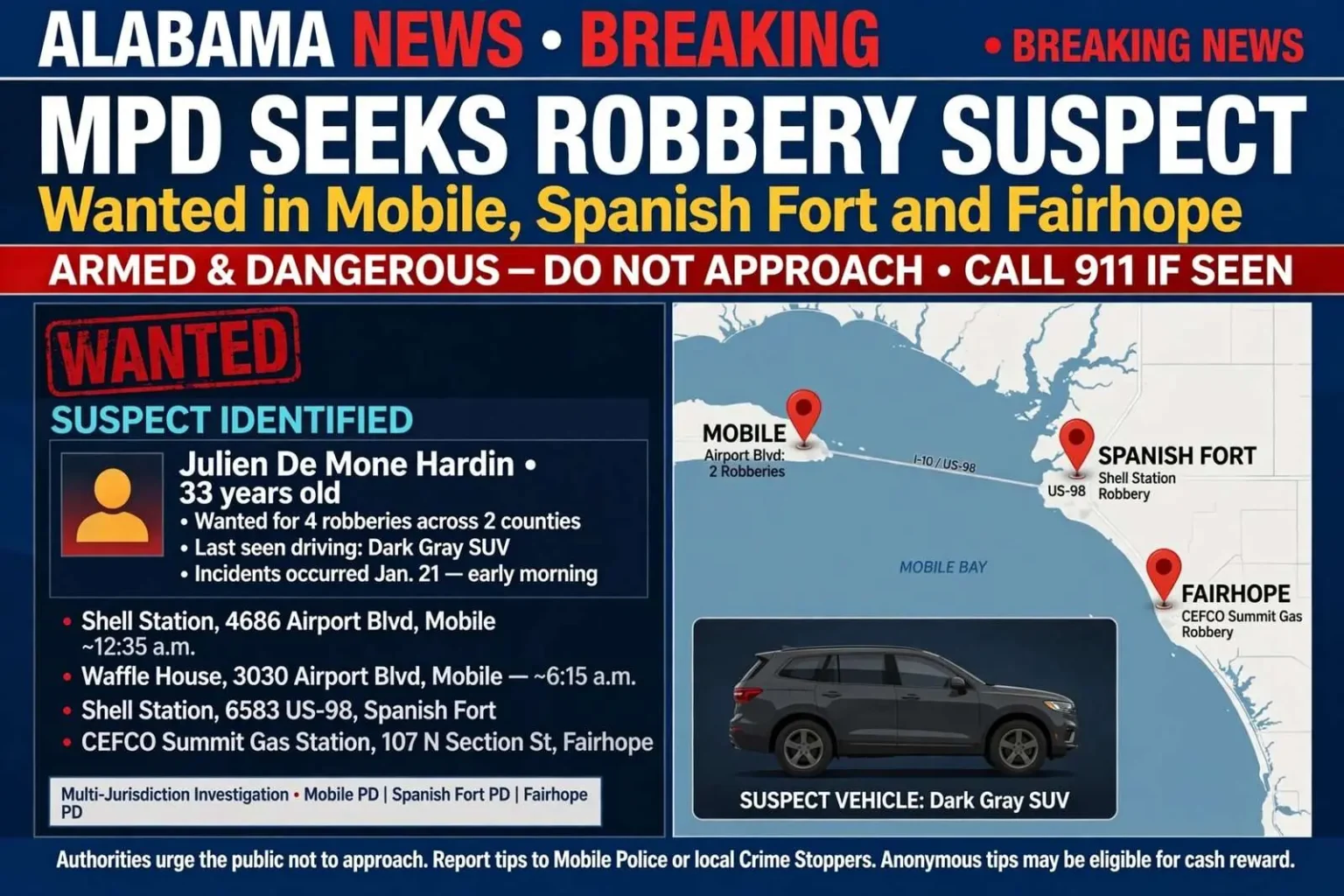
Mobile police are asking for the public’s help locating a 33-year-old man wanted in connection with at least three robberies that stretched across the Mobile area and over the Mobile Bay into Baldwin County. Julien De Mone Hardin is identified by the Mobile Police Department as the suspect in a robbery that occurred about 12:35 a.m. on Jan. 21 at the Shell Station at 4686 Airport Boulevard. According to investigators, Hardin walked into the convenience store, approached the register and demanded money before fleeing the business on foot.
Roughly six hours later, police say the same man struck again, this time at the Waffle House at 3030 Airport Boulevard, at approximately 6:15 a.m. In that incident, Hardin placed his hand inside his jacket pocket in a way that suggested he was armed, demanded money from the register and left the restaurant in a dark gray sport utility vehicle, according to the Mobile Police Department. No injuries were reported in either Mobile robbery, but the quick succession of the two crimes — both along one of the city’s busiest east-west corridors — prompted investigators to begin connecting the cases almost immediately.
The wanted man’s alleged spree did not stay within Mobile city limits. Authorities in Baldwin County say Hardin is also wanted out of Spanish Fort for a robbery at the Shell Station at 6583 U.S. 98, and for a robbery at the CEFCO Summit Gas Station at 107 North Section Street in Fairhope. That brings the total number of linked incidents to four, spread across three separate police jurisdictions in two counties over what investigators believe was a short span of time.
The Mobile Police Department has described Hardin as armed and dangerous, a designation that carries real weight for residents of the neighborhoods near the robbery scenes. The Airport Boulevard corridor, which runs east from the Mobile Regional Airport area through some of the city’s most heavily traveled commercial districts, is lined with gas stations, fast-food restaurants and small businesses that operate long hours, many of them staffed overnight by a single employee. Those are precisely the kinds of locations that late-night robbers tend to target, and the Jan. 21 incidents followed that familiar pattern: a small crew on duty, a demand for cash and a fast departure.
Spanish Fort and Fairhope, the two Baldwin County communities where Hardin is also wanted, sit along the eastern shore of Mobile Bay, connected to the Mobile metro by the Interstate 10 and U.S. 98 crossings. Spanish Fort’s stretch of U.S. 98, near the Eastern Shore Centre retail district, carries heavy daily traffic between the bay bridges and communities farther south, while North Section Street is one of Fairhope’s principal commercial arteries. A suspect moving between Mobile and the Eastern Shore could traverse all of the robbery locations in a matter of minutes by car, which is one reason investigators across the two counties have been coordinating their inquiries rather than treating the cases in isolation.
A Multi-Jurisdiction Investigation
When a robbery suspect crosses municipal and county lines, the investigation necessarily becomes a shared one. In this case, the Mobile Police Department, the Spanish Fort Police Department and the Fairhope Police Department each hold jurisdiction over the crimes committed within their own city limits, and each agency would typically prepare its own warrant packet for the district attorney in its county — Mobile County on one side of the bay, Baldwin County on the other. Detectives routinely share surveillance images, witness statements and vehicle descriptions so that a pattern emerges quickly, as it did here, where the similar method of operation allowed all three departments to point to the same suspect.
The charge of robbery itself is a felony under Alabama law, and the penalties grow more severe when the suspect is believed to be armed or implies possession of a weapon. In the Waffle House incident, police say Hardin used his jacket to suggest he had a gun, a tactic that Alabama courts treat seriously even when no weapon is ever displayed. A conviction can bring a lengthy prison sentence, and prosecutors in both counties would have the option of pursuing charges separately for each incident, meaning a suspect convicted in all four robberies could face consecutive sentences.
What the Armed and Dangerous Warning Means
Law enforcement agencies use the phrase “armed and dangerous” deliberately. It signals to the public that the suspect should not be approached under any circumstances, and it is generally paired with an internal directive that officers confronting the individual should use extreme caution and, where possible, wait for backup. For residents, the guidance is straightforward: anyone who believes they see Hardin, or recognizes him from surveillance images released by police, should call 911 immediately rather than trying to detain him or follow his vehicle. Modern mobile data terminals and automated license plate readers give officers across the region the ability to broadcast suspect and vehicle descriptions across jurisdictions in seconds, so a single well-timed 911 call can put every patrol shift in the metro on notice.
The description of the dark gray SUV used in the Waffle House robbery is significant to investigators because getaway vehicles are often the thread that ties a string of robberies together. Convenience-store and restaurant cameras routinely capture the vehicle in the parking lot even when the interior footage is blurry, and matching a vehicle across multiple scenes strengthens the case that a single offender is responsible. If the vehicle was stolen, that adds another felony charge; if it belongs to an associate, that person can also face criminal exposure for aiding and abetting.
Residents of the affected corridors have also been reminded of basic prevention measures that police departments across the Gulf Coast recommend to businesses that operate at night. Keeping multiple employees on duty during late hours, maintaining clear sightlines from the register to the parking lot, installing high-quality cameras that capture faces at the counter, and limiting the amount of cash kept on hand all reduce both the likelihood of a robbery and the payoff if one occurs. Many stations and restaurants along Airport Boulevard, U.S. 98 and Section Street already employ these measures, and the footage they produced is what allowed investigators to identify a suspect and link the Mobile cases to the Baldwin County ones so quickly.
How the Public Can Help
The Mobile Police Department’s public appeal is built on a simple reality: wanted suspects are most often located when someone in the community recognizes them. Neighbors, coworkers and even distant relatives frequently know where a suspect sleeps, works or spends time, and tips from those sources routinely resolve cases that would otherwise grow cold. Tipsters in the Mobile area can provide information directly to investigators, and those who prefer to remain anonymous can use regional Crime Stoppers programs, which allow callers to submit tips without giving their names and may offer cash rewards when the information leads to an arrest.
Baldwin County residents with information about the Spanish Fort or Fairhope robberies are encouraged to contact those cities’ police departments directly. Investigators there have indicated that the robberies in their jurisdictions match the Mobile pattern, and any additional detail — a direction of travel, a description of the driver, a time of day that fills a gap in the timeline — can help prosecutors build a case that covers every incident. Police have not said whether additional robberies in the region are being reviewed for possible connection, which is common in these investigations; once a suspect’s identity is known, detectives go back through recent unsolved cases to see whether the method of operation matches.
It is worth noting what authorities have not said. No weapon was confirmed at any of the scenes, no injuries have been reported, and the amount of money taken has not been made public. Those details will matter at trial, but for now investigators are focused on a single objective: getting Hardin off the street before anyone gets hurt. The armed-and-dangerous designation reflects the judgment that a suspect who has committed four robberies in rapid succession, moving between counties and using a vehicle to flee, presents an escalating risk.
What Comes Next
Once Hardin is taken into custody, the practical mechanics of a two-county case take over. He would be booked into the jail of the county where he is arrested, and the agencies holding warrants would begin the process of arranging prosecution. If he is arrested in Mobile County, the Mobile charges would be handled first, with Baldwin County authorities able to seek transport to face the Spanish Fort and Fairhope charges afterward. Alabama’s court system handles these inter-county transfers routinely, and defendants in multi-jurisdiction cases frequently end up resolving charges in one county as part of an overall agreement that accounts for the others.
For the business owners and employees who were behind the counters during the four robberies, the arrest would bring a measure of closure to what is, for a single clerk working an overnight shift, a traumatic experience. Victim advocates with the prosecutors’ offices in both counties guide robbery victims through the court process, and the recovery of stolen property, when it occurs, typically happens as part of the criminal investigation rather than immediately.
In the meantime, the alert remains active. Police have asked anyone who spots Hardin or knows his whereabouts to call 911, and to remember that the dark gray SUV may still be in use. The cooperation of residents on both sides of Mobile Bay — the people who work in the stations and restaurants along Airport Boulevard, U.S. 98 and Section Street, and the neighbors who notice a vehicle that does not belong — remains the most likely path to an arrest.