Multi-Vehicle Crash Snarls I-10 Traffic Near Theodore for Hours
A multi-vehicle crash shut down lanes of eastbound I-10 near Theodore for hours Thursday afternoon before ALEA reported the roadway clear.
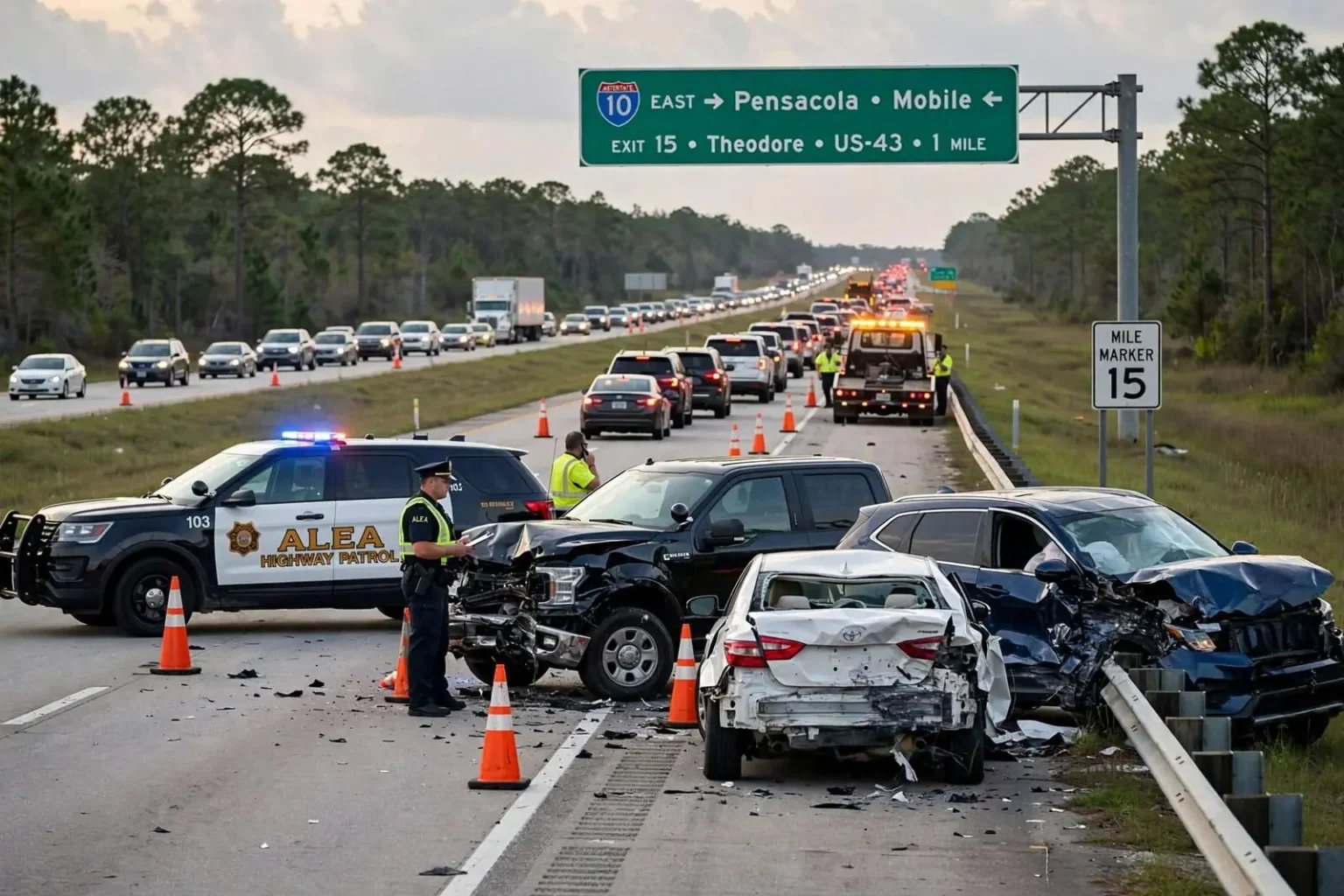
THEODORE, Ala. — A multi-vehicle crash shut down multiple lanes of Interstate 10 near Theodore on Thursday, leaving travelers stuck for hours as the Alabama Law Enforcement Agency investigated. The wreck happened on the eastbound side of the interstate near mile marker 15, one of the busiest stretches of highway in southwest Alabama, and the resulting backup stretched for miles as drivers searched for a way around the blocked lanes.
Troopers with ALEA’s Highway Patrol Division responded to the scene shortly before 2 p.m. and worked throughout the afternoon to document the collision, clear the roadway, and direct traffic past the wreckage. Motorists who were already on the road when the crash occurred found themselves at a standstill, while drivers approaching the area from Mobile and from the Eastern Shore had few practical alternatives once word of the closure spread.
By about 4:40 p.m., ALEA reported that all lanes had been cleared and traffic was moving again through the corridor. The agency did not immediately release additional details about the crash, including how many vehicles were involved or whether anyone was injured. Investigators typically continue working a crash of this kind even after the roadway reopens, reconstructing the sequence of events from skid marks, vehicle damage, and witness accounts.
A corridor that carries the Gulf Coast’s traffic load
Interstate 10 is the primary east-west artery for the central Gulf Coast, linking Mobile County with Baldwin County and continuing on toward Pensacola and the Florida Panhandle. In the Mobile area, the highway carries commuters, freight haulers, and vacation travelers alike, and its volume swells noticeably during morning and afternoon rush periods as well as on holiday weekends when beach traffic peaks.
The stretch near Theodore sits just west of the George Wallace Tunnel and the Interstate 10 crossing of Mobile Bay, and it is a common choke point for congestion even on a normal day. When a crash closes eastbound lanes anywhere in that corridor, there are limited detour options. Drivers heading toward Daphne or Spanish Fort can sometimes divert to U.S. 90, which parallels the interstate, but that two-lane and four-lane surface route is not built to absorb the full volume of an interstate closure and quickly backs up as well.
Mile marker 15 places Thursday’s crash in the segment of I-10 that passes through the Theodore area, between the exchanges that serve U.S. 43 and the roads feeding the Theodore Industrial Canal area. That segment carries heavy truck traffic tied to the Port of Mobile and the industrial facilities along the Mobile River and Mobile Bay, which is one reason collisions there tend to be disruptive even when they involve relatively few vehicles.
How ALEA handles major highway investigations
The Alabama Law Enforcement Agency, created in 2015 by consolidating several state public safety functions, is responsible for investigating serious crashes on Alabama’s interstates through its Highway Patrol Division and its specialized units. When a wreck involves multiple vehicles, possible injuries, or significant damage, troopers close the affected lanes while they document the scene, both to protect anyone still inside the crashed vehicles and to preserve evidence needed for the investigation.
That process can take hours. Troopers photograph the scene, measure final vehicle positions, interview drivers and witnesses, and coordinate with wreckers to remove damaged cars and trucks. In cases involving commercial vehicles, additional inspection steps may apply. Only after investigators are satisfied that the scene has been fully documented and the roadway can be made safe are the lanes reopened to traffic.
During Thursday’s response, ALEA used its official channels to update the public on conditions, including the afternoon announcement that all eastbound lanes were back open. Motorists who rely on the interstate between Mobile and Baldwin County have come to expect those delayed, incremental updates, since details about injuries and the precise cause of a wreck are generally withheld until investigators have completed their preliminary review or released a formal report.
For the drivers caught in Thursday’s backup, the closure turned a routine afternoon drive into an extended ordeal. Vehicles that had been traveling toward the Eastern Shore, Daphne, Spanish Fort, or destinations farther east sat on the interstate as heat built through the afternoon. Some drivers exited at the ramps ahead of the scene and turned to U.S. 90 or to the local roads running parallel to the interstate through Theodore and Tillman’s Corner, spreading congestion onto the surface street network as well.
Local emergency responders staged around such closures as a matter of routine. When a wreck blocks the interstate, fire and rescue units from the surrounding volunteer and municipal departments may be called on to assist with patient care, traffic control, or hazard mitigation, and wrecker services rotate through to clear heavy damage. The coordination between ALEA and local agencies is a familiar pattern along the I-10 corridor, where major wrecks occur several times a year.
What drivers can expect after a crash investigation
Once investigators finish their work, the findings from a crash like Thursday’s typically appear in a preliminary or final report that may take days or weeks to become public. Those reports can note contributing factors such as speed, following distance, lane changes, weather, or mechanical problems. Charges, if any are warranted, are generally filed separately after the investigation concludes, and civil claims between the drivers involved proceed independently of the troopers’ findings.
For commuters and freight carriers who use I-10 daily, the practical lesson from closures like this one is the value of checking traffic conditions before setting out and of knowing the alternate routes. U.S. 90 remains the principal parallel option through the Theodore area, though it adds significant time during peak periods. Drivers who are already trapped in a closure are generally advised to remain with their vehicles, leave space ahead for emergency vehicles to pass, and follow the direction of troopers on the scene.
The Theodore segment of the interstate has seen its share of serious collisions over the years, a product of its traffic volume, its mix of passenger cars and heavy trucks, and the morning and evening rush patterns that compress large numbers of drivers into the same corridor at the same hours. State and local planners have studied improvements to the corridor for years, including long-discussed work around the Mobile Bay crossing, though major infrastructure changes on that scale move slowly and remain in the planning and funding stages.
The afternoon’s timeline, in brief
The sequence of Thursday’s disruption, as reported by authorities: the crash occurred shortly before 2 p.m. on eastbound I-10 near mile marker 15; troopers closed the affected lanes and investigated through the afternoon; and ALEA announced the all-clear at approximately 4:40 p.m. That window meant the closure lasted roughly two hours and forty minutes from the initial report until the lanes reopened.
During that time, the backout rippled westward toward Mobile and eastward toward the bay, with the worst delays closest to the scene. Motorists who entered the highway at interchanges west of the crash, including the connections serving U.S. 43 and the Tillman’s Corner area, found themselves queued behind the closure with limited room to turn around. Traffic generally returned to normal patterns within a short time after the lanes reopened, though residual congestion lingered as the delayed backlog worked its way through the corridor.
Additional details about the crash, including any injuries, were not immediately available. Authorities said the investigation remains open, and further information would be released as it becomes appropriate to do so. Anyone who witnessed the collision and has not yet spoken with troopers may still contact ALEA to provide an account, which investigators can weigh alongside the physical evidence already gathered at the scene.
Safety advocates in the region point out that crashes along this stretch of I-10 tend to cluster during afternoon travel periods, when commuter traffic and freight movement overlap. The interstate’s interchange spacing through the Theodore area is tight by interstate standards, with entrance and exit ramps in relatively quick succession, and lane-changing traffic merges with through trucks that may be several times the weight of a passenger vehicle. Those conditions raise the stakes when drivers follow too closely or react abruptly to slowing traffic.
Alabama’s move-along law, which requires drivers involved in minor collisions to move their vehicles off the roadway when they are able, is intended to reduce exactly the kind of secondary congestion that follows a multivehicle wreck. When a crash is serious enough that vehicles cannot be moved, or when injuries are suspected, the full investigative closure that followed Thursday’s incident becomes unavoidable, and the traffic consequences are simply the price of a thorough scene documentation.
Thursday’s events also illustrate the role that real-time information now plays in how Gulf Coast drivers cope with interstate closures. Navigation apps, ALEA’s traffic advisories, and local media reports spread word of the blockage quickly, allowing some drivers to alter course before reaching the back of the line. That information flow has changed the shape of closures in recent years, dispersing some of the backup onto parallel routes even as the immediate scene remains shut down.
Looking ahead for the corridor
Long-term planning for the I-10 corridor through Mobile remains one of the most consequential infrastructure questions in the region. The proposed Mobile River Bridge and Bayway project, which has been studied for more than a decade, would rebuild and expand the crossing of Mobile Bay and add a new bridge over the river, easing the bottlenecks that funnel interstate traffic through the tunnel and bayway. Funding and tolling questions have kept the project in flux, and in the meantime the existing corridor continues to carry traffic volumes it was never designed to handle at peak hours.
Until any such work advances, closures like Thursday’s will remain a recurring feature of life along the Gulf Coast’s main east-west artery. State troopers will continue to investigate wrecks on scene, motorists will continue to weigh the interstate against U.S. 90, and the afternoon commute through Theodore will continue to depend on how quickly a damaged roadway can be cleared and made safe.
For now, drivers in the region are reminded to build extra time into trips that cross the bay, to check conditions before traveling during peak hours, and to give emergency responders room to work when they pass a crash scene. Alabama’s slow down, move over law requires motorists to change lanes away from stopped emergency vehicles or, when that is not possible, to slow to a speed well below the posted limit while passing.
The investigation into Thursday’s multi-vehicle crash near Theodore remains active with the Alabama Law Enforcement Agency. Updates will be provided as more information about the vehicles involved, the injuries, and the cause of the collision becomes available from authorities.