Murder suspect wanted in North Carolina shot and killed by authorities in Atmore
A man wanted for murder in Charlotte, N.C., was shot and killed by authorities at a mobile home park in Atmore, Alabama, the FBI said.
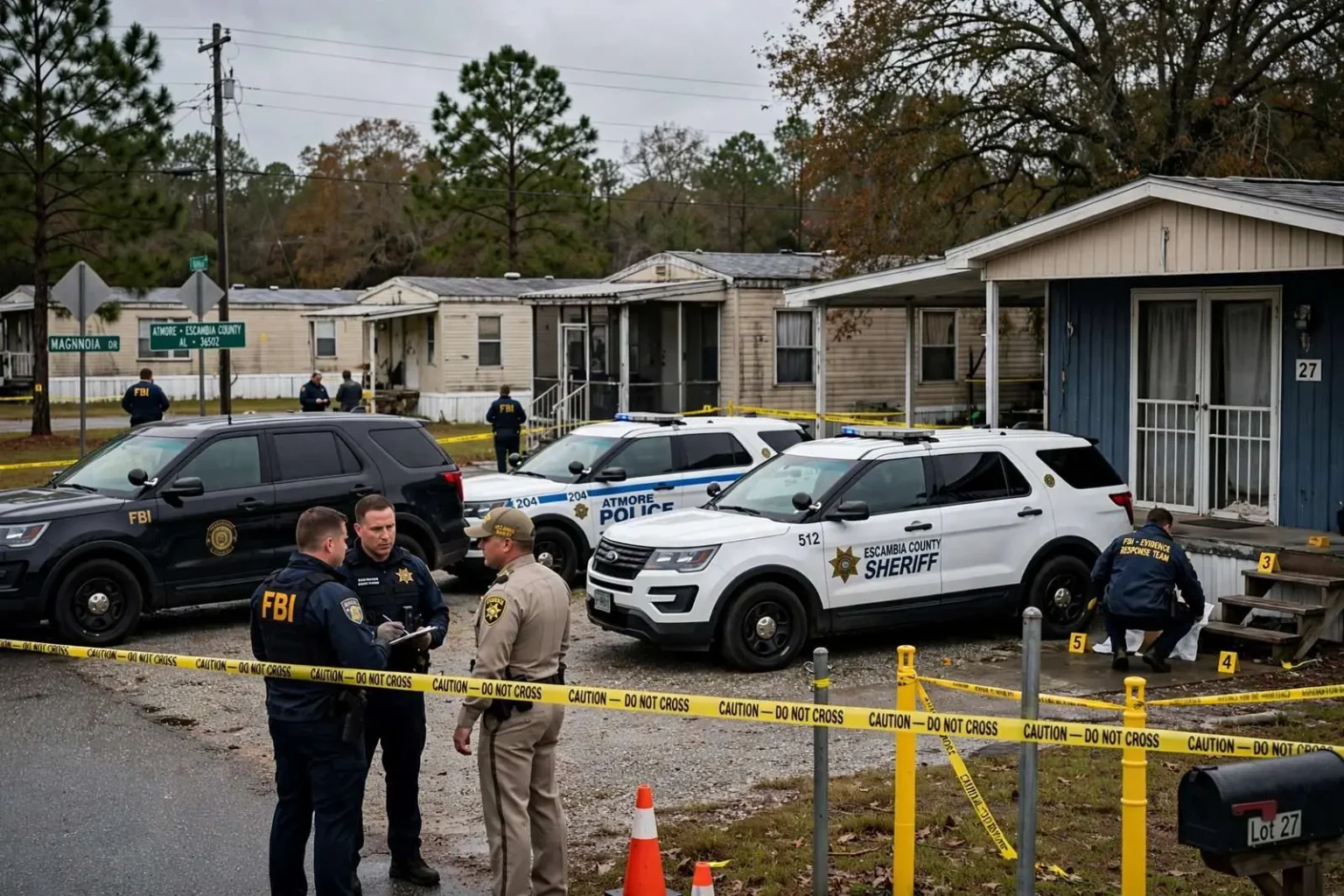
Investigators are continuing to process a scene in Atmore after a man wanted for murder in another state was shot and killed by authorities at a mobile home park. The shooting occurred Wednesday afternoon, ending a manhunt for a fugitive who had crossed state lines before he was located in the Escambia County city.
The suspect, identified as Tobby Wiggins, was wanted for murder in Charlotte, North Carolina, and was shot and killed as authorities attempted to take him into custody. Details about what specifically prompted the use of force have not been released as the review of the encounter continues.
FBI special agents had identified the suspect’s location and moved to apprehend him, according to the agency. The FBI’s involvement reflects the federal role in tracking fugitives who flee across state lines, a routine part of the bureau’s mission that often brings federal agents into small communities far from the cities where charges originated.
Per FBI procedure, a shooting incident review team will gather information and conduct witness interviews for a presentation. The review is standard practice whenever FBI personnel are involved in a shooting, regardless of the circumstances, and its findings will be examined by bureau officials before any conclusions are drawn.
No further details were released, and authorities have not said whether Wiggins was armed or what actions led agents to fire. The scene at the mobile home park remained active as investigators documented evidence and canvassed the area for witnesses.
Atmore: A Small City on the Alabama-Florida Line
Atmore sits in Escambia County in far southern Alabama, just a few miles from the Florida state line along the Interstate 65 corridor. The city of roughly 8,000 residents is home to the Poarch Band of Creek Indians’ reservation and tribal enterprises, a federal correctional facility, and the rail lines that historically built the town.
That position along a major interstate makes Atmore a regular waypoint for travelers between Mobile and Montgomery, and like many interstate communities, it occasionally becomes the setting for investigations involving fugitives passing through or hiding out in the area. Mobile home parks and rental properties on the city’s edges are the kinds of places where people seeking to stay off the radar sometimes surface.
Local agencies in Escambia County, including the Atmore Police Department and the county sheriff’s office, have long-standing working relationships with federal partners. When FBI agents move on a target in a small city, coordination with local law enforcement is standard, providing local knowledge, backup and control of the surrounding area.
Wednesday’s fatal shooting brought a wave of attention to the quiet city. Residents near the mobile home park reported a heavy law enforcement presence in the afternoon hours as the scene was secured and investigators arrived to begin their work.
How Fugitive Apprehensions Work Across State Lines
When a suspect flees the jurisdiction where he is charged, the pursuit typically shifts to federal and multi-agency channels. The FBI maintains field offices and resident agencies across the country, and its agents work with U.S. Marshals and local task forces to locate fugitives who cross state lines to avoid prosecution.
Identifying a fugitive’s location is a painstaking process involving surveillance, records checks, interviews and tips. Once agents believe they know where a target is staying, they plan an apprehension operation designed to minimize risk to the public, weighing the time of day, the layout of the location and the likelihood of resistance.
Even with careful planning, apprehension attempts of suspects wanted for violent crimes are among the most unpredictable encounters in law enforcement. Agents approach with arrest warrants and backup, but decisions about force are made in seconds based on the actions of the suspect in the moment.
Charlotte, where Wiggins faced murder charges, is among the largest cities in the Southeast, and its police department, like most major agencies, works with federal partners when suspects flee the region. The distance between Mecklenburg County and south Alabama illustrates how far fugitive investigations can travel, following leads until a suspect is found.
What Happens After an FBI-Involved Shooting
The FBI’s shooting incident review process is among the most formalized in American law enforcement. Whenever FBI personnel discharge a weapon, a dedicated review team is dispatched to reconstruct the events, collect physical evidence and interview witnesses, including the agents involved and any bystanders present.
The team’s work culminates in a presentation to FBI leadership, who evaluate whether the actions taken were consistent with bureau policy and federal law. That review operates independently of any state or local review that may also take place, and it can take weeks or months to complete.
In fatal shootings, local authorities also have a role. District attorneys in the jurisdiction where a shooting occurs typically review the circumstances to determine whether any criminal conduct occurred, and Alabama’s system allows for such review even when the shooters are federal agents operating under federal authority.
The findings of these reviews are rarely made public quickly, which often leaves unanswered questions in the weeks following an incident. Authorities in Atmore have said only that the investigation is ongoing and that no further details would be released while the review proceeds.
The Community Impact of a Officer-Involved Shooting
Fatal police encounters leave marks on small communities. Beyond the immediate scene, residents deal with road closures, a lingering law enforcement presence and the stress of knowing a violent encounter happened in their neighborhood. Schools and businesses nearby sometimes adjust their routines while scenes are processed.
Mobile home parks present particular challenges for investigators. Close quarters between units mean many potential witnesses, but also privacy concerns for neighbors who saw or heard parts of the encounter. Investigators typically conduct door-to-door interviews in the days after such an event.
Community relations teams and local officials often serve as the bridge between residents and investigators, passing along accurate information about what is known and what remains under review. In towns like Atmore, where residents know their neighbors well, that communication matters to maintaining trust through the investigation.
For now, the focus remains on the evidence. The mobile home park scene will be processed until investigators are satisfied that nothing relevant remains undocumented, and the review teams, both FBI and any local component, will work through the witness interviews before any public accounting of Wednesday afternoon emerges.
Justice for the Charlotte Case
With the suspect’s death, the murder case in Charlotte that prompted the manhunt will close without a trial, an outcome that can be difficult for victims’ families who waited years to see a defendant answer the charges in court. Prosecutors in Mecklenburg County will formally resolve the case in light of the suspect’s death.
Fugitive cases that end this way are a reminder of the stakes involved whenever violent suspects flee. Every day a murder suspect remains at large is a day of risk for the communities they pass through, and the agents and officers who track them down accept that risk on behalf of places that have no other connection to the original crime.
For Atmore, the episode was brief but consequential, ending a fugitive’s run in an afternoon of gunfire on the city’s north side. The reviews that follow will determine what exactly happened, and residents, officials in North Carolina and the FBI itself will all be waiting for those answers.
A Waiting Game for Answers
Reviews of officer-involved shootings follow their own timelines, and small cities often have little choice but to wait for the results. The physical evidence from the mobile home park will be analyzed in laboratories, the witness interviews will be transcribed and compared, and the review team’s presentation will work through the encounter minute by minute before any conclusions are reached.
Residents with information about the encounter or about Wiggins’ time in the area are typically encouraged to share it with investigators, since statements gathered early tend to be the most detailed and reliable. In cases like this, even small details, such as vehicles seen in the days before the shooting, can matter to the reconstruction.
Local officials in Atmore have experience managing the aftermath of high-profile incidents, thanks in part to the large federal installation in the city and the presence of multiple law enforcement agencies in the area. The town’s routine cooperation between city police, the county sheriff and federal partners made Wednesday’s multi-agency operation, for all its gravity, a familiar kind of coordination.
The name Tobby Wiggins will now appear in two states’ records: in North Carolina, where a murder case ends without a verdict, and in Alabama, where a scene has been processed and a review file grows thicker by the week. Between those two records lies the story of what happened Wednesday afternoon in Atmore, and it is one that investigators, not speculation, will eventually tell.