
Murphy High School Seniors Join Mayor and Councilman Carroll to Paint The Loop Cannon Blue
Murphy High School seniors, the mayor and Councilman Carroll painted the iconic cannon at The Loop blue as tornado restoration began.
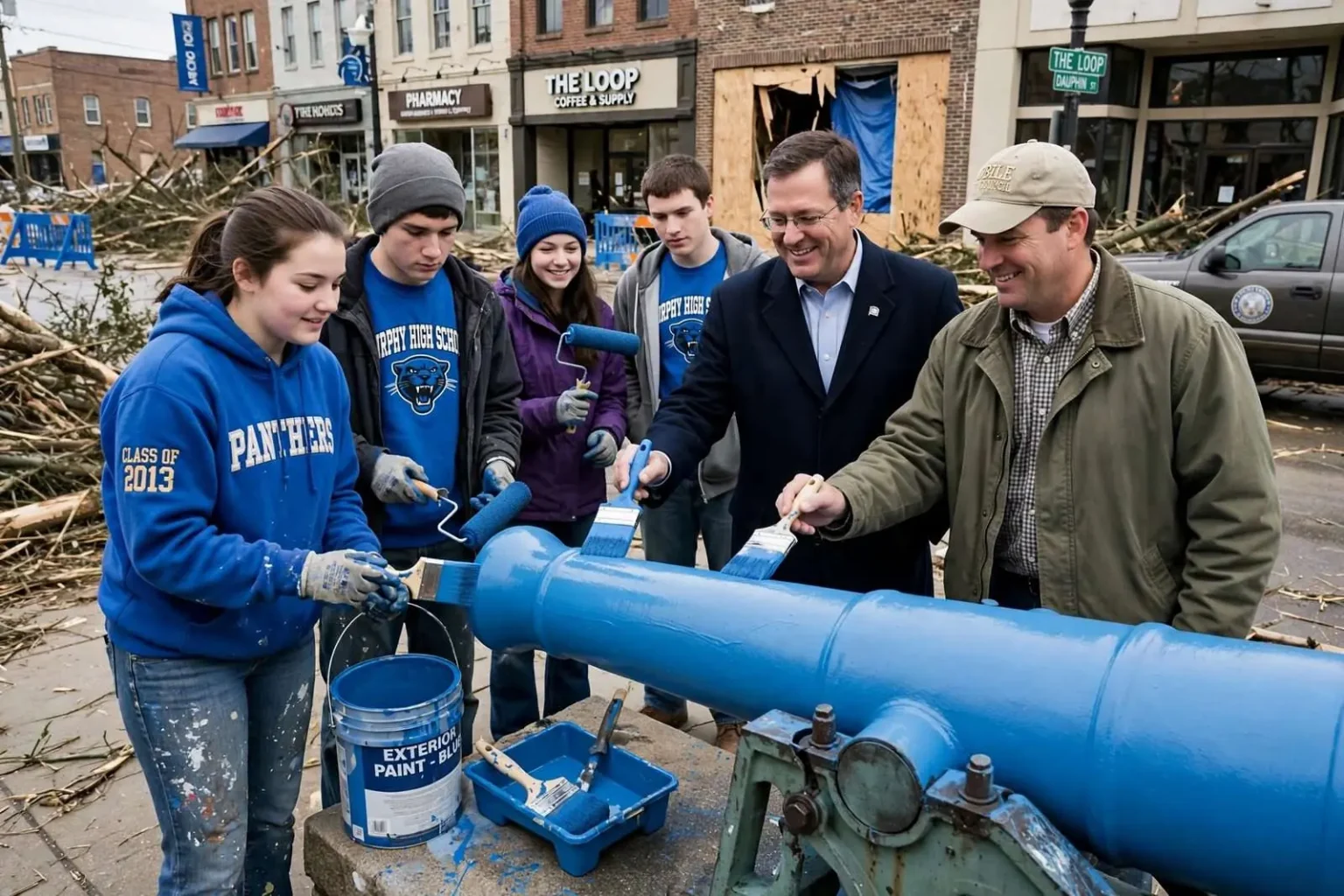
In a show of community spirit and resilience, seniors from Murphy High School joined Mobile’s mayor and City Councilman Carroll on January 2, 2013, to repaint the iconic cannon at The Loop in the school’s signature blue color. The ceremony lasted only an afternoon, but its symbolism ran deep: eight days after a tornado tore through their neighborhood on Christmas Day, students and city leaders stood together at one of Midtown’s best-known landmarks and made it look like themselves again.
The cannon sits in the heart of The Loop, the commercial district that takes its name from the streetcar loop that once turned through the area, and it has served for decades as an informal monument to the neighborhoods around Murphy High School. Generations of students have claimed it, painted it and photographed beside it. When disaster struck the community, the cannon was the natural place for the city’s first public gesture of recovery.
The fresh coat of paint was more than a cosmetic gesture. The beloved cannon, a longtime landmark in the Midtown Mobile neighborhood surrounding Murphy High School, received the new blue paint job as a symbol of respect for the historic institution and a sign of recovery following the devastating Christmas Day tornadoes that struck the Mobile area on December 25, 2012. Choosing blue — the Panthers’ color — made the statement unmistakable: the school and its neighborhood intended to come back.
A Landmark Restored After Christmas Day Tornadoes
The EF-2 tornado that tore through Midtown Mobile on Christmas Day caused significant damage to Murphy High School and the surrounding neighborhood, leaving the community reeling during what should have been a time of celebration. The storm arrived on a holiday when families were gathered at home, with little warning and no students on campus, and it carved a path of destruction through one of Mobile’s most historic residential and commercial districts.
Windows were shattered, roofs were torn away, and debris littered the streets around the historic campus. Trees that had shaded Midtown streets for a century came down across power lines and driveways, and residents emerged from their homes on Christmas night to survey a neighborhood changed in minutes. City crews spent the days that followed clearing roads and restoring utilities, even as families grappled with damaged houses and disrupted holidays.
Murphy High School itself sustained heavy damage. The campus, a fixture of Mobile public education since the mid-1920s, lost windows across its historic buildings and suffered structural damage that would keep students displaced for an extended period. For a school whose identity is woven into the identity of Midtown, the storm’s scars felt personal to alumni, teachers and students alike.
Community Rallies Around Historic School
The cannon-painting effort was one of many early steps in the restoration process for the Murphy High School community. In the days after the storm, volunteers organized cleanup crews, churches opened their doors to displaced families, and alumni networks began raising money and supplies for the school’s recovery. The January 2 gathering added a public, official dimension to that grassroots response, with city government standing visibly beside the school community.
By bringing together students, city officials, and local leaders to refresh the well-known landmark, organizers sent a clear message that the neighborhood intended to rebuild and preserve its heritage. The choice of seniors to lead the effort mattered as well. The Class of 2013 had watched the storm damage the campus during their final year, and taking up brushes to restore a piece of their school’s landscape gave those students a role in the recovery narrative they would carry with them after graduation.
Murphy High School, one of Mobile’s most storied public schools, has served as a cornerstone of the Midtown community for generations. Opened in the 1920s as one of the city’s flagship campuses, Murphy counts among its alumni judges, athletes, musicians, business leaders and public officials who spread from Mobile across the country. Its architecture and its traditions anchor the neighborhoods around it, and its fortunes have long been read as a barometer of Midtown’s own.
The Cannon as a Canvas for Pride
The cannon at The Loop has long been a popular gathering point and a canvas for school pride, traditionally painted in the Panthers’ blue. School spirit rituals like cannon-painting are common across American towns, but Mobile’s version carries particular weight because of the landmark’s setting: a busy commercial crossroads where the painted cannon is visible to thousands of drivers every day, a rolling announcement of whatever the community is celebrating.
After the tornado, that visibility worked in reverse. Damage around The Loop told passing motorists that Midtown had been hit hard, and the sight of the cannon — chipped, weathered and surrounded by storm debris — became part of the neighborhood’s post-storm image. Repainting it in school blue flipped the message back: this community was still here, still proud, and already working.
Recovery Through Cooperation
The collaborative effort between Murphy seniors, the mayor, and Councilman Carroll demonstrated the kind of cross-generational, civic-minded cooperation that would be essential in the weeks and months ahead as the broader restoration of the school and neighborhood continued. Recovery after a tornado is a long project: insurance claims, contractor schedules, grant applications and construction timelines stretch out over years, and the communities that weather the process are the ones that keep showing up for it.
City officials used the occasion to reinforce their commitment to Midtown’s recovery, pledging support for cleanup, code enforcement and rebuilding efforts in the storm’s footprint. For their part, the students brought energy and visibility that formal announcements rarely achieve — a photo of teenagers in blue paint, standing beside the mayor at a beloved landmark, communicates recovery more powerfully than any press release.
The January 2 event also set a tone for the difficult work that followed. Murphy students would spend much of the remainder of the school year attending classes in temporary locations while repairs progressed, a disruption that tested the flexibility of families and the district alike. Neighborhood homes and businesses continued to be repaired for years afterward. Through all of it, the repainted cannon stood at The Loop as a marker of the moment the community decided its story would be one of rebuilding rather than loss.
What the Cannon Represents
Landmarks matter most in the moments when everything around them changes. The Loop cannon survived the Christmas Day tornado, and the decision to repaint it in Panthers’ blue within a week of the storm turned a piece of street furniture into a statement of civic identity. Anyone driving past in early January 2013 saw the same message the students intended: Murphy High School is not going anywhere, and neither is its neighborhood.
For the seniors who picked up the brushes, the afternoon offered a lesson in citizenship that no classroom could match — a demonstration that public spaces are kept alive by the people who care for them, and that recovery begins with small, visible acts of ownership. The cannon has been repainted many times before and since, as school traditions require, but the January 2013 coat of paint remains the one Mobile remembers: the blue that came back after the storm.
Midtown’s Road Back
The Christmas 2012 tornado became a defining chapter for a section of Mobile that had spent decades cultivating its historic character. Midtown’s tree-lined streets, early 20th-century homes and neighborhood businesses give the district an identity residents defend fiercely, and the storm’s damage to that fabric — mature oaks lost, porches shattered, storefronts boarded — was felt as a cultural blow as much as a financial one.
In the months that followed the cannon painting, the recovery gathered institutional support alongside the volunteer energy. School district officials worked through assessments of the Murphy campus, weighing repairs to historic structures against the practical needs of a working high school. Community organizations hosted fundraisers, and city departments coordinated debris removal and rebuilding permits for hundreds of affected properties.
Residents who lived through it often describe the storm’s aftermath as the moment they learned who their neighbors were — crews that appeared with chainsaws, families that cooked for workers, strangers who formed chains to clear streets. The senior-led cannon painting belongs to that same story, a first act in a recovery that Mobile’s Midtown would spend years completing.
City leaders have pointed to that period as proof of what coordinated recovery looks like: residents, schools, churches, businesses and government moving on parallel tracks toward the same rebuilt neighborhood. The cannon painting was the ceremonial start of that effort — an hour of brushes and blue paint that told Midtown, in the first week of a hard new year, that it would not be rebuilding alone.
More than a decade later, the episode at The Loop endures as a small piece of local history with an outsized lesson: when a community’s symbols are threatened, repainting them is more than maintenance. It is a declaration, made in school blue on a January afternoon, that the pride those symbols represent survived the storm intact.


