MOBILE, Ala. — USA Health CEO Natalie Fox will chair the Alabama School of Healthcare Sciences board of trustees, taking the top leadership post at the state’s new residential high school for future health care workers just two months after its first students arrived. Trustees elected Fox on Thursday, Oct. 22, to succeed Mike Warren, the retired Children’s of Alabama chief executive who had led the board since its earliest days.
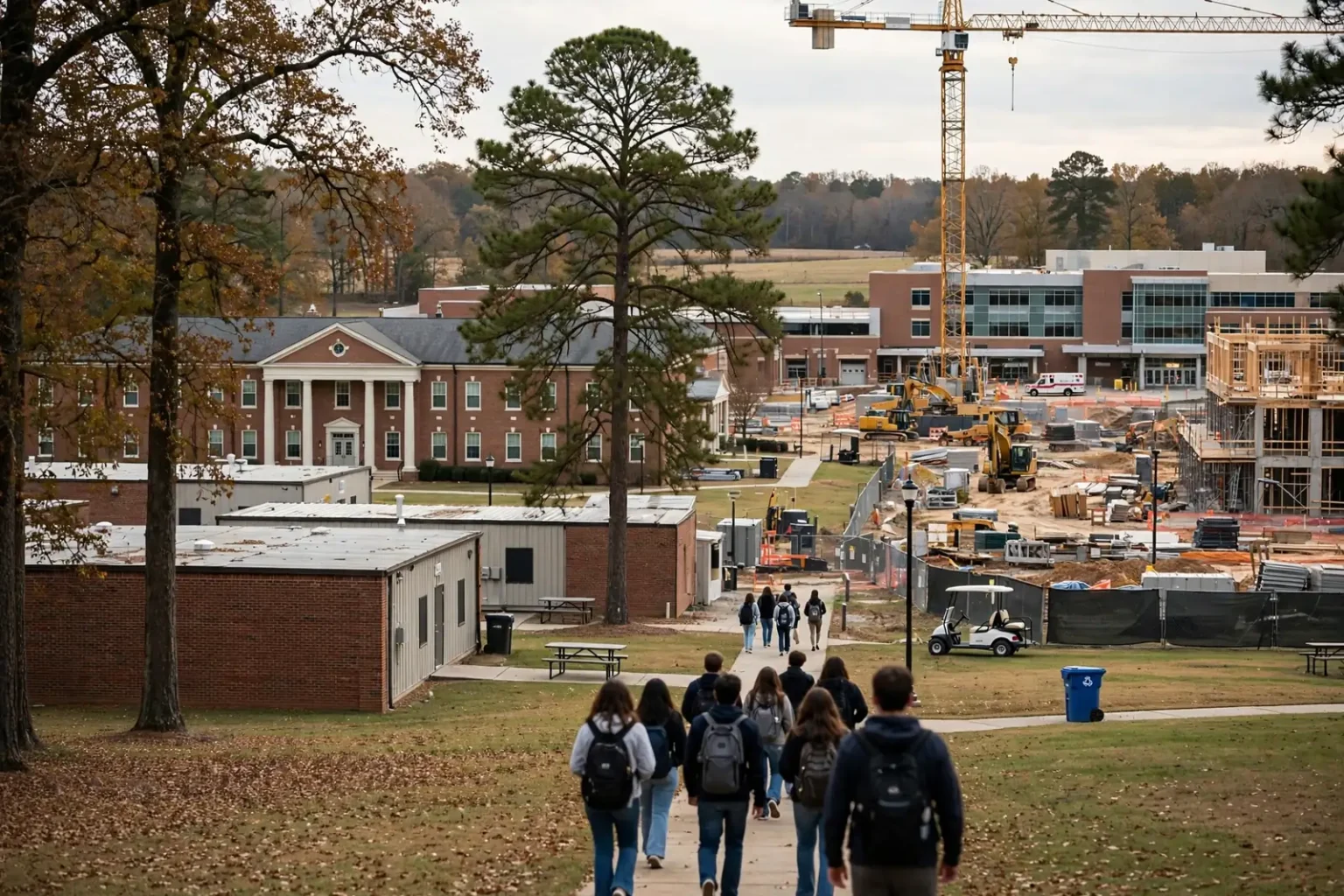
The change comes as the tuition-free public school, known as ASHS, operates from a temporary home at the University of West Alabama in Livingston while crews build its permanent campus in Demopolis. That campus, next to Whitfield Regional Hospital, is scheduled to open to students in August 2027.
A Mobile health leader at the helm
Fox leads USA Health, the academic health system of the University of South Alabama. She is a product of the university herself, having earned her bachelor’s, master’s and doctoral degrees in nursing at South Alabama. Over her career with USA Health she has overseen physician practices and nursing operations and has led efforts to improve access to care across the Gulf Coast.
Her background spans nursing, health care administration and medical education, three areas that line up closely with the school’s mission of steering teenagers toward health careers. Fox was already part of the ASHS board as the University of South Alabama president’s designee, a role South AL News noted in September when she was named to a national list of academic medical center CEOs for the second straight year.
In a statement after her election, Fox said the board’s job now is to build on the work that created the school and keep that momentum going for future classes.
“I am committed to supporting our faculty and staff, strengthening our partnerships, and ensuring that ASHS delivers on its promise to prepare young people for healthcare careers, particularly in the rural communities that need them most,” Fox said.
USA Health is one of the largest employers on the upper Gulf Coast. As of September, the system reported more than 7,200 employees, three hospitals, a cancer institute and more than 40 health care delivery sites. Its physicians also teach medical students and residents through the university’s Frederick P. Whiddon College of Medicine.
A record of recognition
Fox has worked at USA Health since 2011, holding roles that included assistant administrator and chief nursing officer for the USA Health Physicians Group. She is board certified as a pediatric nurse practitioner and holds a Doctor of Nursing Practice degree.
During the COVID-19 pandemic, she helped lead the health system’s testing and vaccination response in partnership with the City of Mobile, work that earned her a Mobile Community Health Leadership Award and an Exceptional Citizenship Award in 2022. That same year she received Alabama’s Top Nurses Lifetime Achievement Award. In 2024 she was one of 42 people nationwide named to a Rising Stars: Healthcare Leaders Under 40 list, and in 2025 and 2026 she was included on a national list of academic medical center CEOs to know.
Warren steps aside after guiding the school’s launch
Warren, who lives in Birmingham, retired as chairman and CEO of Children’s of Alabama. Gov. Kay Ivey appointed him to the ASHS board, and he had served as its first chair since September 2024, a period that took the school from a plan on paper to a functioning campus with students in class.
He said watching the first students arrive and the school begin carrying out its mission had been deeply rewarding.
“What began as an ambitious idea is now an opportunity for young people across Alabama, with even greater promise ahead. Natalie understands both the demands of healthcare and the importance of preparing its next generation. She is exceptionally well suited to lead the board forward,” Warren said.
The board’s new officers
Along with Fox, trustees filled the rest of the board’s executive committee. Most of the officers are returning members; the only newcomer to the committee is Katrina Keefer.
- Chair: Natalie Fox, chief executive officer of USA Health in Mobile.
- Vice chair: Jill Stork, vice president of Alabama Power’s Western Division, based in Tuscaloosa.
- Secretary: Kirk Stephens, a Livingston and Demopolis businessman in the packaging and paper industries who also chairs the ASHS Foundation board.
- Treasurer: Dr. Anupam Agarwal, senior vice president for medicine and dean of the University of Alabama at Birmingham’s Heersink School of Medicine.
- Assistant secretary: Katrina Keefer, president and CEO of DCH Health System in Tuscaloosa.
The lineup brings together leaders from two of Alabama’s academic medical centers, a major regional hospital system, the state’s largest electric utility and the west Alabama business community where the school is being built.
What the Alabama School of Healthcare Sciences is
ASHS is a state-funded public high school that charges no tuition and offers a residential program, so students from anywhere in Alabama can live on campus during the school week. It combines college preparatory academics with specialized instruction and hands-on learning designed to prepare students for careers in health care.
Ivey first proposed the school in her 2023 State of the State address, and lawmakers followed by approving its creation in Demopolis, in the heart of the Black Belt. The location was chosen with a purpose: many rural Alabama counties, including much of west Alabama, have long struggled to recruit and keep doctors, nurses and other health professionals. Supporters of the school argue that students who grow up in or train near rural communities are more likely to practice there later.
The school opened in August with a first class of 79 freshmen and sophomores from 45 Alabama communities, according to Tuscaloosa Thread, with Laura Bailey serving as head of school. Students are spending this year and next on the UWA campus in Livingston before moving to the permanent campus in 2027.
One of four state specialty high schools
ASHS is the newest of Alabama’s four specialty public high schools, each funded by the state and open to students from all 67 counties:
- Alabama School of Fine Arts in Birmingham, the oldest of the group, focused on the arts.
- Alabama School of Mathematics and Science in Mobile, a residential school for students with strong interests in science, technology, engineering and math.
- Alabama School of Cyber Technology and Engineering in Huntsville, which opened in 2020.
- Alabama School of Healthcare Sciences in Demopolis, the most recent addition.
In June 2026, Ivey signed Senate Joint Resolution 84, sponsored by Sen. Arthur Orr, directing the four schools to form a consortium to share information and work together. Administrators from all four met for the first time in August.
Why it matters for south Alabama
Although the school sits well north of the coast, its board chair now comes from the region’s largest academic health system, and its doors are open to students from Mobile, Baldwin, Escambia, Clarke, Monroe and Washington counties. Several of those counties are rural and face the same health workforce shortages the school was created to address.
Fox’s appointment also strengthens the link between ASHS and the institutions that train the state’s health professionals. South Alabama’s colleges of medicine, nursing and allied health train many of the clinicians who practice on the Gulf Coast, and UAB’s Heersink School of Medicine, represented on the executive committee by Agarwal, trains physicians for the entire state. Students who start at ASHS could one day continue their education at either.
How to apply for 2027-28
Applications for the 2027-28 school year opened Oct. 1. Each of the state’s specialty schools runs its own admissions process, with separate requirements and deadlines, so families interested in more than one school must apply to each. School officials encourage families to:
- Review admissions requirements, grade levels and deadlines on the school’s website.
- Schedule a campus visit to meet staff and learn about residential life.
- Ask how weekday living, weekend travel and student support work.
- Submit applications well ahead of posted deadlines.
Because the permanent Demopolis campus is set to open in August 2027, students admitted for next fall would be among the first to attend classes there.
What to watch
Fox takes over the board during a period of rapid change for the young school. Among the issues that will come before trustees in the year ahead:
- The move to Demopolis. Construction of the permanent campus beside Whitfield Regional Hospital is scheduled to wrap up in time for students in August 2027.
- Growing enrollment. The school began with freshmen and sophomores and is expected to add classes as students advance.
- Partnerships. Fox has said strengthening partnerships will be a priority. Hospitals, universities and employers on the board’s executive committee could play a role in clinical experiences and career exposure for students.
- Rural reach. Board leaders have repeatedly tied the school’s success to whether its graduates go on to serve the rural communities that need health workers most.
For Fox, the new role adds to a list of statewide responsibilities. She has also been appointed by Ivey to the Alabama Certificate of Need Review Board, which reviews certain health facility and service projects across the state. At USA Health, she oversees the strategy and operations of the region’s only academic health system while it continues to expand care across Mobile and Baldwin counties.