National GOP, Democratic Committees Trade Fire Over Alabama’s 2nd District Race
National Republican and Democratic campaign committees released dueling statements over Alabama's 2nd Congressional District race following Tuesday's special primary.
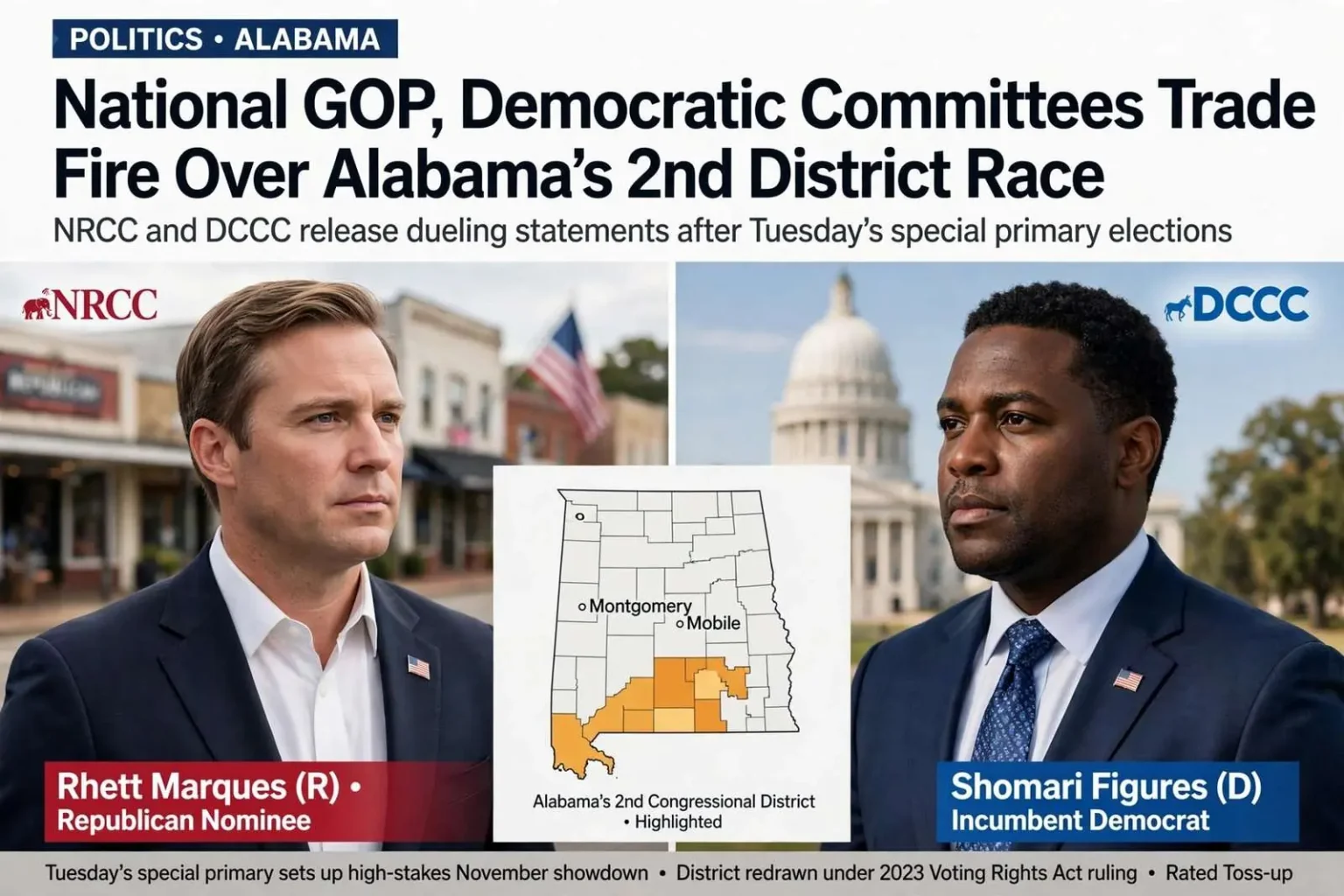
Alabama’s 2nd Congressional District race drew national attention Tuesday, as the National Republican Congressional Committee (NRCC) and the Democratic Congressional Campaign Committee (DCCC) released dueling statements backing their respective candidates and criticizing the opposition following Tuesday night’s special primary elections.
Both Campaigns Respond to Primary Results
NRCC leadership quickly congratulated newly selected 2nd Congressional District Republican nominee Rhett Marques and 1st Congressional District Republican nominee Jerry Carl. In a statement, NRCC Chairman Richard Hudson criticized incumbent U.S. Rep. Shomari Figures, D-Alabama, arguing Marques would work more closely with President Donald Trump on economic and border security issues. “Congratulations to President Trump-endorsed Rhett Marques! Out of touch Shomari Figures has been a disaster in Congress, siding with the extreme Democrat party to push their high-cost, open-border, far-left agenda,” Hudson said. “In Congress, Rhett will show up for Alabamians by helping the President deliver a strong economy, maintain secure borders, and keep men out of women’s and girls’ sports.”
Ahead of poll closures, the DCCC published its “Case Against Rhett Marques,” arguing that Marques, during his time as a state representative, promoted the interests of the ultra-wealthy over everyday Alabamians. “Shomari Figures is the fighter that the people of Alabama need in Congress. He’s laser-focused on the issues that matter most: lowering costs, expanding access to health care, and creating economic opportunity,” DCCC Chair Suzan DelBene said. “While Shomari shows up and puts in the work, his opponent Rhett Marques sells out to the ultra-wealthy who fund his political campaigns.”
The DCCC criticized Marques’ votes to increase Alabama’s gas tax and motor vehicle registration fees, his support for the war in Iran and Trump administration cuts to Medicaid, saying the record showed disregard for the affordability issues Alabamians face. Asked to respond to the NRCC’s statement, the Figures campaign pointed to election night comments in which Figures criticized his opponent’s record on affordability. “The people of Alabama deserve a congressman who will work for them, not against them,” Figures said. “I have delivered over $17 million to the district, including support for our hospitals and our law enforcement, and funds to build affordable housing and improve our water and transportation infrastructure. I’ve also introduced legislation to provide relief for our family farmers and tax relief for Alabama families.”
The DCCC also criticized Marques for comments it described as “disrespecting” Alabamians “by suggesting they are unintelligent,” pointing to remarks he made during a Republican Women of Coffee County panel. When fellow 2nd District Republican candidate David Matthews asked Marques to explain 22 votes he cast in the Alabama House in favor of raising taxes, Marques replied that the measures were local bills affecting counties other than Coffee County and that event attendees “do not understand how local bills work,” before clarifying, “A lot of them do. Some of them do.” Fellow candidate Joshua McKee later criticized the remarks as “questioning Alabama voters’ intelligence.” The Marques campaign had not responded as of Wednesday to requests for comment on the DCCC’s criticisms.
Marques said Tuesday night the 2nd District race is “probably going to be one of the most highly contested races in the country,” adding, “It’s going to be the most watched.” In a statement released Wednesday, he reaffirmed his pledge to return the seat to Republican control: “What a night! AL-02, thank you for trusting me to take Alabama common sense to Congress, put America First, and represent the district we call home. Now, it’s time for Republicans to unite and turn this seat RED in November!”
Figures’ 2024 election, with 55% of the district’s vote, marked the first time in state history that Alabama had two sitting Black members of Congress at the same time. The district was redrawn in 2023 after federal courts, including the U.S. Supreme Court, found the state’s previous congressional map violated the Voting Rights Act of 1965. The Alabama Legislature approved a return to the pre-2023 map during a special session this year, and a subsequent U.S. Supreme Court ruling allowed the state to use it. Despite the district again favoring Republicans, the DCCC argues Democrats have several reasons the seat remains winnable, citing Montgomery turnout in the May 19 primary, declines in Republican turnout in some counties and increased Black voter mobilization. A June poll from Democratic pollster Impact Research showed Figures with 44% support to Marques’ 45% in the district.
Background: Key Terms and Definitions
About the Voting Rights Act
The Voting Rights Act of 1965 is a landmark federal law enacted to prohibit racial discrimination in voting. Originally passed during the civil rights movement, the law outlawed literacy tests and other devices that had been used to disenfranchise Black Americans, and it established federal oversight of election administration in jurisdictions with a history of discrimination. Section 2 of the Act, which bars voting practices that deny or abridge the right to vote on account of race or color, remains a central tool for challenging district maps and election procedures in federal court. Alabama has been the site of numerous Voting Rights Act lawsuits over the decades, particularly concerning the drawing of congressional and legislative districts.
About Congressional Redistricting in Alabama
Congressional district lines in Alabama are drawn by the state Legislature and signed into law by the governor, following each decennial U.S. Census. Because the state’s population and its racial composition shift over time, the maps are periodically litigated. Federal courts, including the U.S. Supreme Court, have repeatedly reviewed Alabama’s congressional maps to determine whether they comply with the Voting Rights Act and the U.S. Constitution. When a map is found deficient, the state may be ordered to adopt a new one, sometimes through a court-appointed special master. Redistricting shapes which communities are grouped together in a given district and therefore influences the competitiveness of federal races.
About the National Campaign Committees
The National Republican Congressional Committee (NRCC) and the Democratic Congressional Campaign Committee (DCCC) are the official campaign arms of their respective parties in the U.S. House of Representatives. Both organizations recruit candidates, raise and allocate funds, conduct polling and opposition research, and coordinate messaging in competitive districts across the country. In closely watched races, the committees often issue parallel statements, run independent expenditure ads, and deploy field programs. Their involvement is a signal that a district is viewed as pivotal to control of the chamber.
About Federal Campaign Finance
U.S. House campaigns are subject to federal campaign finance law administered by the Federal Election Commission (FEC). Candidates must disclose their donors and expenditures in regular reports filed with the FEC, which are public. Individuals, political action committees, political parties, and other groups may contribute within statutory limits, while so-called independent expenditure groups may spend unlimited sums provided they do not coordinate with a candidate’s campaign. Analysts frequently review quarterly FEC filings to gauge a campaign’s financial strength and momentum.
About the U.S. House of Representatives
Alabama is represented by seven members in the U.S. House of Representatives, each elected from a single congressional district for a two-year term. The House is one of two chambers of Congress and shares lawmaking power with the Senate. Control of the House can shift in midterm elections, when the president’s party historically loses seats. Members vote on legislation, serve on committees that review proposed laws, and act as conduits between federal agencies and the constituents they represent.
About Alabama’s Courts
Alabama’s judicial system includes trial courts, the Court of Civil Appeals and Court of Criminal Appeals, the state Supreme Court, and a network of district and circuit courts that handle matters ranging from traffic offenses to serious felonies. Judges in Alabama are elected in partisan races, and the state’s high courts have frequently been involved in election-law disputes, including those arising from redistricting. Cases originating in state trial courts can be appealed through the appellate hierarchy and, where federal questions are presented, may ultimately reach federal courts.
About Alabama State Government
Alabama is governed under a constitution that vests executive authority in a governor, with a bicameral Legislature composed of the House of Representatives and the Senate. State agencies administer programs in areas such as education, transportation, public health, and corrections. The Legislature meets in regular session in Montgomery, the state capital, and may be called into special session by the governor to address specific subjects. Many of the policies debated in Washington originate as state-level decisions that directly affect Alabamians’ daily lives.
About the Regional Economy
The economy of south Alabama is diversified across sectors including aerospace, shipbuilding, healthcare, tourism, agriculture, and port-related commerce. The Port of Mobile is among the largest in the nation by tonnage and supports a wide range of logistics and industrial activity. Major employers include military installations, hospitals, universities, and manufacturing facilities. Economic development organizations at the city and county level work to attract investment and retain jobs, and state incentive programs frequently play a role in site-selection decisions.