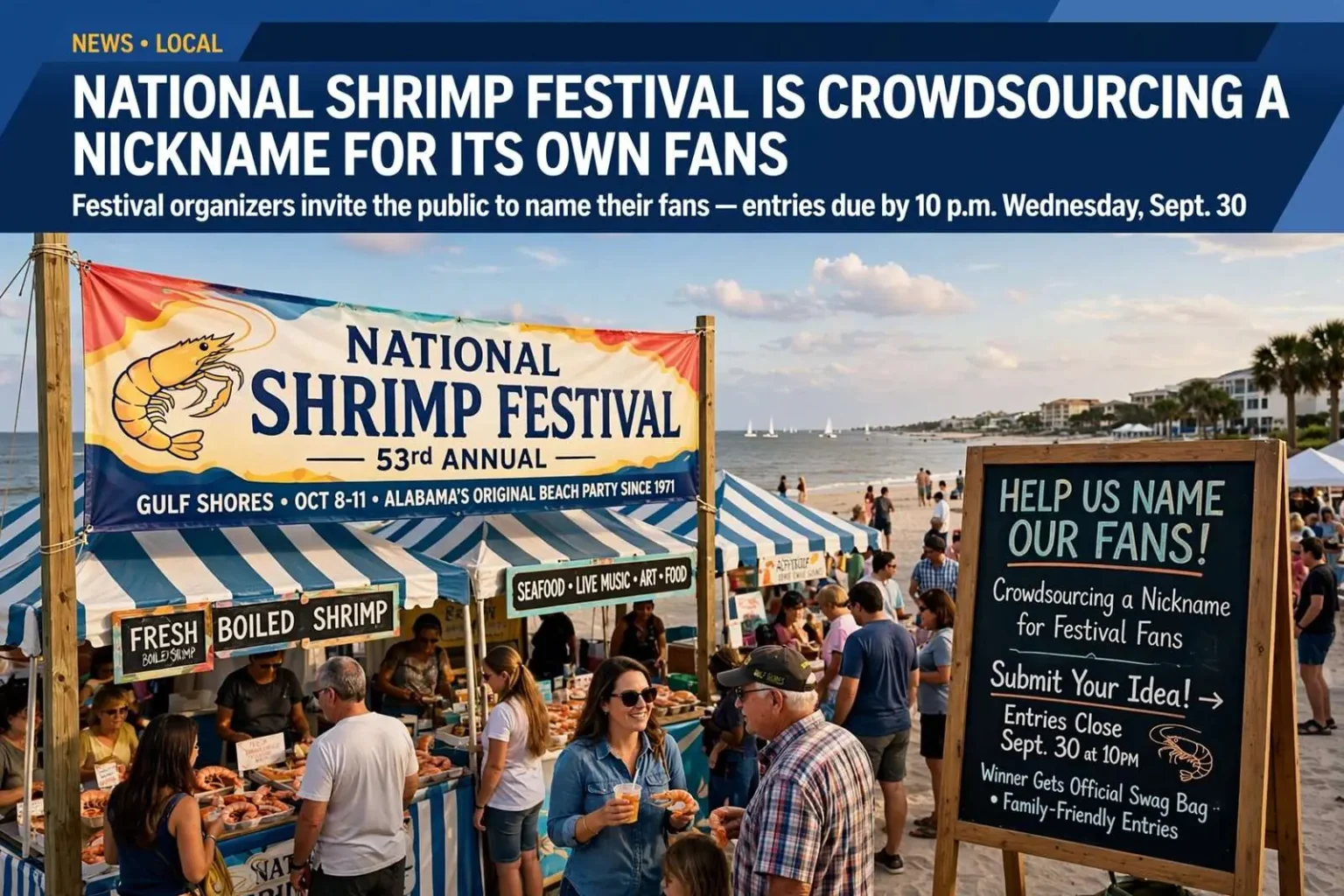
The National Shrimp Festival Is Crowdsourcing a Nickname for Its Own Fans, and Entries Close Sept. 30
Organizers of the National Shrimp Festival have opened an online contest to replace the word 'attendees' with a real nickname for the festival's fans. Entries close at 10 p.m. Sept. 30, ahead of the 53rd festival Oct. 8-11 in Gulf Shores.
Clayton Wallace has been writing announcements for the National Shrimp Festival for more than two decades, and there is one word in them he has never been able to stomach.
“I’ve written announcements for the Shrimp Festival for more than 20 years, and I have always cringed when the people who come down for the festival are referred to as attendees,” said Wallace, the festival’s media chairman.
So the festival is getting rid of the word. Organizers have launched an online contest inviting the public to come up with something better to call the people who come down to the beach in Gulf Shores every October. Entries are due by 10 p.m. on Wednesday, Sept. 30, and the winner will be announced during the week of the festival itself.
The prize is a swag bag from the Official Annual National Shrimp Festival Merchandise Tent.
How the Idea Started
The contest came out of an ordinary planning meeting rather than a marketing plan.
“At a recent staff meeting, we batted around the idea of coming up with a name other than attendees,” Wallace said. Rather than settling on something in the room, staff members decided during that meeting to let festival attendees help decide what to call them.
Festival Co-Chairman Rob Barnas said an online entry form has been set up to collect submissions.
“We want Festival fans to go and submit their ideas for naming themselves,” Barnas said.
“We’re looking forward to receiving some creative names, but we also want to make sure the submissions are family-friendly since we’re a family-friendly event.”
Organizers said entries receiving the winning selection from multiple people will be decided by a random drawing — a practical necessity in any open naming contest, where the most obvious good idea tends to occur to a lot of people at once.
“We have the best fans anywhere,” Barnas said. “We want to give them an original nickname they can be proud of. I can’t wait to see the submissions!”
Why Fandoms Get Names
The impulse behind the contest is older and more commercially serious than a swag bag suggests. Giving an audience a collective name is one of the cheapest and most durable things a brand, a band or an event can do, and the examples are everywhere once you start looking for them.
Grateful Dead followers became Deadheads. Jimmy Buffett’s audience became Parrotheads, complete with a national network of local chapters that outlived the tours that created them. Taylor Swift’s listeners are Swifties. Sports franchises have been doing it for a century, and college programs longer than that.
What those names accomplish is a shift in grammar. “Attendee” describes a transaction: a person who was present at an event. A nickname describes an identity: a person who belongs to something whether or not the gates are open. The first is a customer. The second is a member, and members behave differently. They come back without being asked, they bring people, they buy the shirt, and they defend the thing in public.
For an event that runs four days a year, that distinction is not trivial. A festival has 361 days of silence to fill, and a name gives people something to be during the off-season.
Wallace’s objection to “attendees” is, in that sense, a professional one rather than a stylistic one. It is the language of a headcount, and it flattens the difference between someone who wandered in once and someone whose family has come down every October since the Carter administration.
The Risk in Letting the Internet Name Things
Barnas’ caveat about family-friendly submissions points at the well-known hazard of open naming campaigns: the public is creative, and not always in the direction the organizers had in mind.
The cautionary tale in the field is Boaty McBoatface, the runaway winner of a 2016 online poll to name a British polar research vessel. The ship was ultimately named for Sir David Attenborough; the joke name was attached to one of its remotely operated submarines instead. The episode became shorthand for what happens when an institution hands over the final decision rather than the suggestion box.
The Shrimp Festival’s structure avoids that trap. This is a submission contest, not a popular vote — entries go to organizers, who make the selection, with ties broken by random drawing among the people who submitted the winning idea. That keeps the enthusiasm and the crowdsourced creativity while leaving the final call with the people responsible for the event’s name being on it.
It also produces something a marketing agency generally cannot. The best fan names tend to come from inside the fandom, because they encode a joke or a reference that only regulars would think of. An outsider writing a brand brief would never arrive at “Parrothead.”
A Festival That Predates Most of Its Audience
The 53rd National Shrimp Festival is scheduled for Oct. 8-11 in Gulf Shores and is organized by the Coastal Alabama Business Chamber. Billed as Alabama’s original beach party, it has been a local tradition since 1971.
That longevity is the reason a nickname contest makes sense here rather than at a first-year event. Fifty-two previous festivals have produced multigenerational habits — families that book the same week every year, vendors who have worked the same corner for decades, and a considerable number of people who can tell you what the festival looked like before the current stage setup existed. A crowd like that already thinks of itself as a group. It just does not have a word for it.
The festival is expected to feature food, art and live music across its four days, and organizers said activities, vendors and this year’s music lineup are posted on the festival’s official website.
Running it falls to the Coastal Alabama Business Chamber, which is an increasingly common arrangement for events of this size. Chambers of commerce have the membership rolls, the volunteer base and the relationships with municipal government that a large public event requires, and they have a direct institutional interest in the outcome, because the businesses that benefit from a full October weekend are the same businesses that pay the dues.
Why October Matters More Than It Looks
The timing of the festival is not incidental to the local economy. Early October sits in what the tourism industry calls the shoulder season — the weeks on either side of the summer peak, after the school-vacation surge has ended and before the winter long-stay visitors arrive.
Shoulder-season weeks are the hardest ones for a beach destination to fill, and they are also the most valuable ones to fix. Coastal Alabama’s summer business is largely self-sustaining: families come in June and July because school is out and the water is warm, with or without programming. October requires a reason.
Weather is part of the reason. Gulf water stays warm well past Labor Day, daytime temperatures ease out of the summer range, humidity drops, and the beach is dramatically less crowded than it is in July. Fishing is strong. Rates are lower. For a certain kind of visitor, it is the best month of the year on the Alabama coast, and the main obstacle is that most people never think to come.
A major festival solves that. It puts a fixed date on the calendar that people can plan a trip around, and it fills lodging, restaurants and shops during a stretch that would otherwise run soft. That is why chambers of commerce and destination marketing organizations across the country concentrate their event calendars in the spring and fall rather than in the peak of summer, when the rooms are going to sell anyway.
The lodging math is what makes the effort worthwhile. A destination with a large inventory of condominiums and hotel rooms carries essentially the same fixed costs in October that it carries in July — the same buildings, the same maintenance, much of the same staff. Nights that go unsold are not recovered later. Any event that reliably converts a soft weekend into a sold-out one is doing more for the annual ledger than its ticket sales alone would suggest.
The economic reach of a fall festival extends well past the festival grounds. Visitors who come for a weekend of shrimp and live music also book condos, buy groceries, charter boats, fill gas tanks and eat several meals somewhere other than a festival booth. For seasonal workers, an October event means scheduled hours in a month that historically offered fewer of them.
What a Nickname Is Worth
None of that is what the contest is for, exactly. Nobody is going to book a beach house because a festival gave its fans a name. But engagement campaigns like this one are aimed at a real problem in event marketing: a festival that talks to its audience only in the weeks before the gates open is starting from a standstill every year.
A naming contest is a low-cost way to generate contact in the off-weeks. It asks for participation instead of attention, it produces submissions that people share on their own, and it hands the organizers a piece of language they can use in every announcement for years afterward. Once a name exists, it appears on merchandise, in social media posts, on signage and in exactly the kind of press release Wallace has spent twenty years writing.
There is also a durability argument. Festival staffs turn over, sponsors change, stages move and lineups vary from year to year. A fan name is one of the few assets that costs nothing to maintain and gets stronger the longer it is used, because its value is entirely in recognition. The names that stick tend to be short, sayable, slightly absurd, and specific enough that they could not belong to any other event.
How to Enter
Submissions are made through the online entry form set up by festival organizers. Entries must be in by 10 p.m. on Wednesday, Sept. 30. Organizers ask that submissions be family-friendly, in keeping with the character of the event. If the same winning name is submitted by more than one person, the winner will be selected by random drawing.
The winner will be announced during the week of the festival and will receive a bag of items from the Official Annual National Shrimp Festival Merchandise Tent.
The 53rd National Shrimp Festival runs Oct. 8-11 in Gulf Shores. Whoever comes will finally have something to be called.