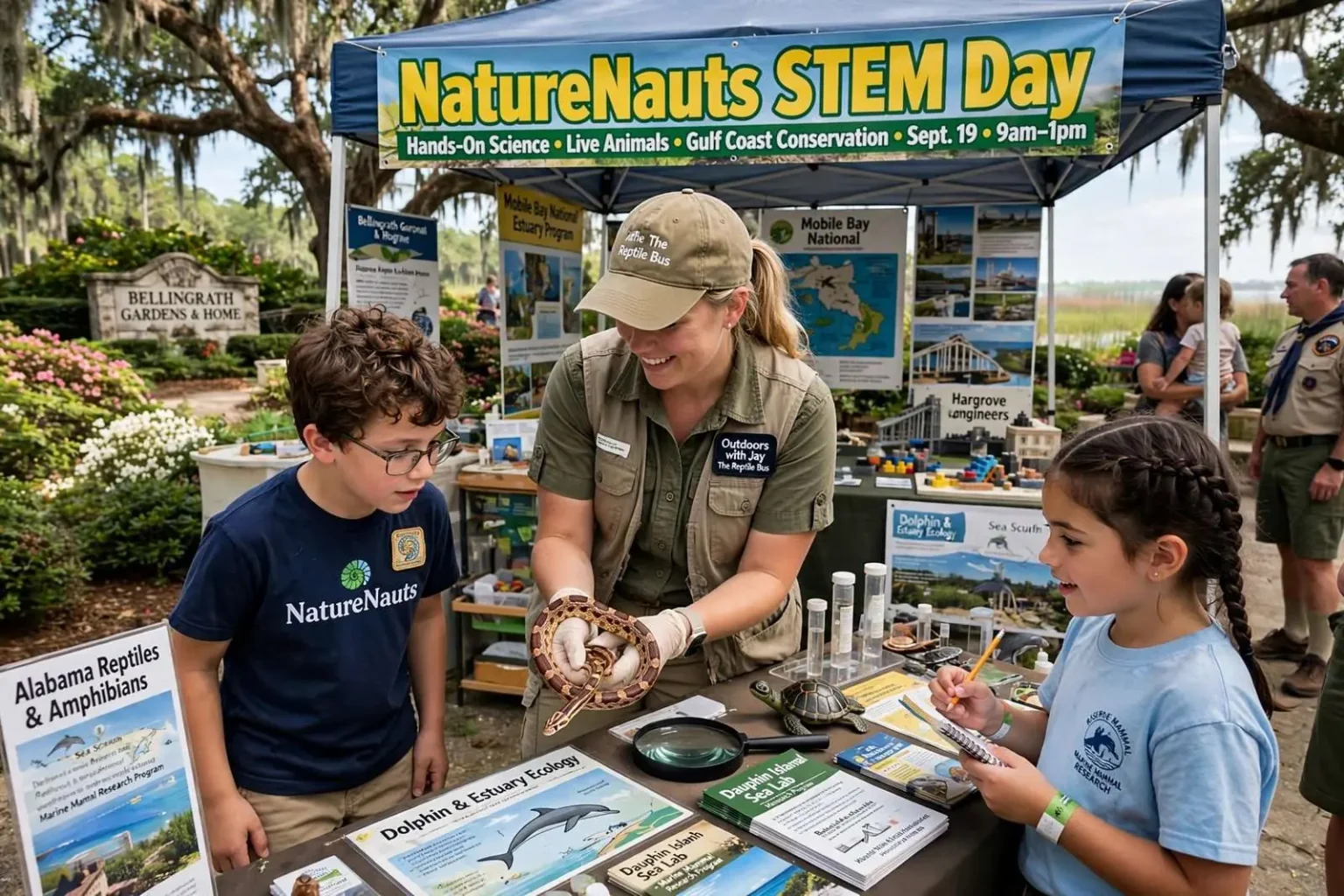
THEODORE — A garden estate better known for azaleas and Christmas lights will spend a Saturday morning this month handing itself over to reptiles, river guides, marine mammal researchers and engineers.
NatureNauts STEM Day is scheduled for Saturday, Sept. 19, from 9 a.m. to 1 p.m. at Bellingrath Gardens & Home in Theodore. Organizers describe it as a family-friendly event built around interactive exhibits, live animal encounters and activities hosted by organizations from across the Gulf Coast.
The format is simple and deliberately unstructured: rather than a lecture or a single demonstration, visitors move between stations staffed by the people who actually do the work — the biologists, educators, park interpreters and engineers whose jobs depend on the coastal systems that surround Mobile County.
Who Is Setting Up a Station
The list of participating vendors and organizations spans conservation groups, research institutions, youth programs, museums and private industry.
Confirmed participants include Historic Blakeley State Park’s Delta Explorer River Cruises, The Reptile Bus with Outdoors with Jay, the Alabama Wildlife Foundation Delta and Bay Conservation Center, Evonik, Sea Scouts, Rebuilding Together of South Alabama, the Mobile Bay National Estuary Program, the Dauphin Island Sea Lab’s Marine Mammal Research Program, the Lynn Meadows Discovery Center, Hargrove Engineers, Alabama Audubon and the Alabama Coastal Foundation.
That mix is worth reading closely, because it maps fairly neatly onto the working landscape of the northern Gulf Coast. The delta, the bay, the barrier islands and the industrial corridor along the Mobile River are all represented by someone who studies, protects or builds in them.
Reptiles, Marine Mammals and Birds
The live animal component is usually the draw for younger visitors. The Reptile Bus, presented with Outdoors with Jay, brings snakes, lizards and other reptiles into direct contact with an audience — a format that consistently does something a textbook cannot, which is to replace a child’s inherited fear of a snake with curiosity about it.
Alabama is unusually rich in reptile and amphibian diversity. The state’s combination of coastal plain, river systems, longleaf pine uplands and wetlands supports a large number of native species, and most of the snakes a Mobile County resident is likely to encounter are non-venomous. Programs that teach identification — how to tell a harmless watersnake from a cottonmouth, for instance — have a practical safety payoff on top of the science.
The Dauphin Island Sea Lab’s Marine Mammal Research Program works on the other end of the size scale. The Sea Lab, located on Dauphin Island at the mouth of Mobile Bay, is Alabama’s marine science education and research institution, serving a consortium of the state’s colleges and universities. Its marine mammal work involves the bottlenose dolphins that live in and around Mobile Bay and the coastal Gulf, along with response to stranded animals along the Alabama coast. Stranding data is one of the primary tools scientists use to track the health of a coastal ecosystem, because dolphins are long-lived predators near the top of the food web and accumulate the effects of what happens below them.
Alabama Audubon rounds out the animal side with birds. The Alabama coast sits along a major migratory corridor, and the beaches, marshes and maritime forests of Baldwin and Mobile counties function as critical stopover habitat for songbirds crossing the Gulf of Mexico each spring and fall.
The Delta and the Bay
Several participants work specifically on the Mobile-Tensaw Delta, the vast network of rivers, swamps, bottomland hardwood forest and marsh north of Mobile Bay. It is one of the largest river deltas in the United States and among the most biologically diverse places in North America, with exceptional numbers of fish, mussel, turtle and plant species.
Historic Blakeley State Park, across the bay in Baldwin County, runs its Delta Explorer river cruises into that system. The park itself sits on the site of the 19th-century town of Blakeley and the Civil War battlefield at Fort Blakeley, and its boat tours are one of the more accessible ways for a family without a vessel to actually get out onto the delta’s waterways.
The Mobile Bay National Estuary Program approaches the same water from a policy and restoration angle. National estuary programs were established under the Clean Water Act to coordinate the federal, state, local and private partners working in a single estuary, and their work typically includes shoreline restoration, stormwater and sediment management, watershed planning and public education. The Mobile Bay program covers the bay and its coastal watersheds.
The Alabama Coastal Foundation and the Alabama Wildlife Foundation Delta and Bay Conservation Center bring additional conservation and outdoor education programming to the same set of resources.
Engineering, Scouting and Service
Not every table will be about animals. Evonik and Hargrove Engineers represent the technical and industrial side of the region’s economy, where chemistry, process engineering and design work translate STEM coursework into careers that exist within driving distance of the event.
That presence matters for an audience of parents. Coastal Alabama’s economy runs on shipbuilding, aerospace, chemicals, logistics and the port, and those industries hire engineers, technicians and skilled trades. A child who spends 20 minutes at an engineering table has been shown, concretely, that the math homework connects to a paycheck somewhere down the road.
Sea Scouts, the maritime-focused youth program, offers a path into boating, seamanship and water safety. Rebuilding Together of South Alabama, the local affiliate of a national nonprofit that repairs homes for low-income homeowners, brings a service and construction dimension. The Lynn Meadows Discovery Center, a children’s museum on the Mississippi Gulf Coast, contributes the museum world’s expertise in designing activities that hold a seven-year-old’s attention.
Why Bellingrath Is the Setting
Bellingrath Gardens & Home occupies a large estate on the Fowl River in Theodore, southwest of Mobile. It began as the country home of Walter and Bessie Bellingrath and opened to the public in the 1930s, and it has operated ever since as a public garden with formal plantings, woodland areas and river frontage.
That combination — manicured gardens next to genuine coastal river habitat — makes it a natural host for an event of this kind. A visitor can walk from a rose garden to the edge of a tidal river in a few minutes, which is a useful thing when the day’s theme is how built landscapes and natural ones sit next to each other along the Gulf Coast.
What Informal Science Days Are Actually For
Events like NatureNauts fall into what educators call informal science learning: science education that happens outside a classroom, without grades, tests or a required curriculum.
The research consensus on this kind of programming is not that a child memorizes more facts at a science day than in school. It is that interest, identity and persistence are shaped substantially by out-of-school experiences. Children decide early whether science is something people like them do, and a morning spent holding a snake, steering a conversation with a working biologist or looking at a delta from the deck of a boat is disproportionately influential in that decision.
The presence of so many organizations in one place also serves the parents. Most of the groups involved run their own year-round programming — camps, cruises, volunteer days, citizen science projects, membership programs — and a single morning is an efficient way to find out what exists within an hour’s drive.
If You Go
NatureNauts STEM Day runs from 9 a.m. to 1 p.m. Saturday, Sept. 19, at Bellingrath Gardens & Home in Theodore. The event is described as family-friendly, with interactive exhibits, live animal encounters and activities hosted by the participating Gulf Coast organizations.
Visitors planning to attend should check with Bellingrath Gardens directly for details on admission, parking and the day’s schedule of activities.