Neo Soul Star Maxwell Brings ’50 Intimate Nights’ Tour to Mobile’s Saenger Theatre
Neo soul pioneer Maxwell brings his '50 Intimate Nights Live Tour' with special guest Marsha Ambrosius to Mobile's Saenger Theatre on Oct. 14.
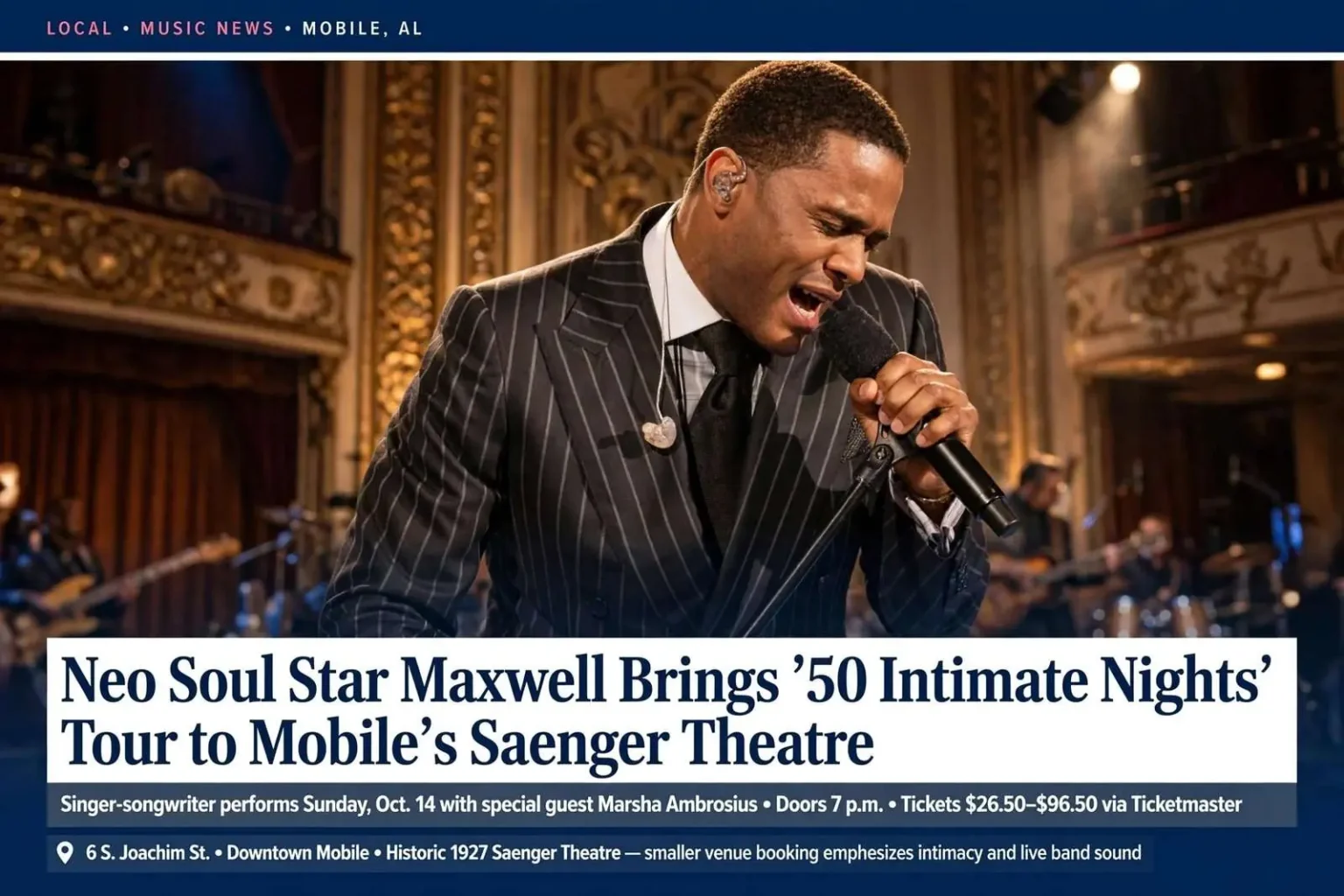
One of the founding voices of the neo soul movement is bringing an intimate night of music to downtown Mobile. Singer-songwriter Maxwell performs at the Saenger Theatre on Sunday, Oct. 14, with special guest Marsha Ambrosius, as part of his “50 Intimate Nights Live Tour.” Doors open at 7 p.m. at the theater, located at 6 S. Joachim St., with tickets ranging from $26.50 to $96.50 through Ticketmaster.
The Saenger stop is one of the smaller venues on the tour’s routing, and that is by design. Rather than filling arenas, Maxwell has deliberately booked theaters in the 2,000-seat range across the country, choosing rooms where the sight lines are short and the acoustics favor a live band over a prerecorded production. For Gulf Coast fans, the Mobile date means a chance to see an artist who has headlined arenas in larger markets in a setting closer to a club show than a stadium spectacle.
An intimate room on Joachim Street
The Saenger Theatre has long been a fixture of downtown Mobile’s entertainment district. The restored movie palace opened in 1927 as one of the grand houses of the South and now serves as the city’s principal downtown venue for touring concerts, Broadway productions and comedy acts. Its ornate interior and modest capacity have made it a favorite stop for performers who want proximity to their audience, and the venue routinely draws ticket buyers from across the Gulf Coast, including New Orleans, Pensacola and the Baldwin County communities across Mobile Bay.
For downtown businesses along Joachim, Dauphin and Government streets, a Sunday-night show at the Saenger is a reliable draw as well. Restaurants and bars in the LoDa entertainment district typically see a spike in traffic before and after performances, and the theater’s location a few blocks from Bienville Square puts it within walking distance of much of the city’s nightlife. Visitors coming from outside Mobile County will find the theater a short drive from the Bankhead and Wallace tunnels, with surface lots and garages scattered throughout the downtown core.
Ticket prices for the Mobile date run from $26.50 for upper-balcony seats to $96.50 for the prime lower-floor sections, placing the show within reach of a broad audience. Given the theater’s size, the least expensive seats still sit comparatively close to the stage, a fact that has historically made Saenger shows popular with fans priced out of arena tours.
From his debut album to a devoted following
Since his debut album, Maxwell has built a following with a smooth, passionate brand of R&B rooted in the soul sounds of the 1970s. Emerging from the New York music scene in the mid-1990s, he helped define a sound that paired live instrumentation and classic soul songwriting with the sensibility of the hip-hop generation. His breakout record, “Maxwell’s Urban Hang Suite,” arrived as a fully realized concept album about love and desire and is now routinely cited among the defining R&B releases of its decade.
The tour blends crowd favorites with deep cuts pulled from across his catalog, spanning from his breakout “Maxwell’s Urban Hang Suite” to his more recent “BLACKsummers’night” project, giving longtime fans and newer listeners alike a set list built for true fans. That catalog spans more than two decades of recordings, and Maxwell has built a reputation for performing with a full live band rather than leaning on backing tracks, a choice that fits the “intimate nights” framing of the tour’s name.
For Mobile audiences, the pairing with Marsha Ambrosius adds a second chapter of the neo soul story to the bill. Ambrosius first gained wide attention as one half of the England-born duo Floetry, whose blend of sung vocals and spoken “flowetry” became a staple of the era’s R&B playlists, and she has since built a solo career as a singer and songwriter. Her presence on the tour gives the evening the feel of a generational showcase rather than a single-artist billing.
Reflecting on the neo soul movement
In a recent interview ahead of the tour, Maxwell reflected on his role in helping shape the neo soul sound of the 1990s, crediting the movement to a group of artists including D’Angelo, Erykah Badu, The Fugees and Mary J. Blige. He said he sees neo soul as part of a broader, ever-evolving soul tradition that continues today through movements like Afropunk.
“I see neo soul as a movement of not only hip-hop and hip-hop/soul, but I also see it continuing in the current movement that I see today, which is the Afropunk movement,” Maxwell said. “I think it’s just another label within a tradition that is soul music, which is always ever-evolving.”
The observation gets at a long-running debate among listeners and critics. “Neo soul” was never a sound the artists themselves set out to codify; it was a marketing label applied from the outside to a wave of late-1990s musicians who shared an aesthetic rather than a formula. What united them was a return to the values of classic soul — live bands, rich harmony, songs about love and community rather than confection — delivered by artists who had grown up on hip-hop. Two decades on, Maxwell’s framing of the label as one entry in a continuous soul lineage is one many of his peers have echoed.
His decision to place the Afropunk movement inside that lineage is telling. Afropunk began as a documentary and grew into a festival culture celebrating Black artists who work outside the mainstream’s expectations, with editions in the United States, Europe and Brazil. The festival scene has become one of the primary places where younger audiences encounter veterans of the neo soul era alongside newer acts, and Maxwell’s appearance there is part of a broader pattern of legacy artists finding renewed energy on the festival circuit.
Afropunk Paris and a young crowd
Maxwell recently performed at Afropunk Paris, an experience he described as one of the more memorable moments of his career, both because of the timing, the show fell on the day France won the World Cup, and because of the young age of the crowd. He said seeing fans in their early 20s embracing music he recorded decades earlier was a powerful reminder of how his catalog has carried across generations.
That cross-generational reach is visible in streaming-era data and in the makeup of his touring crowds, where listeners who first heard “Maxwell’s Urban Hang Suite” as teenagers now attend shows with children of their own. Songs from the 1990s have found second lives through playlists, social media and sampled references, and artists from the neo soul cohort have generally benefited from the rediscovery. For a theater-scale tour like “50 Intimate Nights,” that means a house split between fans who have followed the catalog for twenty years and younger attendees hearing the material performed live for the first time.
The French date also underscored how far the audience for American soul has stretched. Paris has long been one of the strongest European markets for R&B and soul touring acts, and the Afropunk festival’s arrival there drew crowds from across the continent. Falling on the day of a national celebration only amplified the atmosphere, turning the performance into something closer to a shared civic event than a standard tour stop.
A new single and what comes next
The singer also discussed his latest single, “The Glass House (We Never Saw It Coming),” which he said was inspired in part by his reflections on the world around him. The single represents his most recent studio work and arrives as Maxwell continues to shape the next phase of a catalog that has been defined by long gaps between releases and a deliberate, album-first approach to his art. He has never been a prolific singles artist; instead, his releases tend to arrive as complete statements, which has helped sustain interest in his records long after their initial release.
The “50 Intimate Nights” tour itself follows that pattern of patience over volume. Rather than a heavy routing of back-to-back arena dates, the tour strings together selected theater performances, each built around a full live show. The title’s reference to fifty nights frames the run as a limited engagement, and the Mobile date falls within a broader swing that touches markets across the eastern half of the country.
What Mobile audiences can expect
Attendees on the tour can expect a program that runs the length of the catalog. Early-decade staples like “Sumthin’ Sumthin'” and “Ascension (Don’t Ever Wonder)” from the debut era share the set list with the mid-career hits that made “BLACKsummers’night” a multi-year commercial presence, along with the newer material. Maxwell’s live arrangements tend to stretch and reinterpret the recorded versions, with extended instrumental passages that lean on his band’s rhythm section — a quality that suits the Saenger’s acoustics particularly well.
Special guest Marsha Ambrosius opens the evening, giving the show a two-act structure that covers both the American and British wings of the neo soul story. Her set typically draws on the Floetry songbook as well as her solo material, and the pairing has been a fixture of this tour’s routing.
For residents of Mobile, Baldwin County and the broader Gulf Coast, the date is one of the more significant R&B bookings in the region this season. Mobile’s position between New Orleans and Pensacola has historically made it a mid-point stop for tours crossing the Gulf South, and the Saenger’s calendar regularly captures acts that bypass larger cities’ bigger rooms in favor of a theater setting. Sunday’s show continues that pattern.
Getting there and getting in
Doors open at 7 p.m. at the Saenger Theatre, 6 S. Joachim St. in downtown Mobile. Tickets range from $26.50 to $96.50 and are available through Ticketmaster. As with any downtown Mobile event, patrons should allow time for parking; the theater is surrounded by surface lots, and the streets around Joachim and Dauphin fill quickly in the hour before showtime.
The show’s Sunday placement gives out-of-town fans an easy travel day, with the theater a short trip from the Interstate 10 exits into downtown and walkable from several hotels in the city center. For those crossing Mobile Bay from the Eastern Shore, the Baltzell and Bankhead tunnel routes put the venue within roughly half an hour of most of Baldwin County’s population centers in light traffic.
For a career built on the idea that soul music is always evolving, an intimate Sunday night in a restored 1927 theater may be the most fitting setting there is. The lights go down at the Saenger on Oct. 14, and downtown Mobile will once again host a chapter of a tradition that, as its founding voice puts it, never stops moving.