New 130/80 Threshold Redefines High Blood Pressure — What a Mobile Cardiologist Advises
Updated AHA guidelines redefine hypertension at 130/80. A Mobile cardiologist explains what the new threshold means and how patients should respond.
Millions more Americans now technically have high blood pressure under updated guidelines that lower the hypertension threshold from 140/90 to 130/80, and a Mobile cardiologist says the change puts the burden squarely on patients to know their own numbers.
Under the new definition, any reading at or above 130 systolic (the top number) or 80 diastolic (the bottom number) counts as high blood pressure. The previous thresholds had been in place since 1993. Announced at an American Heart Association conference in Anaheim, California, the change adds roughly 30 million Americans to the ranks of those with hypertension — meaning nearly half of all U.S. adults now qualify.
Local Doctors Urge Home Monitoring
Dr. Ritesh Gupta, a cardiologist with Rihner, Gupta & Grosz Cardiology in Mobile, said the streamlined categories are useful but shift responsibility toward patients.
“I think these guidelines are very useful in streamlining management of hypertension… it makes it easier by cutting down on the number of categories,” Gupta explained. “But it’s also putting more responsibility back on the patient in terms of taking measurements at home.”
Doctors stress that only about 2 percent of people newly classified as hypertensive need medication right away; for most, lifestyle changes come first. That means watching salt intake, exercising regularly, and getting enough sleep.
The Silent Killer
High blood pressure often produces no symptoms, earning it the nickname “silent killer.” It is the second-largest contributor to preventable deaths from heart disease and stroke, which is why physicians across the Gulf Coast are encouraging patients to check their readings at home rather than waiting for symptoms to appear.
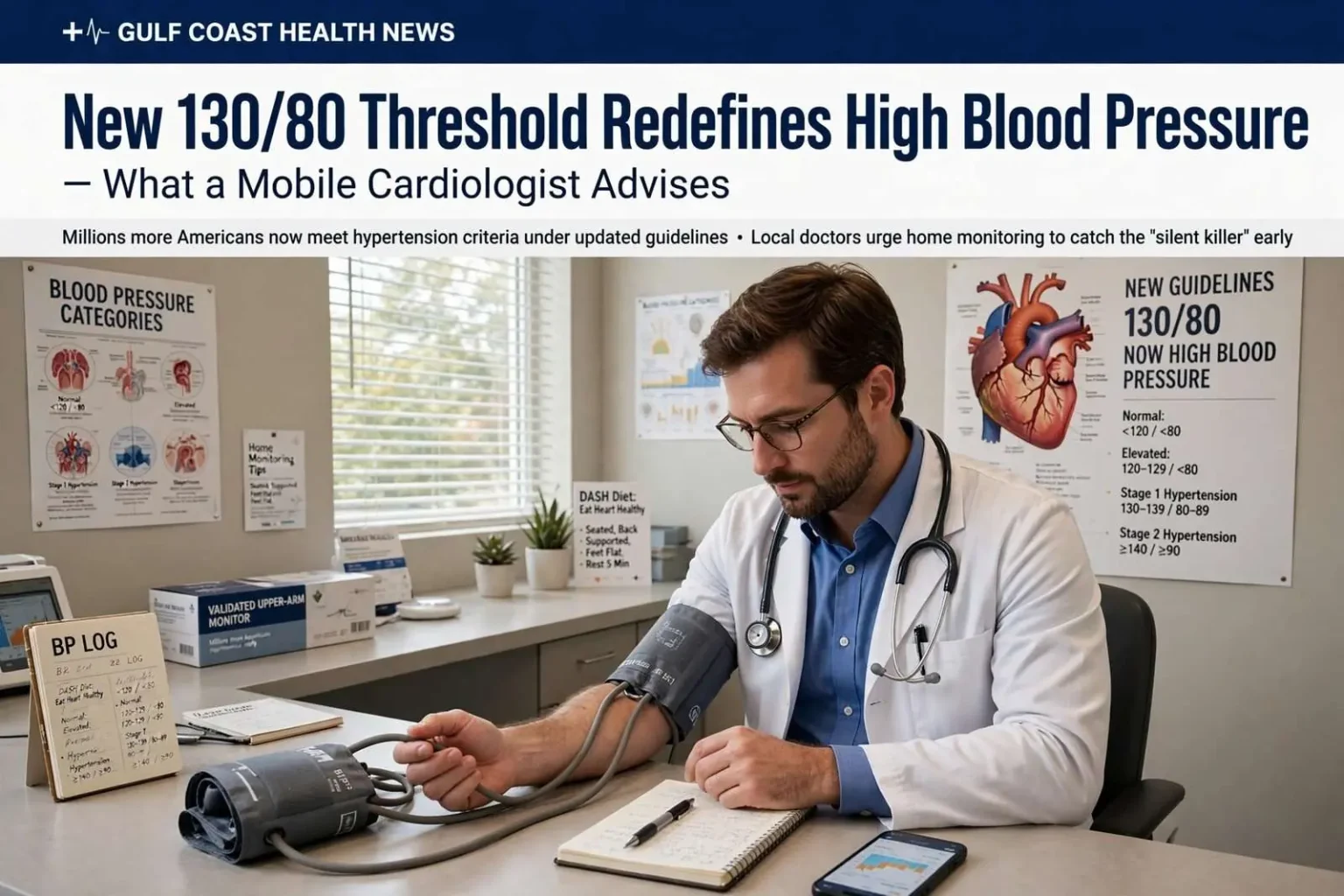
The guideline change, the first comprehensive revision of American blood pressure standards in fourteen years, was issued jointly by the American Heart Association and the American College of Cardiology, with nine other professional societies endorsing it. The new framework eliminated the old “prehypertension” category — a label that had confused patients since its 2003 introduction — and replaced it with two elevated categories: “elevated” blood pressure for readings above 120 systolic, and “stage 1 hypertension” for the 130–139 systolic range that now defines the threshold. Stage 2 hypertension begins at 140 systolic, the level that was previously the starting point for any diagnosis at all. The restructuring was intended to simplify what doctors do with a given reading and to communicate risk more honestly to patients whose numbers had long been described as “borderline” when the evidence suggested otherwise.
The evidence behind the shift came principally from the SPRINT trial, a large National Institutes of Health study whose results, published in 2015, changed the field’s understanding of how low blood pressure targets should go. SPRINT found that intensive treatment — targeting a systolic pressure below 120 in high-risk adults — produced measurable reductions in cardiovascular events and deaths compared with standard targets, despite some increase in side effects like dizziness and electrolyte abnormalities. The trial’s findings gave the guideline writers the data to argue that the old 140/90 threshold allowed damage to accumulate in the years before treatment began, and that intervening at 130 or above — particularly in patients with existing cardiovascular disease, diabetes, or kidney disease — prevented heart attacks, strokes, and deaths that the older standard had written off as acceptable risk.
The reclassification’s arithmetic — some 30 million additional Americans, pushing hypertension prevalence toward half the adult population — landed differently across the country’s regions. In the Deep South, where hypertension rates have led the nation for decades, the new threshold expanded an already enormous affected population. Alabama and its Gulf Coast neighbors consistently rank among the states with the highest blood pressure, obesity, and cardiovascular mortality rates, a convergence that public health officials attribute to diet patterns, lower physical activity levels, reduced access to preventive care, and the region’s elevated rates of diabetes and kidney disease. For a Mobile cardiologist’s practice, the new categories mean that a substantial share of patients previously told their readings were “high normal” now carry a hypertension diagnosis — a shift in the conversation that begins at the front desk and runs through every treatment plan.
Dr. Gupta’s emphasis on home monitoring reflects a central change in how the new guidelines expect hypertension to be managed. Clinical blood pressure readings — taken in a doctor’s office on a single day — are subject to white-coat effects that inflate readings by 10 points or more, and the new guidelines place greater weight on out-of-office measurements: home cuff readings taken properly, or 24-hour ambulatory monitoring, before a stage 1 diagnosis triggers treatment decisions. The proper technique matters — seated, back supported, feet flat, arm at heart level, after five minutes of rest, with two readings a minute apart, morning and evening over several days. Physicians recommending home monitors point patients toward validated upper-arm cuff devices rather than wrist models, and toward logging readings rather than trusting memory, since the record is what informs the clinical decision.
The guideline’s staged approach to the newly diagnosed is why only a small fraction of the newly classified need immediate medication. For a patient with stage 1 hypertension and no cardiovascular disease, diabetes, or ten-year risk above 10 percent, the recommended intervention is lifestyle: the DASH diet — rich in fruits, vegetables, and low-fat dairy, and proven in trials to lower systolic pressure by 8 to 14 points — plus sodium reduction toward 1,500 milligrams daily, regular aerobic exercise, weight loss where applicable, alcohol moderation, and smoking cessation. Each element contributes its own measurable reduction, and for many patients the combination brings readings below the new threshold within months. Medication enters the algorithm for patients whose lifestyle changes fail, whose baseline risk is higher, or whose readings exceed 140 — the point at which the evidence for drug treatment is strongest.
What “silent killer” means in practice is the cumulative damage hypertension does to organs that never complain until they fail. Chronically elevated pressure injures the endothelium — the lining of the arteries — accelerating atherosclerosis that narrows the coronary vessels and the vessels of the brain and kidneys. The heart thickens under the load of pumping against resistance, enlarging toward failure; the kidneys’ filtering units scar; the small vessels of the eye and brain rupture or occlude. Hypertension contributes to roughly half of all strokes and heart attacks, and it is the leading modifiable risk factor for the heart failure that fills Gulf Coast hospital beds. The absence of symptoms through all of this is why the diagnosis depends on the cuff — and why the patients who measure their blood pressure regularly are, in the guidelines’ logic, the ones who catch the disease while it is still a risk factor rather than an event.
The mobile-home-monitoring advice carries particular weight for the region’s older and rural populations, for whom a trip to a clinic means distance and cost. A $30 to $50 home cuff, used properly, substitutes for that trip in the routine management of a chronic condition, and telemedicine platforms increasingly let physicians review home readings between visits. For the population the new guidelines newly classify — often younger adults in their 30s and 40s who had never considered themselves at risk — the first intervention is information: knowing the numbers, understanding what they mean, and treating the diagnosis as the early warning it is rather than a verdict. Gupta’s formulation — that the responsibility has shifted to patients — is both a burden and an opportunity: the guidelines give patients more to do, but they also give them the measurement tools and the lifestyle levers that determine whether a diagnosis of stage 1 hypertension becomes a lifelong medication regimen or a chapter that closes with lifestyle change.
For patients deciding what to do with a new diagnosis, the local advice converges on the same sequence the guidelines prescribe: confirm the readings at home with proper technique; calculate cardiovascular risk with a physician; commit to the lifestyle changes that lower pressure without a prescription; and return for the follow-up that determines whether those changes worked. The threshold’s change from 140/90 to 130/80 reclassified millions — but its purpose, as the cardiologists explaining it emphasize, is not to medicate the population. It is to start the conversation ten points earlier, at the stage where the silent killer can still be silenced by the patient’s own habits, before the damage that no symptom announces is done.
The economics of hypertension in Alabama give the clinical advice a public-health dimension. The state’s Medicaid population, its rural counties with few cardiologists, and the health-disparities data that consistently show Black Alabamians suffering hypertension’s consequences at higher rates and younger ages all shape how a guideline change ripples through the state’s health system. Community health centers, pharmacy-based screening programs, and church-based health ministries — the infrastructure through which much of the Gulf Coast’s preventive care actually reaches people — became the front line for the new threshold’s message, since the patients least likely to see a cardiologist are the most likely to benefit from knowing their numbers early. National data showing that only about half of hypertensive Americans have their condition controlled under any threshold suggests the scale of work the new standard implies: control rates depend on diagnosis, treatment, and the months of follow-up that turn a prescription into a normalized reading.
The salt-exercise-sleep triad that the local doctors recommend maps onto measurable physiology. Dietary sodium raises blood pressure in salt-sensitive individuals — a trait more common in older adults, Black patients, and people with diabetes — while the potassium in fruits and vegetables counteracts it, which is why the DASH diet’s effect exceeds sodium reduction alone. Aerobic exercise lowers systolic pressure by 5 to 8 points through vascular adaptations that begin within weeks of a regular walking program. Sleep matters through the nervous system’s overnight regulation of vascular tone: chronic short sleep and untreated sleep apnea — itself common in hypertension patients — blunt the nighttime pressure drop that healthy cardiovascular systems show. None of these levers is exotic; the clinical challenge is that each requires behavior sustained over months, in a food and built environment that makes the defaults easy rather than healthy.
The patient’s first home cuff reading, done properly, is where the new guidelines meet daily life. Physicians advise establishing a baseline: readings at the same times each day, in the same seated position, logged for a week before any treatment decision. That week of data distinguishes true hypertension from white-coat effect, identifies masked hypertension — the readings that run high at home despite normal office values — and gives both patient and doctor the trend lines that management depends on. It also, in the guidelines’ behavioral logic, begins the engagement that treatment requires: a patient who measures daily is a patient who notices what salt, exercise, and stress do to the numbers, and who therefore has the feedback loop that lifestyle change depends on. The burden Gupta described is real — but so is the control it gives patients over a condition that, caught early, responds to their own habits before it requires anything a pharmacy can supply.