New Data Shows Alabama’s Economy Is Growing, But Not Evenly Across Cities
New Bureau of Labor Statistics data shows Alabama added jobs and raised wages statewide since 2022, but growth was uneven, with Huntsville and Auburn surging ahead while Gadsden lags roughly $23,700 behind in average pay.
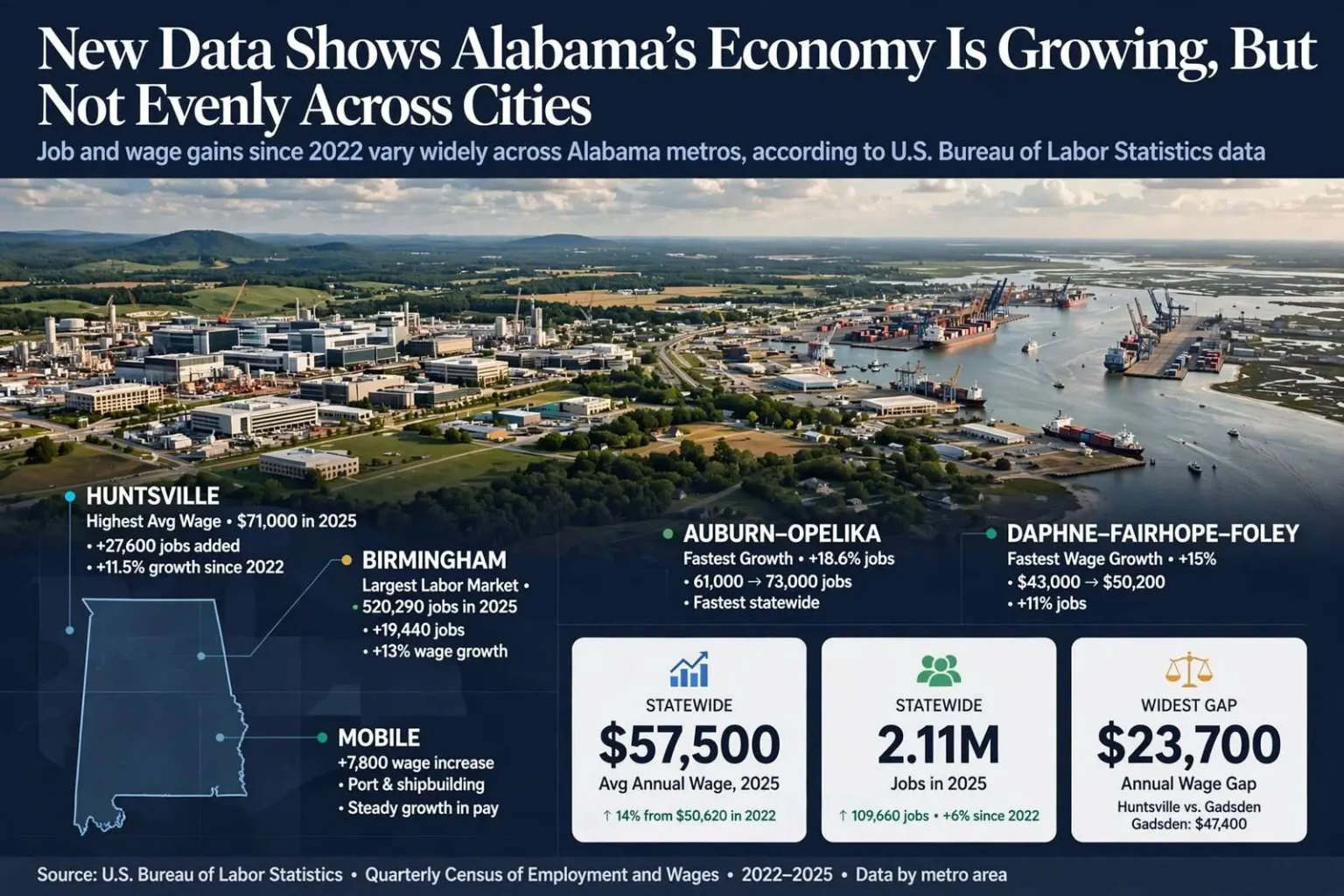
Alabama’s economy has added jobs and boosted wages across nearly every corner of the state since 2022, but new federal data shows the gains have been far from even, with some metro areas surging ahead while others struggle to keep pace, including a wide gap that separates the state’s highest and lowest earning cities.
According to figures from the U.S. Bureau of Labor Statistics, Alabama’s average annual wage climbed to $57,500 in 2025, up roughly 14% from $50,620 in 2022. The state added about 109,660 jobs during that stretch, pushing total statewide employment to 2,113,660 in 2025, an increase of about 6%.
Huntsville Leads, But Auburn Grows Faster
The Huntsville metro area, Alabama’s second largest, added about 27,600 jobs between 2022 and 2025, more than any other metro in the state and ahead of the much larger Birmingham metro, which added nearly 19,500 jobs. Huntsville’s 11.5% job growth rate ranked second statewide, trailing only Auburn-Opelika’s 18.6%. Auburn’s employment grew from about 61,000 jobs to nearly 73,000, the fastest pace of growth of any Alabama metro.
Huntsville also holds onto the title of Alabama’s highest-paying metro. The average annual wage there rose from nearly $64,000 in 2022 to just over $71,000 in 2025, keeping it well ahead of every other metro area in the state.
What the Numbers Mean for South Alabama
Closer to home, Baldwin County’s Daphne-Fairhope-Foley metro posted the fastest wage growth of any metro area in Alabama. Average wages there rose roughly 15%, from about $43,000 in 2022 to $50,200 in 2025, while job growth in the area was also strong, up nearly 11% over the same period.
Mobile posted one of the largest dollar-figure wage increases in the state, with average pay rising by about $7,800, even though job growth in the metro was comparatively modest. Together, the Mobile and Daphne-Fairhope-Foley numbers suggest that while South Alabama isn’t adding jobs at the pace of Huntsville or Auburn, workers in the region have still seen meaningful pay increases over the past three years.
A Widening Gap Between Alabama’s Metros
The data also highlights a stark divide between the state’s best- and worst-performing labor markets. Gadsden’s average wage sits at $47,400, even after the metro saw its own wage increase of about 16%. That leaves a gap of roughly $23,700 per worker annually between Gadsden and top-earning Huntsville.
Anniston-Oxford was the only metro area in the state to see employment decline over the period, though the drop was small, less than half a percent. Even so, wages there jumped almost 16%, from about $44,000 to roughly $51,000, showing that pay gains and job growth don’t always move in tandem.
Decatur posted a wage increase of about $7,600, not far behind Mobile’s gain, while also adding nearly 4,700 jobs, good for an employment growth rate of about 8%. Tuscaloosa recorded the slowest wage growth among the state’s metros, up about 9%, even as its employment also rose by roughly 9%.
Birmingham Remains Alabama’s Largest Market
Despite trailing Huntsville and Auburn in growth rate, Birmingham remains Alabama’s largest labor market by a wide margin, with 520,290 jobs in 2025, an increase of 19,440 since 2022. That compares to 266,650 jobs in the Huntsville metro. Birmingham’s wage growth was moderate, at roughly 13%, which officials say reflects the nature of a large, already diversified regional economy rather than a market still building momentum.
Taken together, the figures paint a picture of an Alabama economy that is expanding on the whole, but unevenly, with fast-growing tech and manufacturing hubs like Huntsville and Auburn pulling away from smaller metros like Gadsden and Anniston-Oxford, even as those smaller markets post real, if smaller, wage gains of their own.
The Bureau of Labor Statistics data
The figures cited in the article come from the Quarterly Census of Employment and Wages, the U.S. Bureau of Labor Statistics’ standard survey of employment and wages across all covered employers in the country. The data cover all jobs reported through state unemployment insurance systems, which makes them comprehensive rather than sample-based. Because the survey reports at the metro-area level, it allows comparisons between regions of different sizes, and because it tracks both total employment and average annual wages, it provides two distinct measures of economic performance: one that counts the number of jobs added, and one that measures the pay those jobs provide.
The time frame – 2022 through 2025 – is significant because it spans a period that includes both the tail end of pandemic-related labor disruptions and the beginning of a sustained national hiring trend. Alabama’s 6% overall job growth and roughly 14% wage increase over the period are consistent with national figures, but the metro-level differences reveal how uneven that national trend is at the local scale.
Why metro-level comparison matters
Comparing metro areas is a standard way for economists and journalists to track regional economic health, but it requires care in how the numbers are read. Job growth rates favor smaller metros, where the addition of a few thousand positions produces a larger percentage change. Wage growth rates, by contrast, can be driven by the composition of an area’s industries, since regions dominated by high-paying sectors – such as technology, health care, and advanced manufacturing – will tend to show faster wage increases than regions where employment is spread more evenly across lower-wage sectors.
That distinction helps explain the pattern in Alabama. Auburn-Opelika, with an employment base of about 61,000, grew by 18.6%, the fastest of any metro, but its absolute gain – roughly 12,000 jobs – was smaller than Huntsville’s 27,600. Huntsville, by contrast, combined rapid job growth with the state’s highest wages, a combination that makes it the standout performer in both measures. Birmingham, with the largest labor market, showed more modest growth in both categories, which is typical for a mature, diversified economy.
South Alabama in the statewide picture
The South Alabama figures in the data – Mobile, the Daphne-Fairhope-Foley metro, and Baldwin County more broadly – show a different profile from either Huntsville or Birmingham. Mobile posted one of the largest dollar-figure wage increases in the state (,800) without the rapid job growth seen further north. Daphne-Fairhope-Foley posted the fastest wage growth of any metro (about 15%), paired with strong job growth of nearly 11%. Together, these numbers suggest that South Alabama is not leading the state in employment growth but is participating in the wage gains, which reflects both the region’s own economic dynamics and the broader upward pressure on pay across the state.
The region’s economic base includes the Port of Mobile, the Gulf Coast tourism and service economy, the shipbuilding and manufacturing industries along the coast, and the growing residential and commercial development on the eastern shore of Mobile Bay. Each of these sectors responds differently to national economic conditions, and together they produce a labor market that moves in its own rhythm rather than simply following the patterns of the larger metros to the north.
The gap between the best and worst performers
The gap between Gadsden’s 7,400 average wage and Huntsville’s 1,000 – a difference of roughly 3,700 per worker per year – is one of the most striking figures in the report. It is important to read that gap as a measure of regional economic structure rather than of individual performance: a worker in Gadsden is not necessarily earning less for the same work, but rather working in a region whose overall industry mix produces a lower average. That distinction is central to interpreting wage data at the metro level, and it explains why the data can show both rapid wage growth in Gadsden (about 16%) and a continuing gap relative to Huntsville.
Anniston-Oxford’s experience highlights another feature of the data: the disconnect between wage growth and employment growth. Even though the metro lost a small number of jobs over the period, average wages rose by almost 16%. That can happen when the jobs lost are in lower-paying sectors, or when the jobs that remain grow more productive or are concentrated in higher-paying industries. The combination shows that a region can improve its economic position even without adding employment – though in most cases the two measures move together.
What the numbers cannot show
Metro-level data is a powerful tool for tracking economic trends, but it does not capture everything that matters to a region’s economic health. It does not show who holds the new jobs, whether they are full-time or part-time, whether the pay increases keep pace with local cost of living, or whether the growth is concentrated in particular neighborhoods or spread across the metro. It also does not reflect the experience of individual workers, families or businesses, which is shaped by factors – education, transportation, health, housing, and opportunity – that are not captured in an employment and wage survey.
What the data do show, clearly, is that Alabama’s economic growth over the past three years has been real, significant and uneven. The fast-growing tech and manufacturing hubs have pulled ahead, while smaller and more diversified metros have grown at their own pace and with their own patterns. For South Alabama, the message of the figures is that the region is part of the statewide growth story, not just an observer of it – and that the details of that participation are visible in both the job counts and the paychecks.