New DCCC Poll Shows Figures and Marques Deadlocked at 46% in Alabama’s 2nd District Race
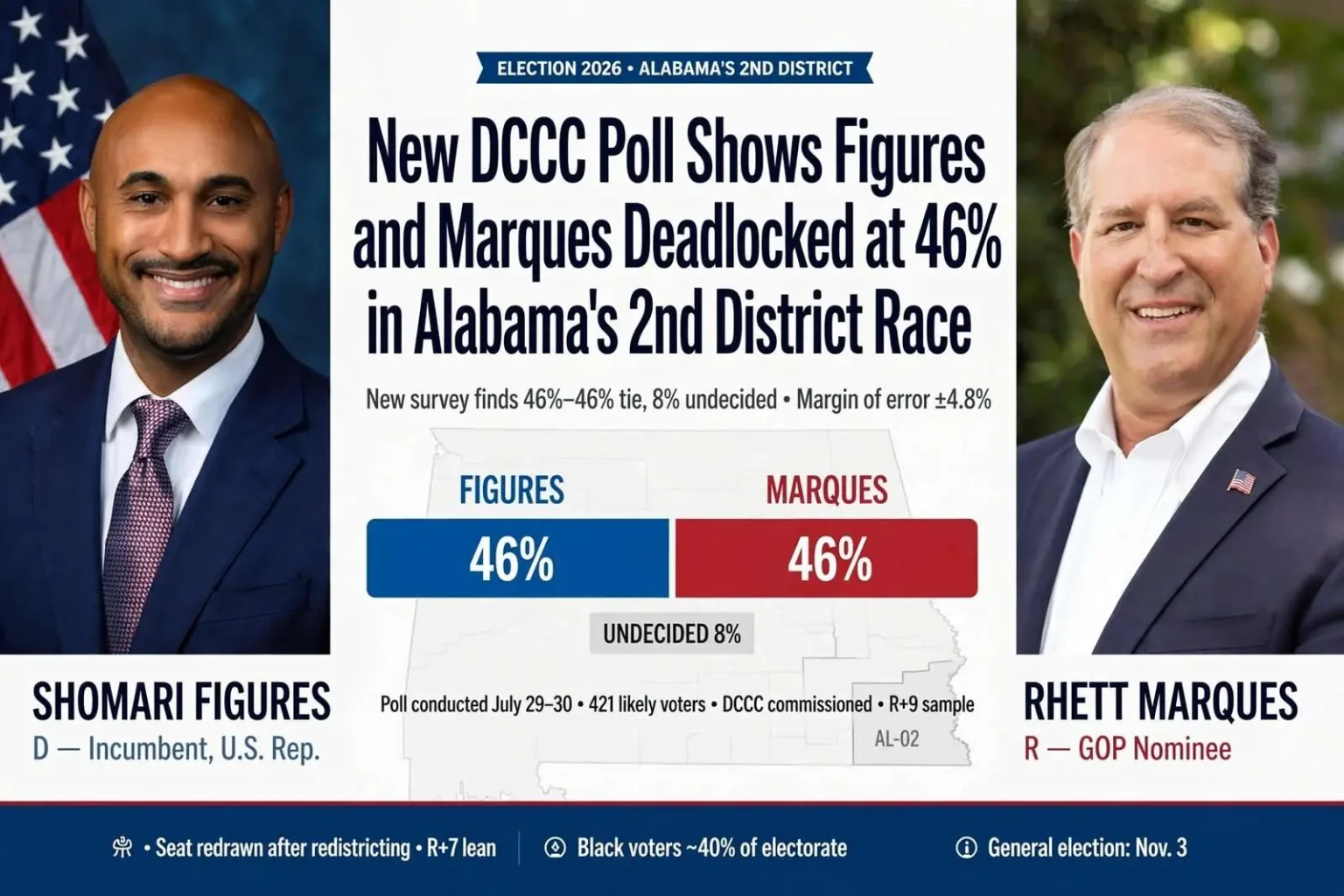
A new Democratic Congressional Campaign Committee poll finds U.S. Rep. Shomari Figures and Republican nominee Rhett Marques tied at 46% each in Alabama's redrawn 2nd Congressional District, with 8% of voters still undecided ahead of the November election.
New DCCC Poll Shows Figures and Marques Deadlocked at 46% in Alabama’s 2nd District Race
A new poll sponsored by the Democratic Congressional Campaign Committee (DCCC) finds U.S. Rep. Shomari Figures, D-Alabama, and Republican nominee Rhett Marques locked in a dead-even race for Alabama’s 2nd Congressional District, with both candidates drawing 46% support and 8% of voters still undecided. The survey, conducted July 29-30 among 421 likely general election voters in the district, carries a margin of error of plus or minus 4.8% at a 95% confidence interval.
The DCCC said the sample had an R+9 party identification edge, meaning it skewed more Republican than the district’s overall partisan makeup, and the committee did not release further detail on the poll’s demographic breakdown. That skew matters when reading the result: if the sample leaned more Republican than the district itself, a tie on the topline can suggest the incumbent is running at or above what the district’s underlying partisanship would normally deliver. The undecided 8% will be the pool both campaigns compete to claim as the fall campaign intensifies.
A Race Reshaped by Redistricting
The poll comes after Marques, a state representative from Enterprise, won the Republican nomination in the Aug. 11 special primary, taking roughly 50% of the vote in a six-candidate field. Figures, the incumbent, did not face a primary challenger. The special primary was called after the seat’s map was redrawn, and the compressed timeline left the GOP field little time to consolidate, with six candidates splitting a primary vote that Marques still managed to win outright.
Alabama’s 2nd District looks very different than it did when Figures won his seat in 2024 with 54.6% of the vote. Following the U.S. Supreme Court’s ruling in Louisiana v. Callais, the district was redrawn, and fewer than three-fifths of the voters now inside its boundaries were part of the district in 2024. The wholesale change in the electorate means neither candidate can assume that past voting behavior in any particular precinct will carry over — the seat’s political geography has effectively been rebuilt.
Nonpartisan election analysts currently rate the reconfigured seat as R+7, meaning its two-party vote share ran 7 points more Republican than the national average in the 2020 and 2024 presidential elections. The new district stretches from the Wiregrass to Montgomery and west into Butler and Lowndes counties, with Black voters making up about 40% of the electorate. The spread from the Wiregrass region around Dothan through the River Region and into the Black Belt’s western counties gives both campaigns vast ground to cover in a district far larger than the old Mobile-area seat Figures originally won.
What the Poll Found
Beyond the topline 46-46 tie, the DCCC’s polling found that roughly half of the district’s voters already know who Figures is, an indication that name recognition will remain a factor as the race develops. In a district where most voters are new to him, half the electorate recognizing the incumbent is a meaningful starting point, but it also means the other half must be introduced to him from scratch in a compressed campaign calendar.
To win, Figures is expected to need support from voters who did not back him in 2024, some of whom may currently lean toward Marques, who lives in the Wiregrass region. Marques’ residence inside the reconfigured district has been a talking point for his campaign, and the redrawn map’s Republican lean means he starts with a structural advantage that Figures’ incumbency and fundraising must offset.
The poll also found Democratic gubernatorial nominee Doug Jones running 3 points ahead of Republican nominee Tommy Tuberville in the district — a data point Democrats are watching closely as a sign of the district’s overall competitiveness this fall. A statewide ticket outperforming the district’s R+7 baseline would change the environment for every race on the ballot, and both parties’ field programs are built around turning out voters for the top of the ticket.
This is not the first poll to show the race tightening. An earlier DCCC-sponsored survey conducted in late June also found Figures and Marques essentially tied. Two consecutive committee-sponsored surveys landing on the same result suggest the race’s fundamentals have not shifted materially between the primary and mid-summer, though campaigns routinely treat their own polling with more optimism than outside observers do.
Campaigns React
“Multiple public polls make it clear: this is a toss up race, plain and simple,” DCCC spokesperson Eli Cousin said in a statement on the new numbers. “While Shomari Figures shows up and delivers for the people of Alabama, his opponent Rhett Marques has been supporting tax increases and policies that raise prices on working people.”
“That clear contrast is why Congressman Figures is drawing support from both Republicans and Democrats in every corner of Alabama’s 2nd Congressional District as he builds the coalition needed to win in November,” Cousin added. The DCCC’s framing emphasizes crossover appeal — the argument that an incumbent who won his original seat by double digits can assemble a coalition even in a seat tilted Republican.
A spokesperson for Marques’ campaign pushed back on the poll’s framing, saying the “national Democratic establishment is going to pull out every trick in the book to flood Alabama’s Second Congressional District with left-wing money from California and New York.” The spokesperson added: “At the end of the day, Rhett said it best: this race is a contest between common sense and craziness. Rhett is the only candidate who lives in and shares the values of this district.”
On the night of his primary win, Marques predicted the general election would draw heavy national interest. “This is probably going to be one of the most highly contested races in the country,” he said. “It’s going to be the most watched.” Figures’ campaign did not immediately respond to a request for comment on the new poll.
Money and the National Picture
Both campaigns have built substantial war chests ahead of the fall. As of July 22, Figures had raised about $1.35 million to Marques’ roughly $1.32 million, with Figures holding $663,000 on hand compared to Marques’ $188,000. The cash-on-hand gap is the sharper contrast: after an expensive six-way primary, Marques enters the general with a fraction of the incumbent’s banked resources, though national party committees and outside groups can narrow that difference quickly.
Both the DCCC and the National Republican Congressional Committee have stepped up their involvement in the race since the special primary, a sign both parties see it as one of the most competitive House contests in the country this cycle. When both congressional campaign arms target the same district with advertising and field spending, the race typically becomes one of the most expensive per voter in the nation, and Alabama’s 2nd has already drawn that level of national attention.
Campaign-sponsored polls, including internal surveys released by party committees, tend to show results more favorable to their preferred candidate than independent polling does. Still, national “generic ballot” polling — which asks voters whether they would generally support a Democratic or Republican candidate for Congress — has shown Democrats with an advantage of roughly 6 points heading into 2026, fueling talk of a possible wave election. Given the district’s Republican lean, Democrats would likely need to outperform their 2024 numbers by several points for Figures to hold the seat.
The arithmetic for both sides is unforgiving. A Democrat holding an R+7 seat needs either a strong national environment or a candidate-level advantage large enough to overcome the map; a Republican in a wave year must defend a district his party would normally win comfortably. With both candidates near financial parity in total fundraising, with two committee polls showing a tie, and with eight percent of the electorate still undecided, the 2nd District has become exactly what Marques predicted on primary night — one of the most watched House races in the country.
The general election is Nov. 3. In the weeks between now and then, both campaigns will pivot from summer polling and fundraising toward the on-the-ground work that decides races in a district this large: parades and fish fries across the Wiregrass, canvassing in Montgomery’s neighborhoods, church visits in the Black Belt, and advertising aimed at the roughly 8% of voters who have not yet picked a side in a contest both parties consider a genuine toss-up.
Redistricting cases of this kind also carry long shadows beyond a single cycle. The Supreme Court’s decision in Louisiana v. Callais did not just redraw one map — it reset the legal framework under which Southern districts with significant Black electorates are drawn, and Alabama’s 2nd is the immediate test case of what the new landscape produces. Depending on how the seat votes in November, both parties will draw lessons that shape map litigation, candidate recruitment and national spending priorities across the region for cycles to come.