New Fairhope Traffic Signal Goes Up Near St. Michael Catholic School
A new signal at State Route 104 and St. Michael Way is running in flash mode through July 21 as ALDOT and Baldwin County work to ease school-zone congestion.
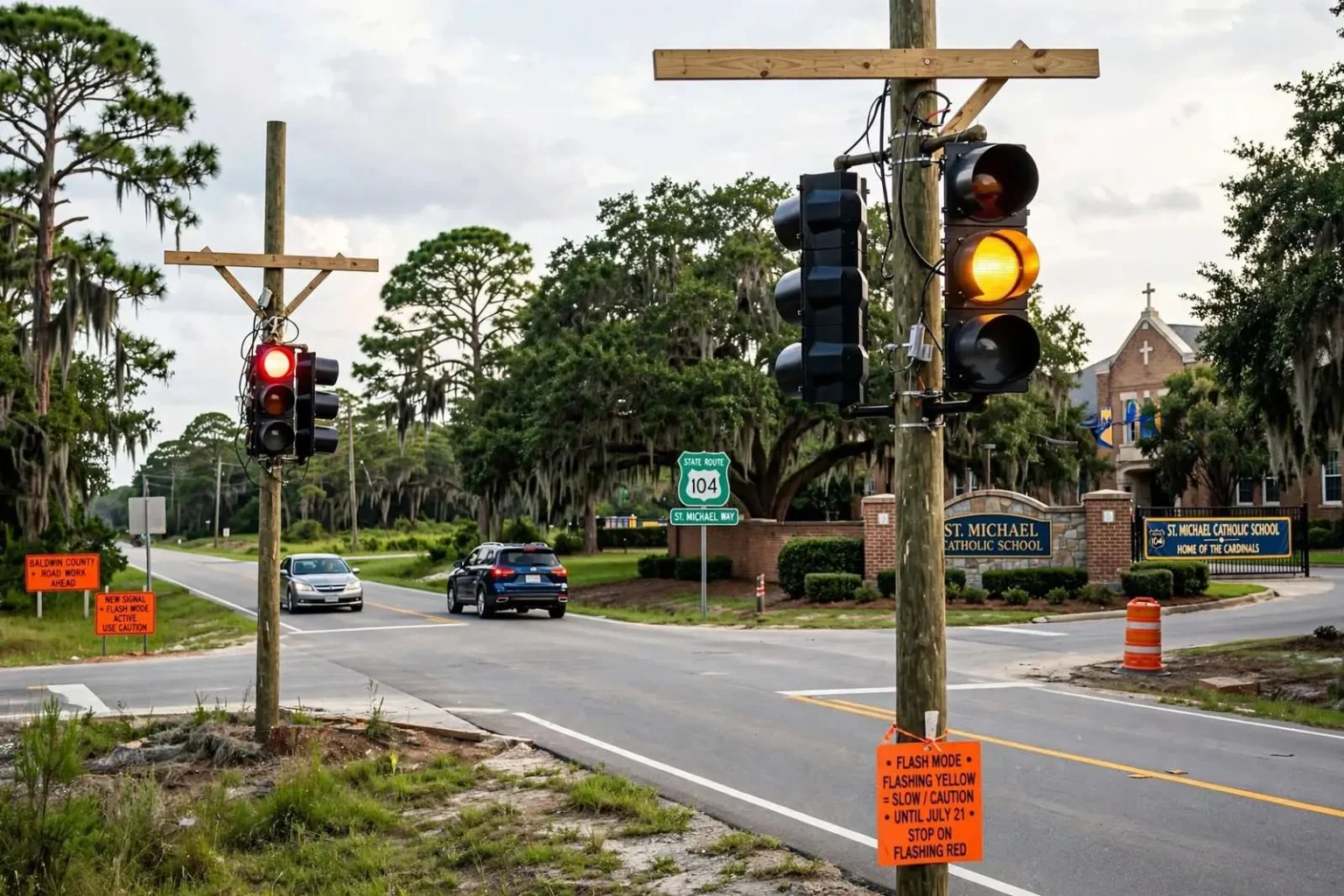
Drivers passing through a busy stretch of Fairhope have a new traffic signal to get used to, installed this week at the intersection of State Route 104 and St. Michael Way. The Baldwin County Commission, working with the Alabama Department of Transportation, announced the new signal as part of an ongoing effort to improve roadway safety and manage growing traffic near St. Michael Catholic School. Morning drop-off and afternoon dismissal at the school have historically caused significant backups at the intersection, and county officials say the project was designed specifically to address that congestion.
The intersection sits at one of Fairhope’s most challenging traffic points. State Route 104 carries commuter and school traffic through the growing city on the east shore of Mobile Bay, and St. Michael Way feeds directly into the school campus, concentrating hundreds of vehicle movements into two short windows each school day. Before the signal, drivers navigating those peaks relied on judgment and gaps in traffic — a workable arrangement in light flow, and a difficult one when the school’s arrival and dismissal waves met the highway’s through traffic all at once.
Flash Mode Until Tuesday
ALDOT installed the signal this week, and it will run in flash mode through Tuesday, July 21, giving drivers time to adjust before it switches to standard operation. During flash mode, a flashing red light means drivers must come to a complete stop and proceed only when it’s safe to do so, while a flashing yellow light means drivers should slow down and move through the intersection with caution. The graduated introduction is standard practice for new signals on state routes, and it exists to prevent the most dangerous failure mode a new signal can produce: drivers who do not yet expect a light arriving at full speed at the moment it turns red.
The flash period also lets engineers watch how the intersection behaves before the signal takes command. Vehicles queue differently under a flashing red on the side street; some drivers race the yellow on the highway; sight lines reveal themselves when traffic slows in predictable places. The observations from the flash week inform the final signal timing — how long the highway stays green, how long the school approach gets, and how the pedestrian and turning phases fit in. By the time full operation begins, drivers will have practiced the new pattern, and the timing will have been tuned to the intersection’s actual rhythms.
Temporary Poles for Now
To get the signal operating before the new school year begins, crews installed temporary timber poles at the intersection. Permanent galvanized steel poles will go up later once fabrication is complete. The two-phase installation is a pragmatic compromise between calendar and construction: steel signal poles of the size needed at a state-route intersection are fabricated to order, and waiting for them would have pushed the signal’s activation past the start of school — precisely the period the project was intended to fix.
Baldwin County has agreed to help fund the upgraded steel poles, which are intended to hold up better over time and withstand severe weather. The cost-sharing arrangement reflects how such projects are actually governed in Baldwin County. State routes fall under ALDOT’s jurisdiction, but the traffic a school generates and the safety of the surrounding network are county concerns, and the commission has historically put county money behind safety improvements that the state’s program alone would not fund on the county’s preferred timeline.
The weather durability point matters along the Gulf Coast. Signal infrastructure here must stand up to hurricane-force wind, driving rain and lightning seasons that most inland intersections never see, and the galvanized steel standards exist because timber and lighter assemblies have a documented record of failure in major storms. A signal that goes dark after the next hurricane is a signal that cannot manage evacuation traffic or post-storm recovery movement — one more reason the permanent poles were worth the county’s contribution.
A Welcome Change for the School Community
Andrea Williamson, principal of St. Michael Catholic High School, has welcomed the new signal, calling it a long-awaited improvement for the school community. “We are incredibly grateful to the Baldwin County Commission and the Alabama Department of Transportation for prioritizing the safety of our students and families,” Williamson said. “This traffic signal is a meaningful investment in our community and truly an answer to prayers. It will make a lasting difference for the students, families and visitors who travel to our campus each day.”
The gratitude reflects how long the problem had persisted. School-related congestion is not an abstract inconvenience at a place like St. Michael: the daily peak puts teenage drivers, parents with young children, school buses and highway commuters into the same intersection at the same minutes, twice a day, in both directions. Every family that has sat through the dismissal backup knows the specific anxiety of watching a student cross or turn while through traffic on 104 accelerates past the school entrance. A signal changes the arithmetic of those moments by assigning each direction its own protected time.
How the School Shapes Fairhope’s Traffic
St. Michael Catholic School’s campus draws from across the Eastern Shore — families in Fairhope, Daphne, Spanish Fort, Point Clear and the county’s unincorporated communities — which means its traffic does not arrive from one neighborhood but converges on the intersection from every direction at once. Schools differ from retail generators in exactly this way: a shopping center’s traffic spreads across the day, while a school’s arrives in two spikes that coincide with the highway’s own commuter peaks. Intersection design at a school site therefore has to solve a convergence problem, not just a volume problem.
State Route 104 itself is part of the story. The route links Fairhope’s inland growth areas to the older street grid and to the north-south corridors that carry Eastern Shore commuters, and as Baldwin County’s population has climbed, routes like 104 have absorbed traffic volumes their original designs never anticipated. Adding signal control at a school entrance is one of the standard tools ALDOT uses to manage a corridor in transition, alongside turn lanes, wider shoulders and, in larger projects, realignment — and the county’s growth ensures the tool will keep coming into play.
The Commission’s Broader Safety Work
The Baldwin County Commission has made rural-and-suburban road safety a recurring budget priority, funding intersection improvements, paving and drainage projects across a county whose unincorporated roads it maintains even where the state routes the heavier traffic. School zones have received particular attention as new campuses open to serve the county’s fast-growing population. Each new school brings the same pattern: a site chosen for land availability and central access, then a surrounding road network that needs upgrades to handle the concentrated traffic the campus generates.
The cooperation between the commission and ALDOT on the St. Michael signal follows a familiar division of labor. ALDOT designs, installs and operates signals on the state routes it controls; the county contributes funding and local coordination, especially where school traffic — a county concern by any measure — drives the need. For parents, the jurisdictional details matter less than the result: a signal at the school entrance, running in time for the first day of school.
County officials are asking drivers to stay alert and use extra caution while they adjust to the new signal pattern in the coming weeks. The flash period’s warnings bear repeating: a flashing red requires a complete stop before proceeding, a flashing yellow calls for slowed, watchful passage, and the difference between the two is the difference between a safe first week and a crash at a brand-new signal. By the time the permanent steel poles rise and the light runs in full operation, the goal is simple — that the intersection’s most dangerous minutes, the morning drop-off and afternoon dismissal, become among its most controlled.
What Drivers Should Expect During the Transition
The weeks after a new signal activates are statistically the riskiest of its life, which is why both agencies leaned on public education. Drivers accustomed to years of uncontrolled flow through the intersection have to unlearn habits — the rolling gap judgment, the maintained speed — that the new signal now overrides. ALDOT’s flash period addresses the problem in the gentlest way available, but the full red-yellow-green cycle will still surprise some drivers in its first days, and the county’s request for extra caution is aimed squarely at that window.
For the school community specifically, the transition overlaps with the start of a new year, when student drivers are relearning their own routes and new families are finding the campus for the first time. That layering of novelty — new signal, new school year, new drivers — is precisely why the agencies timed the flash week to the weeks before classes resumed, giving every routine commuter several days of exposure before the stakes rose.
Signals as Safety Tools: The Record
Traffic engineering has a long, well-documented record on what signals do and do not accomplish. At intersections with high volumes, poor sight distance and significant turning conflicts, signals reduce the most severe collision types — angle crashes, the broadside impacts that produce the worst injuries — by separating conflicting movements in time. They can, if installed at an unwarranted location, increase rear-end collisions, which is why signal installations on state routes follow engineering study rather than local preference alone. The study behind the St. Michael Way signal would have weighed crash history, traffic volumes, delay and the school’s pedestrian activity before both agencies committed to the project.
The school factor weighs heavily in that analysis. School crossings generate pedestrian and young-driver exposure that ordinary volume counts understate, and federal and state guidance treats school-area intersections with corresponding priority. The backups that motivated the project are also a safety issue in themselves: queues of waiting cars extending along a highway approach create their own rear-end risk and block sight lines for turning vehicles, so relieving congestion and improving safety point at the same remedy.
The Engineering Behind the Poles
The distinction between the temporary timber poles and the permanent galvanized steel ones involves more than appearance. Mast-arm signal poles carry the signal heads out over the travel lanes, positioning them in drivers’ sight lines, and they must resist wind loads, vehicle impacts and the constant vibration of a highway corridor. Steel mast arms are fabricated to specific wind-rating standards for Gulf Coast exposure; timber poles with span wire, the classic temporary arrangement, get a signal working quickly at a fraction of the cost but with less overhead reach and less storm resilience.
Fabrication lead time is the reason the project runs in two phases. Steel pole assemblies are manufactured to order, and their production schedule can stretch across months — longer than the gap between the project’s approval and the first day of school. The temporary poles bridge exactly that gap, and their cost is a small premium for having signal control in place for the school year rather than arriving mid-semester.
When the permanent poles arrive, crews will transfer the signal heads to the new structures, and the intersection will take its final form. By then, drivers will have lived with the signal through weeks of school-year traffic, the timing will have been refined against real conditions, and the intersection that once ran on luck and gaps will run on a fixed, visible allocation of time — the ordinary, unglamorous machinery by which a growing county keeps its busiest school entrance safe.