New Mobile Mardi Gras Crewe Honors ‘Man of Many Faces’ Legacy
Descendants of Mardi Gras masking legend Louis Diemert formed the Order of Many Faces, a new Mobile crewe set to debut with six floats in 2016.
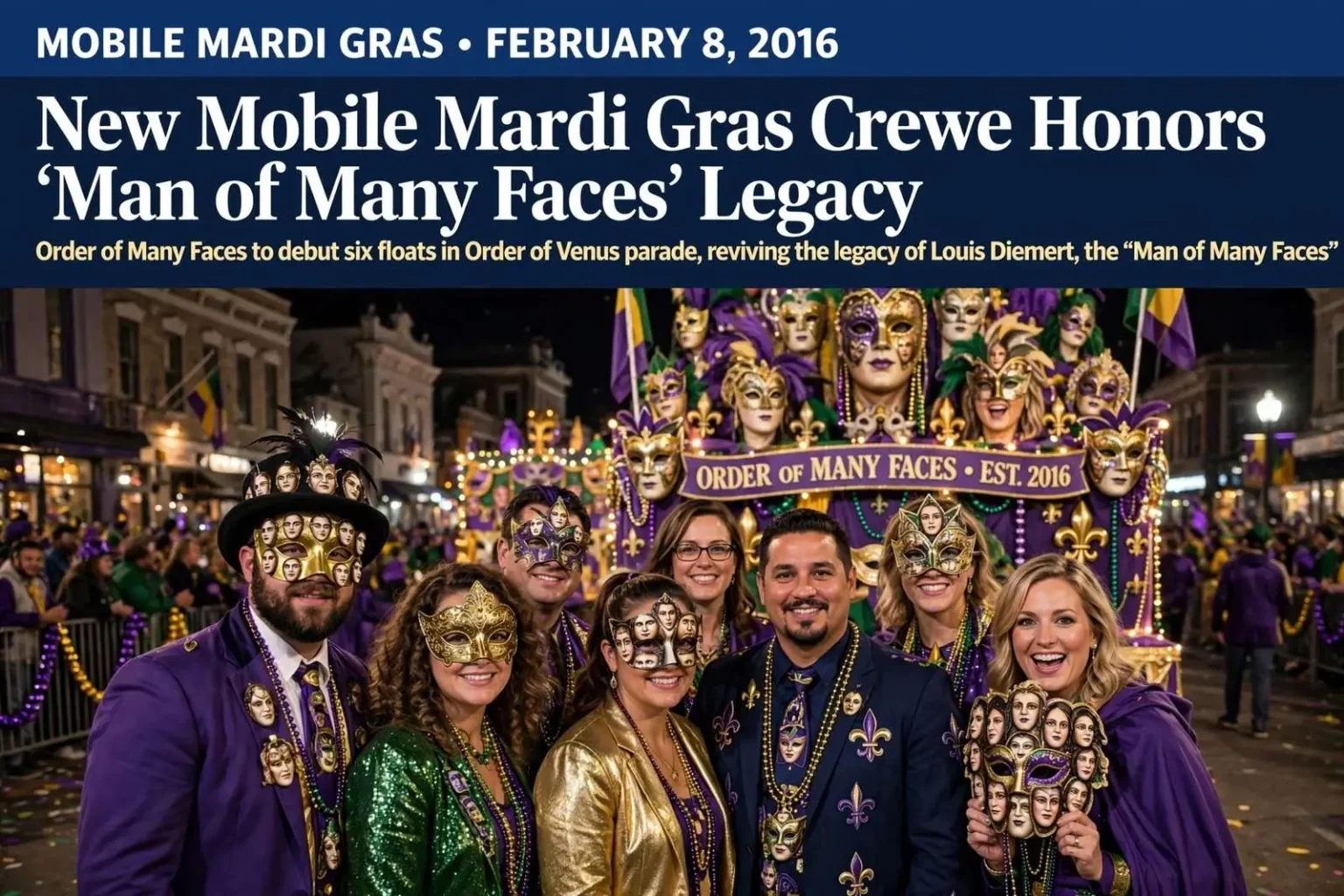
A new Mardi Gras crewe rooted in one of Mobile Carnival’s more obscure masking legends is set to make its debut in 2016, organized by the great-grandchildren of a man once celebrated for his elaborate costume transformations.
The Order of Many Faces takes its name from Louis Diemert, a New Orleans native who became known throughout Mobile decades ago as the “Man of Many Faces” for his intricate masquerade caricatures. Diemert used his talent for disguise to repeatedly win individual masking prizes once offered by the Mobile Carnival Association, and one particularly striking costume even landed him in a national magazine in 1939.
In an era before costume design for Carnival was a commercial industry, the maskers who won the admiration of crowds did so through ingenuity and craft, often spending months on a single costume in the weeks before Fat Tuesday. Diemert’s specialty was transformation — faces within faces, characters nested inside characters, disguises elaborate enough that the crowd was never quite sure what it was looking at until the reveal. That artistry made him a repeat prize-winner in the city’s masking competitions and, for a time, a recognizable celebrity of the Carnival season, even as his own identity stayed hidden behind the work.
Masking itself is among the oldest traditions in Mobile’s Carnival, which traces its origins to the early 18th century and holds the distinction of predating New Orleans’ celebration. Individual maskers, riding societies, parading mystic societies and marching bands each carry a piece of that history, and the Mobile Carnival Association’s contests once gave solitary costumers a stage alongside the city’s grand organizations. Diemert’s dominance of those contests placed him in a lineage of craft that few Mobilians today could name — which is precisely the point his descendants are trying to change.
A crewe built from family memory
Eight of Diemert’s great-grandchildren came together to found the new crewe, which received official parading status from the Mobile Mardi Gras Parading Association over the summer. One of the group’s primary founders said the idea for the crewe had been in the works for roughly a decade, driven by a desire to restore recognition to an ancestor whose contributions to Mobile Carnival history had largely faded from public memory.
“Hardly anybody you talk to really knows about Louis,” the founder told local media ahead of the crewe’s debut. “It seems sad that he hid so much for the city of Mobile, that he’s been so neglected. I’m thrilled we picked a name that brings him into a bigger light than he’s ever been before.”
The founding by great-grandchildren says something about how Carnival memory is transmitted in Mobile — through families as much as through organizations. Societies in the city often trace their identities to founders, myths and historical figures, and membership passes along generational lines. For the Diemert family, the crewe functions as a kind of living memorial: a way to write their great-grandfather’s name into the annual calendar of the season he helped color, and to do it through the same medium he mastered, the costume.
Another descendant helped keep the family’s Carnival legacy visible in recent years by portraying a central figure in Mobile’s Joe Cain Day festivities during the 2015 celebration, a role that deepened his connection to his great-grandfather’s masking traditions. He has credited his mother’s lifelong appreciation of Diemert’s legacy, since Diemert was her grandfather, for inspiring his own involvement in Carnival culture.
Joe Cain Day and the folk side of Carnival
Joe Cain Day, the Sunday before Fat Tuesday, celebrates one of Mobile’s most beloved Carnival folk figures — the man credited with reviving the city’s Carnival celebrations after the Civil War by parading through the streets as the fictional Chickasaw chief Slacabamorinico. The day has grown into a people’s celebration, deliberately looser and more irreverent than the formal balls of the established societies, and portraying a central figure in its pageantry is a mark of local Carnival credibility. For a Diemert descendant to take such a role in 2015, the year before his family’s crewe debut, tied the new organization to both strands of Mobile’s tradition at once — the polished artistry of the masking contests and the folk spirit of the people’s parade.
Six floats on a Monday night
The Order of Many Faces plans to field six floats during the Order of Venus parade on the Monday night before Fat Tuesday in 2016, an appearance organizers are billing as the start of what they call Mobile’s second original tradition. Six floats is a modest train by the standards of the city’s largest parading societies, but a deliberate one — a debut-sized entry that lets the crewe establish its identity before growing in later seasons, and one placed inside an established Monday-night parade rather than launched on its own night.
Riding in the Order of Venus parade puts the new crewe in front of one of the most loyal audiences of the Mobile season. The Monday before Fat Tuesday is a night when downtown streets fill with families who have claimed their spots hours in advance, and a new float train that night will be seen by crowds in the tens of thousands. The Order of Venus, one of the city’s longstanding mystic societies, provides the parade framework while the Order of Many Faces contributes its own floats, maskers and throws to the evening’s procession.
Founders say the crewe was deliberately built to be as inclusive as possible, welcoming members regardless of race, gender or sexual orientation, with membership open to anyone 21 and older. That stance distinguishes the organization from the older Mobile societies, many of which kept long traditions of single-sex or socially exclusive membership, and it aligns the Order of Many Faces with the newer generation of crews that have broadened who can belong in Mobile Carnival. In a season whose organizations sometimes mirror old social lines, the crewe’s open-door approach is itself a statement about what the tradition should look like going forward.
Getting to that first parade required the approvals that govern every society in Mobile. Parading status from the Mobile Mardi Gras Parading Association means navigating the season’s crowded schedule — the city’s streets can accommodate only so many processions between Twelfth Night and Fat Tuesday — and agreeing to the routing, insurance, float safety and operational requirements that the city and the association impose on every organization that rolls. For a first-year crewe, securing a slot in an established parade rather than an independent night was both a practical entry route and a symbolic endorsement: the city’s Carnival establishment recognizing the organization as part of the season rather than a curiosity alongside it.
The throws and float design will carry the crewe’s identity as much as its name does. Organizations in Mobile spend the year developing their themes — the medallion beads, cups and plush throws that identify a society at a glance, and the float designs that tell its story to a crowd in motion. For a crewe honoring a master of disguise, the visual possibilities are unusually rich: nested faces, transformations and mirror imagery offer float designers a theme that spectators can read instantly from the shoulder of the route, and that maskers among the members can interpret in costume on foot.
Local reaction to the crewe’s announcement has leaned curious and welcoming, with seasoned Carnival watchers noting that Mobile’s season has room for organizations with a genuine story to tell. The city’s celebration has absorbed new crews repeatedly over the decades, and the ones that endure tend to be those with an identity distinct enough to be remembered after the beads are swept up. A lineage reaching back to one of the city’s great individual maskers gives the Order of Many Faces exactly that kind of hook, and its members’ family ties to the Carnival community give them a head start on the volunteer corps, float builders and musicians every parading organization depends on.
A name meant to be remembered
The crewe’s formation adds another chapter to Mobile’s long tradition of Carnival organizations tracing their identities back to specific historical figures and family legacies. The city’s societies have always traded on their origin stories — founding dates, founding myths, the men and women whose names still appear on the rolls — and the Order of Many Faces takes that practice a step further by choosing as its identity a person whose contribution was hiding his own face.
Organizers say they hope the Order of Many Faces will help introduce a wider audience to a piece of Mobile Mardi Gras history that had largely faded from public view, while giving Diemert’s descendants a lasting way to honor his memory each Carnival season. If the name does its work, every program, banner and conversation about the new crewe will carry a question with it — who was the Man of Many Faces? — and eight great-grandchildren will have their answer ready: an artist who transformed himself for the delight of the city, and who is finally being invited out of the archive and back into the parade.