
New Orleans’ Flow Tribe Makes Its Callaghan’s Debut in Mobile
New Orleans band Flow Tribe plays its first show at Callaghan's Irish Social Club in Mobile on August 7, 2015, blending funk, rock, and Latin influences.
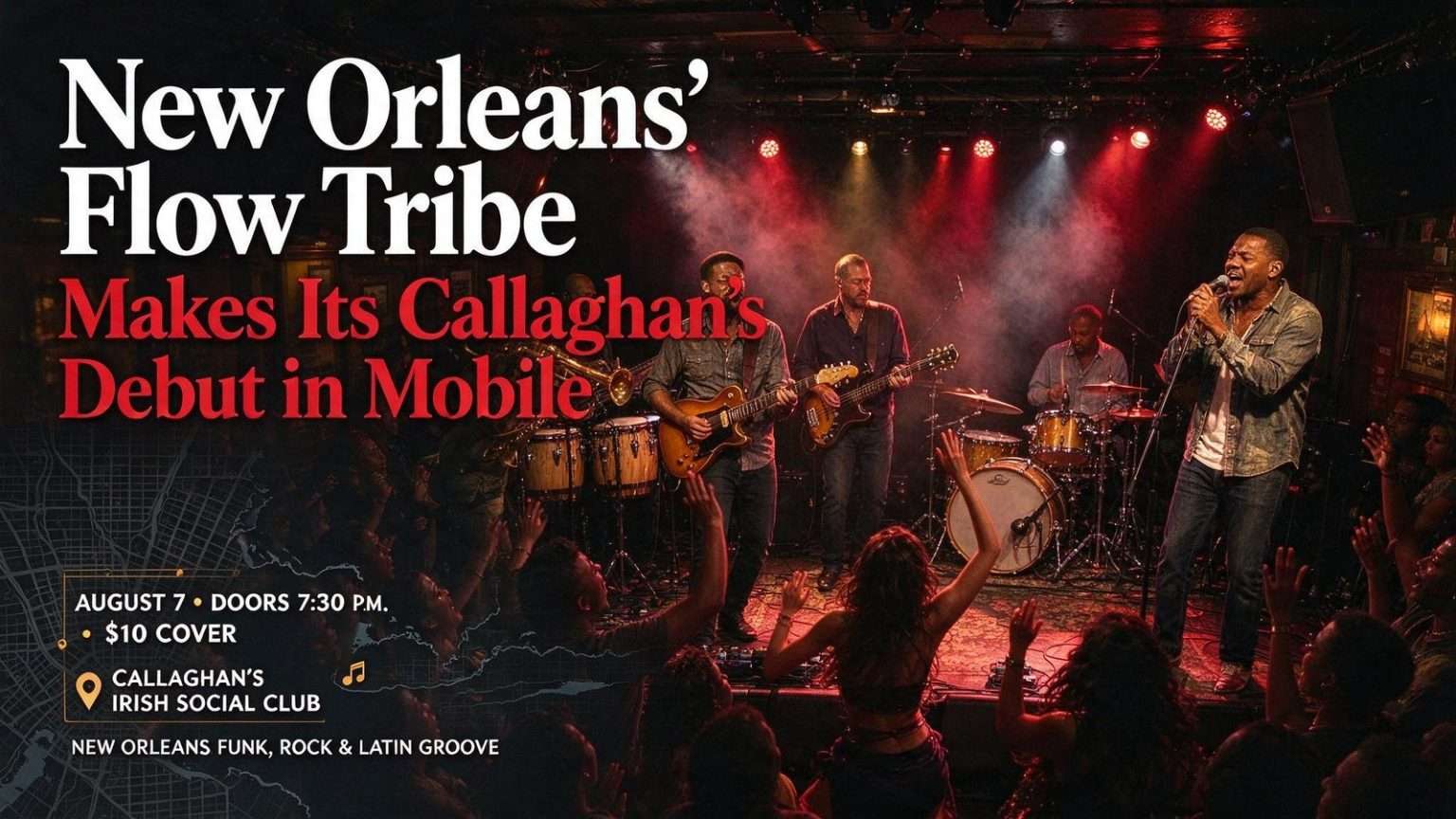
New Orleans outfit Flow Tribe brings its high-energy blend of funk, rock, and Latin groove to Callaghan’s Irish Social Club on August 7, with doors at 7:30 p.m. and a $10 cover. The show marks the band’s first appearance at Callaghan’s, a mainstay of Mobile’s live-music scene. “This will be our first time at Callaghan’s, looking forward to it,” the Flow Tribe members stated.
For a band that spends most of the year on the road, a first-time booking is always a small milestone. Callaghan’s occupies a particular place in Mobile’s music landscape: a neighborhood-sized club with a reputation built on booking touring regional acts rather than national headliners, and a room where the band and the audience are never far apart. Venues like it have long served as the proving grounds for Gulf Coast acts, and a strong debut there can turn a passing tour stop into a recurring date.
Flow Tribe arrives in Mobile as part of a busy summer run, the kind of schedule that has become standard for New Orleans bands working the regional circuit. New Orleans musicians have historically depended on the broader Gulf Coast for touring income, with clubs in Mobile, Pensacola, Biloxi, and the Florida Panhandle forming a natural loop that keeps a working band busy between hometown gigs. The short drive from New Orleans to Mobile — barely a few hours west on Interstate 10 — makes the city an easy and frequent extension of a New Orleans band’s itinerary.
A Gumbo of Influences
For the uninitiated, the band draws on a wide musical palette. Members likened the mix to a great New Orleans gumbo, pulling from funk to rock to Latin rhythms, with influences ranging from James Brown to G. Love and Special Sauce. “Anything that has a solid groove and gets you going. Audiences can expect to leave thoroughly entertained and satisfied,” Flow Tribe said.
That gumbo metaphor is more than a press-kit flourish. New Orleans music has always been an accretive tradition, absorbing Caribbean rhythms, brass band cadences, blues, rock and roll, and R&B into something recognizably its own. A band that describes its sound as a gumbo is placing itself squarely in that lineage, insisting that the mixture itself — not any single ingredient — is the point. The comparison also sets expectations for the live show: layered, danceable, and less concerned with genre boundaries than with keeping a room moving.
Funk sits at the center of that mixture, and for good reason. The New Orleans funk tradition, with its syncopated rhythms and emphasis on the pocket, is among the most dance-oriented sounds in American music, and it translates naturally to a club the size of Callaghan’s. The band’s rock and Latin elements broaden the appeal, pulling in listeners who might not otherwise seek out a funk night and giving the set list enough variety to sustain a full evening.
The James Brown reference in the band’s list of influences points to the foundation beneath it all. Brown’s emphasis on relentless groove and showmanship — every song a launching pad for movement — remains the template for funk bands everywhere, and audiences at a Flow Tribe show can expect that spirit. G. Love and Special Sauce, meanwhile, reflect a more recent strain: the laid-back, hip-hop-inflected blues and soul of the 1990s jam-club scene that shaped a generation of touring bands.
Representing the Gulf Coast
The group said it takes pride in representing New Orleans and the Gulf Coast wherever it plays. “We love representing New Orleans and the gulf coast in general wherever we go. Our unique and inclusive culture lets us bring our backbone cracking music all across America and beyond,” the band emphasized.
That sense of cultural ambassadorship is common among New Orleans acts, and it is rooted in something real. The city’s music is inseparable from its festivals, its neighborhoods, and its tradition of public celebration, and bands that grow up inside that culture tend to carry it with them. For audiences outside Louisiana, a New Orleans band’s show often doubles as an introduction to a musical heritage that casual radio listening rarely captures. The band’s pride in Gulf Coast culture more broadly also reflects the shared identity of the communities along the coast, which have long traded music, food, and people back and forth across state lines.
For Mobile audiences, the concert offers a chance to hear that heritage up close without crossing state lines. The connection between the two cities runs deep: the Gulf Coast corridor has historically moved music as readily as freight, and Mobile crowds have long shown an appetite for New Orleans rhythm and brass. A funk and groove band from the Crescent City playing a Mobile social club is less an exotic booking than a continuation of a decades-long exchange.
Callaghan’s Role in the Local Scene
Callaghan’s continues to be one of the Mobile venues that regularly brings regional acts to town, and Flow Tribe is among the many performances the club has hosted over the years. The Irish Social Club has built its booking identity around exactly this model: keeping touring bands from New Orleans, Pensacola, and across the Southeast on the calendar, and giving local audiences a steady supply of live music without the ticket prices of a concert hall.
Small clubs like Callaghan’s punch above their weight in the regional music economy. They offer bands reasonable guarantees on weeknights and weekends, they cultivate loyal regular crowds, and they give developing acts a room big enough to build a following but small enough to feel the audience’s response. For a band making its Mobile debut, the club is an ideal first stop — intimate enough to win over newcomers and established enough to draw the local listeners most likely to become fans.
The practical details are simple. Doors open at 7:30 p.m. on August 7, the cover charge is $10 at the door, and the show runs with Callaghan’s usual setup — a compact room where arriving early generally means a good spot close to the stage. Ten dollars remains one of the better entertainment bargains in Mobile for a touring band’s full live show, and the club’s neighborhood location makes it an easy night out.
For Flow Tribe, the night is a first impression, and first impressions on a new market matter for a touring band’s long-term plans. A strong showing can lead to return bookings, word-of-mouth crowds the next time through, and a foothold in a city that sits conveniently on the Gulf Coast touring loop. Given the band’s stated enthusiasm for the debut and Callaghan’s track record with New Orleans acts, the ingredients are in place for the kind of show that generates exactly that kind of momentum — a packed room, a funk-heavy set, and a Mobile audience introduced to one of New Orleans’ hardest-working groove bands.
What a Flow Tribe Show Looks Like
Flow Tribe shows are built for movement. The band’s sets typically run long and groove-heavy, with songs blending into one another and tempo shifts designed to keep a dance floor from ever fully cooling off. The Latin percussion in the band’s arsenal gives the rhythm section an extra layer that sets it apart from standard funk-rock outfits, while the guitar work keeps one foot firmly in the rock tradition. In a room the size of Callaghan’s, where the crowd stands close to the band, that energy tends to feed on itself — the tighter the space, the more electric the show.
The band’s versatility has made it a fixture of the New Orleans festival scene as well as the club circuit, with appearances alongside a wide range of local acts. That breadth matters on tour, where a band may play a festival stage one night and a small club the next. Flow Tribe’s members have spent years developing the sort of tight, road-tested sound that only comes from constant live work, and Mobile audiences on August 7 will be hearing a band in touring form rather than one easing back into live rhythm.
For the members, the first visit to Callaghan’s is also a chance to see one of the venues they have heard about from other Gulf Coast musicians. New Orleans bands talk shop across the circuit, and certain clubs develop reputations among traveling acts long before a band plays them. Callaghan’s standing as a friendly room with an attentive crowd has made it one of those stops — the kind of gig a band looks forward to on the calendar rather than a date to be gotten through.
A Night Out in Mobile
The show also lands at a good moment in Mobile’s summer. August is traditionally a lean month for touring acts in the Southeast, with many bands taking a break from the heat, which makes a high-energy New Orleans funk show in an air-conditioned local club an easy sell. For residents looking for live music that night, the choice is straightforward: doors at 7:30 p.m., $10 at the door, and a band whose entire reputation rests on leaving rooms thoroughly entertained.
As Callaghan’s continues to book regional acts week after week, nights like this one are what keep the club’s ecosystem healthy — a touring band making its debut, a curious local crowd, and a modest cover that keeps the door open to anyone willing to take a chance on something new. If the band’s own description of its show holds up, those willing to take the chance are likely to walk out satisfied, and Mobile’s live-music scene gains one more connection in its long, ongoing exchange with New Orleans.


