Nine Paddlers Chart the Length of Three-Mile Creek — and Find a Restoration Worth Fighting For
Nine Mobilians kayaked the length of Three-Mile Creek, likely a modern first, finding cleaner water than Dog River and hope in a restoration push.
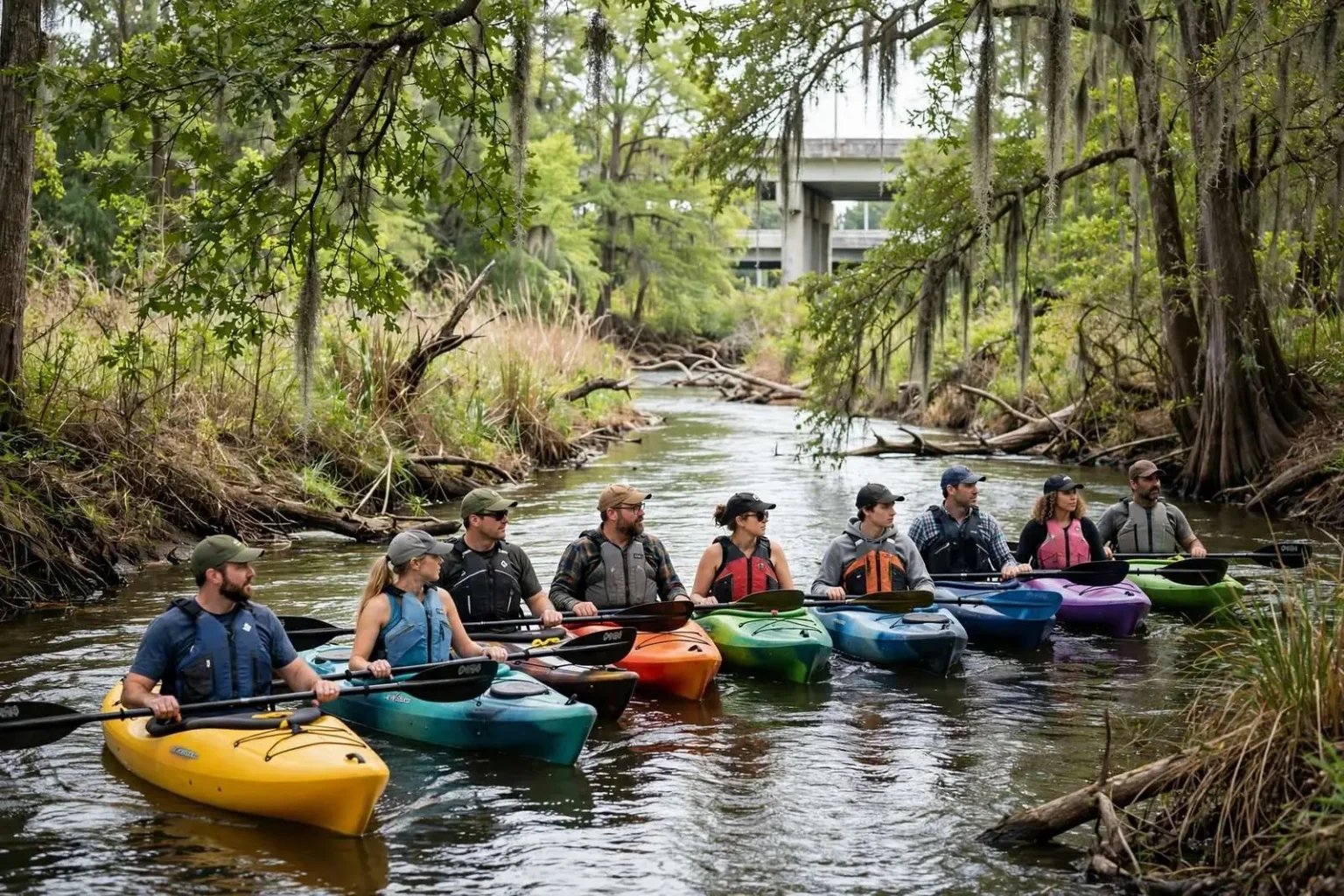
Nine Mobilians set out on July 25, 2011, to do something nobody could recall anyone doing in modern times: paddle the length of Three-Mile Creek from end to end. The team — Chris A., Lindsay B., Heath G., Ted F., Allie S., Colin D., Brendon C., Kris Skoda and Jamie Voss — ran the creek in stages, from the Japanese Garden to I-65 and onward toward Mobile Infirmary, documenting the trip on video.
The expedition was part endurance test, part reconnaissance mission. Three-Mile Creek threads through some of Mobile’s oldest and most neglected urban corridors, and the paddlers wanted to see for themselves what the waterway actually looks like along the stretches most residents know only from car windows and overpass views — and what it could become if the city ever commits to restoring it.
A creek with a champion
Efforts to reclaim the waterway have been gathering force. Dr. George Crozier of the Dauphin Island Sea Lab has secured grants to restore Three-Mile Creek and build a linear park and bike trail along its banks, with groups such as Mobilians on Bikes pitching in. After three centuries of steady degradation at the hands of generations of residents, the creek may finally be getting a plan for its future.
Crozier, the Sea Lab’s longtime executive director, has been among the most persistent voices arguing that Mobile’s relationship with its own waterways is overdue for repair. His vision pairs ecological restoration with public access — a cleaned-up creek lined with a trail that would connect neighborhoods to the water and to each other, in the way that urban greenways have transformed cities across the country.
Mobilians on Bikes, the cycling advocacy group that has pushed for better bicycle infrastructure across the city, saw in the creek corridor a chance to link the trail vision to its own goals: a continuous, car-free route along the water would give cyclists a connection through the heart of the city that no street network can offer.
What they found above I-65
The paddlers came back with an unexpected finding: above I-65, at least, the creek receives less stormwater runoff and runs cleaner than Dog River. For a waterway with a reputation as an open sewer, the finding upended expectations. The upper stretches, less burdened by the storm drains of the city’s developed core, showed water quality that compared favorably with a creek most Mobilians consider a recreational asset.
The comparison matters because Dog River — with its own active association, its waterfront homes, and its established kayak launch — represents what Mobile already knows a healthy urban waterway can be. If the upper Three-Mile Creek runs cleaner than a river the city treats as an amenity, the argument follows that the creek’s problem is not the water itself but everything the city has allowed to happen to it downstream.
The crew stayed well upstream of the Macy Place spill site, noting that anyone who had been in Mobile Bay that weekend had more reason for concern. The reference was to an ongoing spill incident that had drawn public attention that summer, and the paddlers’ point was blunt: the creek’s worst problems are concentrated, identifiable, and separate from the baseline water quality a restoration effort would be working with.
What Denver can teach Mobile
The expedition’s advocates point to Denver’s South Platte River as the model — a waterway once written off as a drainage ditch that now draws joggers, cyclists and kayakers along its restored banks. The South Platte’s transformation, which began in the 1970s and accelerated through the 1990s, turned a channelized industrial river into the spine of Denver’s park system, with miles of greenway trail, whitewater features, and the redevelopment that followed the water’s revival.
The lesson the Three-Mile Creek advocates draw is not that Mobile should copy Denver’s plan, but that the trajectory is available. A waterway’s reputation is not permanent; investment, cleanup, and public access compound on one another until a creek that residents once avoided becomes the reason they move to a neighborhood. Every restored urban waterway in the country began as a Three-Mile Creek — dismissed, polluted, and running through the part of town nobody visited on purpose.
Everything flowing through Three-Mile Creek, which winds through neighborhoods including Crichton and Toulminville before it reaches the bay, ends up in Mobile Bay and its sea life. The creek is not a backwater; it is a tributary of the estuary that drives the region’s economy, from the seafood industry to the tourism that fills the beaches each summer. What runs off Crichton’s streets and Toulminville’s yards flows, eventually, into the same waters that Mobile’s oystermen work and the Bay’s dolphins hunt.
That downstream connection is the conservation argument in miniature. Residents who would never dream of dumping into Mobile Bay often think nothing of what washes into a neighborhood creek — and the creek is simply the delivery system. Restoring Three-Mile Creek, its advocates argue, means treating the whole watershed as one system, from the storm drains of the upper neighborhoods to the bay itself.
Readers even submitted a photo of what appeared to be a 12-foot alligator in the creek, a reminder that despite its degraded reputation, the waterway supports wildlife that has quietly persisted through decades of neglect. Alligators inhabit the drainage systems of coastal Alabama cities regularly, and a large one in Three-Mile Creek would surprise no herpetologist — though it gave the paddlers something to think about on the stretches they ran.
The route the nine ran
The paddlers’ route traced the creek from its upper reaches at the Japanese Garden — the landscaped gardens on Mobile’s western side — down to I-65 and then onward toward the Mobile Infirmary area, splitting the trip into stages that could be completed and documented in a single day’s effort. The video the team recorded gives Mobile a rare continuous portrait of the creek: the clear upper stretches, the narrowing channel as development closes in, the debris and obstructions accumulated over decades, and the wildlife living in spite of it all.
Running the creek end to end also served a practical purpose for the greenway vision. A linear park is only as strong as its weakest segment, and the paddlers’ account — logjams, low culverts, eroded banks, and the occasional clear, quiet run — amounts to the first-hand survey that planners and grant writers need. Crozier’s grants fund studies and construction, but the ground truth of what the corridor looks like today has come from exactly this kind of citizen effort.
The nine paddlers emerged from the creek with sore arms, video evidence, and a story to tell that city officials and neighborhood groups have been hearing in pieces for years. What they saw above I-65 suggests the restoration question is not whether Three-Mile Creek can be saved, but which segments get saved first — and whether Mobile will treat the creek as the asset its advocates insist it already is.
Three-Mile Creek’s name understates its reach. The waterway gathers drainage from a broad swath of west and central Mobile, flowing through neighborhoods whose residents live alongside it without always knowing its name — and through some of the city’s most historically significant corridors. Crichton and Toulminville, the communities the paddlers noted along the route, are among Mobile’s oldest settlements outside the downtown peninsula, and the creek has run through their geography since long before it ran through anyone’s culverts.
Three centuries of degradation is not an exaggeration. From the colonial era forward, the creek has absorbed whatever Mobile built beside it — sawmills, rail lines, highways, subdivisions, and the storm drains that tie every impervious surface in the watershed directly to the water. Urban creeks across the South share this history, but few remain as little known to their own cities as Three-Mile Creek has been to Mobile.
The greenway vision taking shape
The linear park and bike trail that Crozier’s grants support would run along the creek’s corridor, linking the neighborhoods it threads together and giving them a destination instead of a drainage. Urban greenways built along restored waterways have become one of the most reliable economic development tools American cities have discovered: trails attract daily users, daily users attract businesses, and businesses return tax revenue that pays for the maintenance the original restoration required. The South Platte in Denver, the Chattahoochee in Atlanta, and dozens of smaller river corridors across the South followed that arc from liability to centerpiece.
For Mobile, the creek corridor offers something the street grid cannot: a continuous public route through the city that crosses no major intersection. A trail along the water could connect the western neighborhoods to the bay without a single traffic light, linking parks, schools, and commercial districts along the way. That is the pitch advocates have been making to grant agencies, and the nine paddlers’ expedition was, in effect, that pitch documented in real time.
Mobilians on Bikes and similar advocacy groups have been pressing the city on connected infrastructure for years, and the creek trail would give the cycling community its longest protected corridor. The alignment of interests — environmental restoration, recreation, transportation, and neighborhood development — is what has allowed the creek’s advocates to keep securing grant funding even as the restoration itself remains a work in progress.
The expedition’s video, meanwhile, does what no grant application can: it shows residents their own creek. In a city where most people’s closest view of Three-Mile Creek is from an overpass at sixty miles an hour, nine Mobilians paddling it end to end and filming what they found may be the most persuasive restoration argument yet made.