No Charges Filed After Incidents at Clarke County-Jackson Game
No charges were filed after incidents surrounding the Aug. 14 Clarke County-Jackson preseason football game in Grove Hill, including a cutting at a nearby McDonald's.
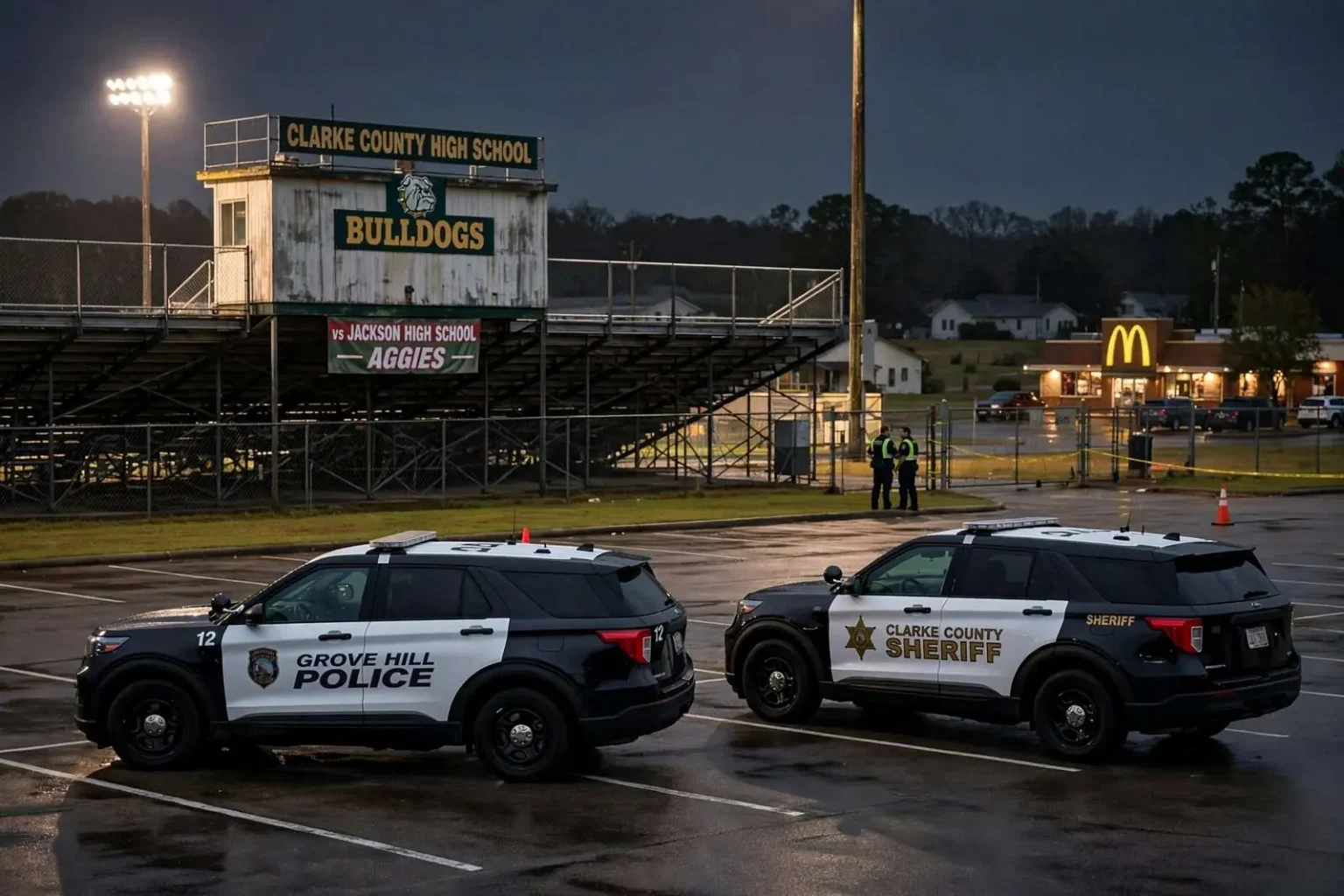
GROVE HILL, Ala. — No arrests have been made after a series of incidents surrounding a preseason football game between Clarke County High School and Jackson High School, including a cutting at a McDonald’s restaurant after the contest. Grove Hill police and other law enforcement officers dealt with a variety of issues before, during and after the Aug. 14 game in Grove Hill, including a juvenile who was cut on his ankle.
The episode underscored the challenges that accompany the renewal of a long-dormant rivalry, even in a preseason setting. Preseason jamboree games do not count in the standings, but they draw the crowds, the emotions and, in this case, the complications of a matchup that had been shelved for years because officials on both sides feared exactly the kind of trouble that followed this one.
Incidents After the Game
Grove Hill Police Chief Daniel Gibson said the cutting happened at the McDonald’s restaurant after the game. Gibson said no charges have been filed against those involved, whom he said are from Thomasville. A juvenile was cut on his ankle in the episode, and investigators continued to review what occurred at the fast-food restaurant in the hours after the final whistle.
Other incidents included several that Gibson described as “scuffles,” as well as one car chase. None of the post-game episodes produced immediate arrests, though police typically continue gathering statements and reviewing any available video before deciding whether charges are warranted. The scattered nature of the incidents — spread across the game venue, nearby businesses and local roadways — is a familiar pattern for officers handling large crowds after emotional contests in small towns, where a single intersection and a handful of restaurants must absorb hundreds of departing fans.
Small-town policing of a rivalry game involves particular difficulties. Grove Hill, the seat of Clarke County, has a modest police force, and a game drawing fans from two communities can temporarily double or triple the population needing supervision. Fast-food restaurants along the main routes become gathering points, and incidents that begin with taunting in the stands can re-erupt an hour later miles from the stadium.
A Heavy Law Enforcement Presence
Gibson said his entire force was on patrol, along with several officers from the Jackson Police Department and Clarke County sheriff’s deputies. He said officers made several traffic stops after the game that he credited with keeping tensions and possible altercations at bay.
That level of coordination reflects planning rather than luck. Mutual aid among small municipal departments and the county sheriff’s office is standard practice across rural Alabama, where no single agency can staff a major event alone. Clarke County sheriff’s deputies cover a large, mostly rural county, and Jackson, the larger of the two cities involved, fields its own department. Pooling those resources for the game gave commanders the flexibility to assign officers to the stadium, the parking areas, the restaurants and the roads out of town simultaneously.
The traffic stops Gibson credited with defusing tensions serve two purposes in that kind of deployment. They slow the exodus of vehicles from the stadium area, spacing out traffic and reducing the chances of confrontations at stoplights and parking lots, and they put marked patrol cars visibly in the path of anyone considering a continuation of trouble away from the game. Officers who stop a vehicle for a moving violation also gain a lawful opportunity to assess whether occupants are armed, impaired or spoiling for a fight.
A Rivalry Renewed
Friday’s game was the first contest between the two teams, once fierce county rivals, since 2021. Games had been curtailed because of the fear of problems. Jackson won 28-0.
The history behind that caution is common in Alabama high school football, where county rivalries can run generations deep. Clarke County and Jackson are separated by a modest drive through the county, and fans on both sides include relatives, coworkers and longtime acquaintances — familiarity that fuels the intensity of the matchup and, on bad nights, spills past the fence line. When incidents accumulate across successive meetings, athletic directors and principals sometimes conclude that the safest course is to drop the series for a period, as happened here, and the decision to restore it is always made with a plan for security.
Preseason games occupy an unusual place in that calculus. A jamboree offers both programs a live rehearsal before the regular season, and for coaches it is a chance to evaluate rosters under game conditions. But the preseason label offers no protection against crowd problems, as the Aug. 14 events made clear; the stands were full and the stakes, for fans, felt real despite the zeroes those games place in the record books.
High School Football and Crowd Security in Rural Alabama
Friday night football is the largest recurring public gathering in most rural Alabama counties, and school systems treat it accordingly. Districts employ resource officers, hire off-duty police and coordinate with local agencies for big games, and principals review crowd management plans each season. Gates, designated visitor sections and expelled-spectator lists are all standard tools, and many systems now enforce clear-bag policies and restrict re-entry to keep stands orderly.
The Alabama High School Athletic Association also gives member schools a framework for handling trouble. The AHSAA can fine schools, place programs on probation or require contests to be played without spectators when crowd control repeatedly fails, and athletic directors across the state are well aware that a single bad night can bring that scrutiny down on a program. That enforcement structure is one reason schools sometimes suspend a rivalry voluntarily: a district can avoid AHSAA penalties by simply declining to schedule a problematic matchup.
What Happens Next
With no arrests made and no charges filed, the immediate outcome of the Aug. 14 incidents is a set of open investigations rather than court cases. Police in situations like this typically continue interviewing witnesses, canvass businesses for camera footage and consult with the district attorney’s office before closing files. Juvenile cases add another layer, since matters involving minors are handled through the youth court system and details are rarely made public.
For the two schools, the game itself is now a completed data point in the decision of whether the rivalry continues beyond this preseason rehearsal. The score — a 28-0 Jackson win — will be remembered by the players; the off-field incidents will weigh on the administrators. If both communities conclude that the presence of a large, coordinated law enforcement detail kept a rough night from becoming a dangerous one, the series may earn its place back on the schedule. If not, the hiatus that stretched from 2021 to this year could easily resume.
For Grove Hill residents, the episode was a reminder of what a Friday night can bring to a town of modest size. The police chief’s account — an entire force deployed, mutual aid from Jackson and the county, pre-emptive traffic stops, and no serious injuries beyond the juvenile’s ankle wound — reads as a picture of a department doing what it could with what it had. The quiet streets afterward, with no arrests and no charges, suggest that as much was contained as happened, which in the ledger of renewed rivalries counts as a manageable night.
The Communities Involved
Clarke County High School draws from Grove Hill and the surrounding county, while Jackson High School serves the county’s largest city to the south. Jackson sits along the Tombigbee River and has long been the industrial center of Clarke County, with timber and papermaking anchoring its economy, while Grove Hill anchors county government from its courthouse square. The two programs know each other well from decades of region play, and alumni on both sides can recite the old games from memory.
Thomasville, home to those involved in the McDonald’s cutting, lies just across the county line to the north and maintains its own city school system. Its connection to the incident illustrates how a rivalry game pulls spectators from well beyond the two participating communities — friends, relatives and fans from neighboring towns all fill the stands, and after the game they all end up on the same roads and in the same restaurants.
Keeping Perspective
It is worth noting what did not happen on Aug. 14. A juvenile was treated for a cut to his ankle, scuffles were broken up, one vehicle pursuit ended, and everyone went home. No one was hospitalized with life-threatening injuries, no shots were reported, and no charges have been filed against anyone. For a night that police had feared enough to curtail the series over in years past, the presence of the heavy law enforcement deployment appears to have made the difference between scattered disturbances and something far worse.
Sheriff’s deputies, Grove Hill officers and Jackson officers together gave the event a security footprint that a single small department could never have provided, and the traffic stops that Gibson credited with calming the roads afterward were a low-drama tactic with a high payoff. As the investigations wrap up, both schools and both cities will be left to decide whether football’s oldest kind of contest — two county rivals separated by a short drive — belongs back on the regular schedule, played under lights, with the lessons of this preseason night written into the game plan.