
No One Hurt as Early-Morning Fire Damages Mobile Duplex on Persimmon Street
Firefighters responded to a duplex fire on Persimmon Street in Mobile around 4:30 a.m. Friday. No one was hurt and the cause remains under investigation.
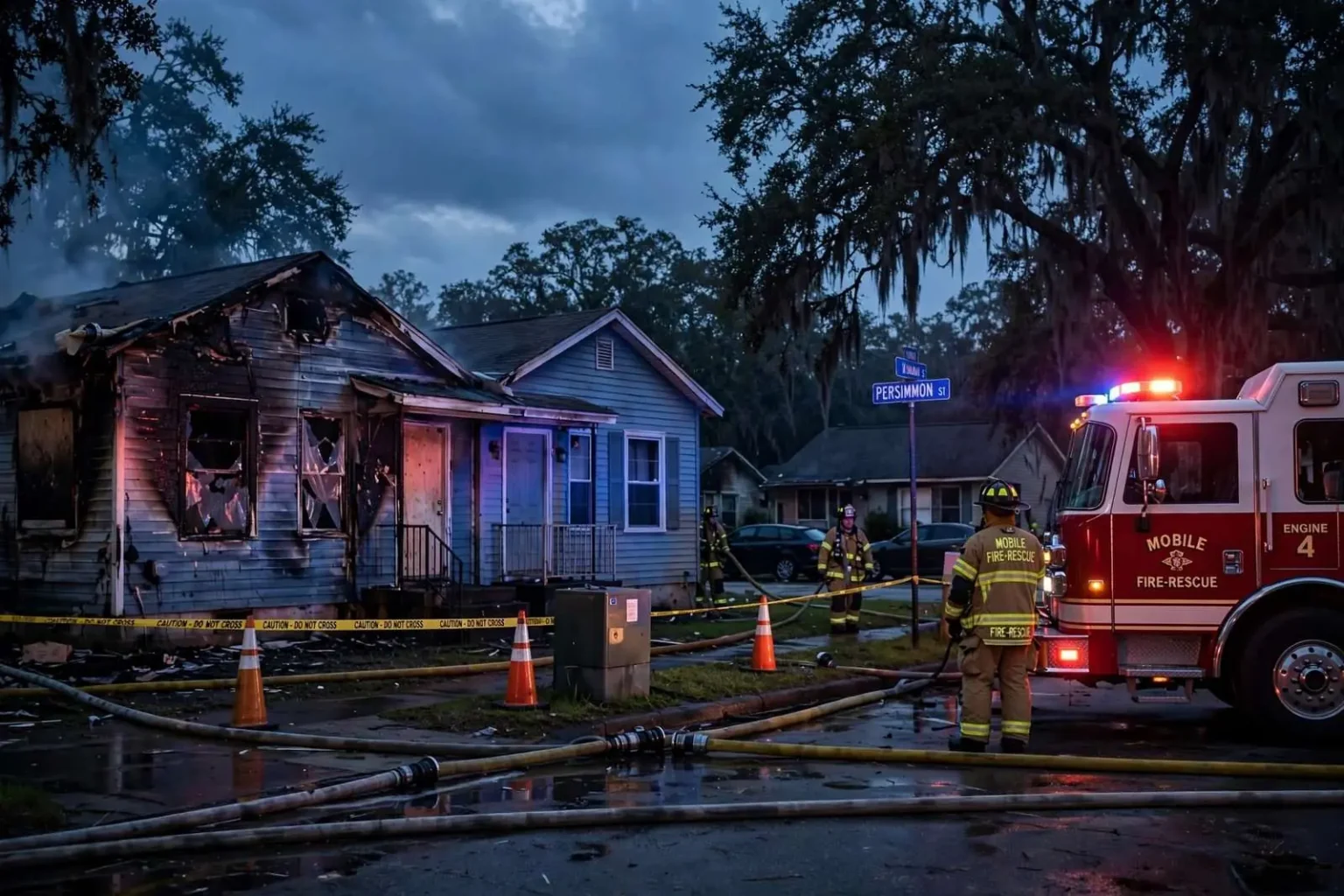
Duplex Fire Strikes Persimmon Street Before Dawn
Firefighters were called to a duplex fire on Persimmon Street in Mobile early Friday morning after flames broke out around 4:30 a.m. No one was hurt in the blaze. According to neighbors, the man who lived in the duplex was hospitalized at the time for an unrelated medical issue and was not home. The cause of the fire remains under investigation.
A pre-dawn house fire is among the most dangerous calls a fire department answers, precisely because everyone nearby is asleep. Flames visible at 4:30 in the morning, when darkness hides smoke and residents’ defenses are at their lowest, depend on early detection — an alert neighbor, a passing driver, or a working smoke alarm — to get crews moving before the fire spreads beyond the unit where it started. On Persimmon Street, the call brought Mobile firefighters out in darkness, and the result was the best one available: everyone accounted for and no injuries.
The duplex occupied by the fire is the kind of housing that fills much of Mobile’s older neighborhoods — side-by-side units sharing a wall and a roofline, often home to long-term residents and working families. Fires in attached housing carry a built-in urgency that detached homes do not: a fire in one unit can extend into the shared attic or wall cavity and quietly move next door before anyone sees it. Crews arriving on Persimmon Street would have been working against that possibility from the first moments, opening walls and checking the adjoining unit while knocking down the visible fire.
According to neighbors, the man who lived in the duplex was hospitalized at the time for an unrelated medical issue, which placed him away from the scene during the fire. That circumstance, a cruel piece of timing on any other day, meant the home’s resident was spared the fire’s danger entirely — and spared the experience of waking to flames in his own house. His recovery from the medical issue that put him in the hospital now comes with a second burden waiting at home, and neighbors’ accounts of his absence were laced with relief that he was not there to face it.
The Night Work of Firefighting
A structure fire in the hours before dawn assembles a response that residents rarely see in full. Engines and ladders roll from stations across the district, a Battalion chief takes command of the scene, and the first-arriving crew makes the split-second assessment that shapes everything else: is this an offensive fire, fought from inside, or has it grown beyond that? Water supply is established from the nearest hydrant, hoses are stretched, and a rapid-intervention team is assigned to stand by for a mayday that everyone hopes never comes.
In a duplex, the first minutes also answer the question that matters most to the neighborhood: is anyone inside? Crews search the smoke even as they fight the fire, checking bedrooms and back rooms of both units. On Persimmon Street, that answer came back clean — no one was home, and no one was hurt. The other half of the duplex, its occupants roused by alarms or by knocks on the door, stood in the street while firefighters kept the flames from crossing the common wall.
Utility crews are called to cut gas and electricity, both to remove fuel from the fire and to make the building safe to work in. Traffic is rerouted around the block, and neighbors gather at the tape. In the aftermath, the fire scene belongs to investigators, who walk it once the hot spots are darkened, reading the damage for clues about where the fire started and how it spread. The cause of the Persimmon Street fire remains under investigation, and that process — photographs, samples, interviews with the residents and the first crews — unfolds over days.
Fires in Mobile’s Older Neighborhoods
Mobile’s housing stock, much of it built in the first half of the twentieth century, gives the city a character that residents prize — and gives its fire department a challenge that newer cities do not face. Older wood-frame construction, aging wiring, and houses packed close together along narrow streets all raise the stakes when fire breaks out. The city’s fire crews know these neighborhoods block by block, know which hydrants work and which streets will not fit two trucks abreast, and that local knowledge is part of why early-morning fires in Mobile so often end without serious injury.
Smoke alarms remain the single most important piece of equipment in that equation. Fires at 4:30 a.m. kill sleeping residents when alarms fail, and fire departments across the country — including Mobile Fire-Rescue — distribute free alarms and batteries for exactly this reason. A duplex fire with no one home is the mirror image of the tragedy those programs exist to prevent; the same house occupied on any other night would have depended on working alarms to wake its resident in time.
The neighborhood response to a fire like this one is also part of the city’s fabric. Neighbors who stood in the dark watching the flames are the same people who will pass along word about the resident’s condition, help sort through what can be salvaged, and connect a displaced family with the organizations that step in after a fire. The American Red Cross responds to house fires across the Gulf Coast region to arrange emergency lodging and immediate needs, and churches and civic groups in Mobile’s neighborhoods routinely fill in the gaps that formal aid does not cover.
Fire officials use every incident like this one to repeat the lessons that cost nothing to apply. Keep a working smoke alarm on every level of the home and test it monthly. Close bedroom doors while sleeping, because a closed door slows both fire and smoke long enough to matter. Plan two ways out of every room and agree on a meeting place outside, so that no one re-enters a burning building to search for a family member who is already out. And once out, stay out — firefighters have the equipment and the training to go back in, and residents do not.
What the Investigation Will Examine
Determining the cause of a fire is slow, methodical work, and it begins only after the scene is safe. Investigators from Mobile Fire-Rescue walk the structure from the least-damaged areas toward the point of origin, reading burn patterns and heat shadows for the story they tell. They look at the electrical system, the heating equipment, and any appliances in the room of origin; they collect samples where accelerants are suspected; and they interview neighbors, the resident when he is able, and the firefighters who saw the fire in its early stages.
The timing of the fire — around 4:30 a.m. on a Friday — is itself a data point investigators weigh, though it proves nothing by itself. Electrical faults, unattended heating equipment and cooking left overnight all have their own signatures in the debris. Until the investigation concludes, officials describe the cause as under investigation, which is both accurate and deliberate: premature conclusions have a way of hardening into assumptions that later evidence contradicts.
For the resident of the duplex, the investigation’s findings will matter practically as well as personally. Insurance claims, assistance applications and decisions about rebuilding all depend on the documented cause of the fire. A renter in a duplex faces a particular set of challenges, since the structure is someone else’s property — renters’ insurance covers belongings, and coverage decisions follow the investigation’s conclusion about how the fire started.
The Road Back After a Fire
A house fire’s damage is measured in more than what burned. Smoke permeates everything the flames did not touch, water and the holes cut to fight the fire compound the loss, and homes that are structurally sound are often unlivable for weeks. For the Persimmon Street duplex, the days after Friday morning will bring board-up crews, insurance adjusters and the unglamorous work of cataloging what can be kept and what cannot — and for a resident who was in the hospital when it happened, the first sight of the damage is still ahead of him.
The neighborhood, meanwhile, resumes its routine with the fire’s aftermath in view. Persimmon Street runs through a residential stretch of Mobile where duplexes and small homes sit close to the sidewalk, the kind of blocks where people notice when a neighbor’s porch light is dark. The news that no one was hurt travels fast and settles a block down; the sight of a burned duplex stays longer, a reminder of how quickly an ordinary night can change.
The final accounting of the Persimmon Street fire will come from the investigators, and this summary reflects what was known in the hours after the blaze: flames around 4:30 a.m. Friday, no injuries, the resident away and hospitalized for an unrelated medical issue, and the cause still under investigation. What was already clear by dawn was the outcome the city’s fire crews work every night to produce — a fire contained, a neighborhood intact, and everyone alive.


