Officer Hospitalized After Struggle With Wanted Man in Thomasville
Thomasville police say a man with warrants from 2013 used his car against officers in a Subway parking lot, sending one officer to the hospital.
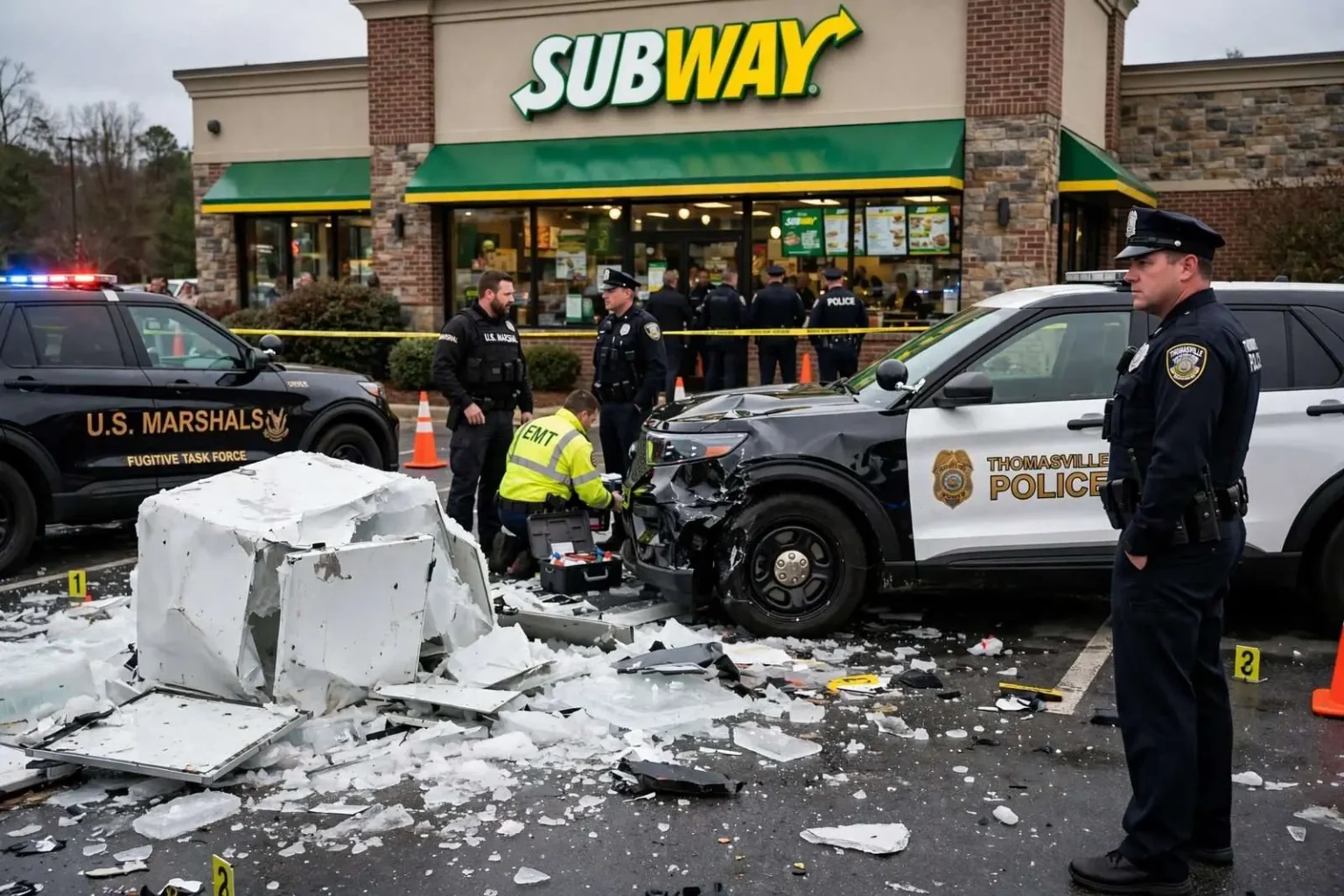
A Thomasville police officer was taken to the hospital Saturday after what police describe as a violent encounter with a man who had warrants dating back to 2013, closing a small-city Saturday with patrol cars, an ice machine casualty and injuries on both sides of the arrest. Officers assigned to the U.S. Marshals Fugitive Task Force located the man, identified by police as Derrius Donae Griffin, sitting in a vehicle in a Subway parking lot in Thomasville.
The task force assignment matters to the story. Fugitive teams operate on accumulated intelligence — addresses checked, associates interviewed, patterns tracked — and locating a wanted person is usually the quiet part of the job: an approach, an identification, an arrest. What followed in the Subway parking lot was, by the police account, the opposite of quiet.
Police account of the encounter
According to the department, Griffin refused to get out of the vehicle and instead put the car in drive, striking an ice machine. In a statement released Tuesday, police alleged that he “used his vehicle as a weapon intentionally trying to strike officers with it” and came close to hitting a bystander. Police said the vehicle eventually collided with a Thomasville patrol car parked behind it. Two officers and Griffin were hurt during a brief struggle that followed.
The sequence described in the statement — a refusal to exit, a vehicle driven at officers, a collision with an unoccupied patrol car, then a physical struggle — represents one of the most dangerous scenarios a fugitive arrest can produce. Vehicles turn a routine warrant service into a potentially lethal encounter within seconds, and departments train extensively on how to approach parked cars, position units and disengage when a subject uses a vehicle aggressively. The ice machine and the parked patrol car took the impacts that, in a marginally different geometry, could have taken officers or a member of the public.
The bystander detail underscores the risk a parking-lot arrest always carries. A fast-food lot on a Saturday serves a steady stream of families and drive-through traffic, and a car moving erratically with officers at its windows endangers everyone in its path — which is why the department’s account emphasized how close the vehicle came to someone not involved in the arrest at all.
Injuries and aftermath
One officer was treated at Thomasville Regional Medical Center and released later the same day. Griffin was also treated for minor injuries. The second officer hurt in the struggle was also injured, and the department’s statement tied the harm to the physical effort of taking a resisting subject into custody after the vehicle episode — the kind of ground-level violence that produces sprains, cuts and contusions even when it ends quickly.
Thomasville Regional Medical Center serves the town and the surrounding Clarke County communities, and a treated-and-released outcome for the injured officer was the day’s best news — the alternative, when a vehicle is driven at police, is frequently far worse. Griffin’s minor injuries were likewise addressed at the hospital, as protocol requires for any subject injured during an arrest.
The allegations described above come from the Thomasville Police Department’s own account of the incident and have not been tested in court. That distinction is standard in police statements about contested encounters, and it will fall to prosecutors and, if charges move forward, the courts to weigh what the evidence shows.
The warrants behind the arrest
Warrants dating back to 2013 tell their own story. A person who has been wanted for years lives in a state of permanent evasion — moving between addresses, avoiding ordinary interactions that produce identification checks, and building a record of failures to appear that deepens the original charges. Fugitive task forces exist precisely because those cases age badly: the longer a warrant sits, the more dangerous the eventual contact becomes, both for the officers making it and for the community the subject moves through.
The U.S. Marshals Fugitive Task Force model pairs federal marshals with local officers — in this case, Thomasville police personnel — to hunt down exactly those long-outstanding warrants. The collaboration gives small departments access to federal databases, cross-county reach and the specialized techniques of fugitive investigation, while local members contribute the ground knowledge of where a subject is likely to be found. Thomasville’s participation reflects a choice many small Alabama cities have made: the volume of outstanding warrants is simply too large for routine patrol to clear alone.
Task force work concentrates its risks at the moment of location. A wanted person confronted after years of evasion has the strongest incentives to resist — the arrest means facing charges that have compounded since the warrants issued — and vehicle encounters are among the highest-risk forms that moment can take.
Thomasville and the region it polices
Thomasville serves as the largest town in Clarke County, a rural stretch of southwest Alabama where the police department handles everything from downtown traffic to the county’s wider social challenges with a force of modest size. An incident like Saturday’s strains a small department in ways larger cities rarely feel: two officers injured at once removes a meaningful share of a shift’s strength, and the investigative, medical and administrative aftermath of an officer-injury arrest lands on the same small command staff that runs daily operations.
The Subway parking lot where the encounter began is the kind of unremarkable site where most American policing actually happens — a fast-food lot on a main road, serving a steady Saturday crowd. The town’s familiarity cuts both ways: officers know the vehicles and the people, and residents know the officers, which makes a public encounter involving a car driven at police a shared local event rather than an anonymous news item.
Thomasville Regional Medical Center, where the officer was treated, anchors healthcare for the surrounding county, and its emergency staff handle the injuries — vehicle, agricultural, highway — that rural south Alabama produces. On this Saturday, that included a police officer struck or hurt in the line of duty and the man accused of causing it.
What happens next
The statement the department released Tuesday — three days after the encounter — reflected the time a contested arrest requires. Witnesses must be interviewed, the scene documented, vehicle damage assessed and the subject’s medical condition resolved enough for booking. Allegations that a suspect used a vehicle as a weapon carry charges of corresponding seriousness, and the department’s language was deliberately precise about what it was asserting and on what basis: its own account, pending the court process.
For the community, the episode served as a plain-language illustration of why fugitive warrants are pursued at all. A man with years-old warrants allegedly drove a car at officers and near a bystander in a fast-food parking lot — the kind of escalation that long-standing warrants are meant to prevent by bringing subjects before a judge before circumstances make the arrest dangerous. The task force officers who located Griffin did the quiet work that preceded it; the struggle that followed is what their training prepares them for, and the released officer’s discharge from Thomasville Regional that same evening was the outcome the town could be grateful for.
The case now moves where all contested accounts eventually go — to the courts, where the department’s allegations will be tested against the evidence gathered in that Subway parking lot.
Vehicle attacks on officers: a recognized danger
The allegation at the center of the Thomasville encounter — a suspect deliberately driving at officers — belongs to a category of incident that police training treats with singular seriousness. Vehicles are the most lethal object most officers will ever face on a call: they weigh thousands of pounds, they move faster than a person can react, and they appear in traffic stops, parking lots and warrant arrests where the officer is standing a few feet away. Departments across the country have revised their approach procedures over the years for exactly this reason — approaching from behind the driver’s door, angling patrol cars as shields, assigning one officer to cover while another makes contact.
When a subject puts a car in drive with officers at the windows, the options collapse to immediate ones: get clear, engage, or both. The ice machine the vehicle struck and the parked patrol car it eventually collided with mark the path that car traveled in those seconds, and the injuries to two officers in the struggle that followed show how quickly a vehicle encounter becomes a physical one. That a bystander escaped without injury — despite the department’s statement that the car came close — was the margin the day’s outcome turned on.
Incidents like this also explain the charge structure that typically follows. Using a vehicle against an officer is treated in Alabama law as a form of assault with a dangerous instrumentality, and prosecutors weigh it alongside the underlying warrants that prompted the contact. The 2013 origin of those warrants means the eventual case, if pursued, would carry years of accumulated exposure.
The cost to a small department
Two officers hurt in a single encounter is a logistical event in a department the size of Thomasville’s. Shifts must be covered, reports completed, the scene processed — all while the department answers to the town for an incident that played out in a public parking lot on a weekend. Small-city departments absorb that strain through overtime, mutual aid and the long hours of the command staff, and the days following such an arrest are consumed with paperwork that larger agencies spread across specialized units.
The officers’ injuries — one treated and released at Thomasville Regional Medical Center the same day, the other hurt in the struggle — also highlight the physical reality of fugitive work. Task force assignments are sought after for their investigative variety, but they concentrate the risk of exactly the encounters a warrant service can produce, and departments that loan officers to these teams accept that their people face the most resistant subjects in the region.
For Griffin, treated for minor injuries before booking, the encounter ended years of evasion — and began the court process that will test the department’s account.
The account and the courts
The Thomasville Police Department’s Tuesday statement was built the way police statements about contested arrests must be: attributing every claim, describing what officers said happened, and preserving the distinction between allegation and adjudication. The department’s account — the refusal to exit, the vehicle driven as a weapon, the near-miss with a bystander, the collision with the patrol car, the struggle — will be measured against witness statements, the physical evidence of the damaged car and ice machine, and whatever the task force officers testify to.
That process matters to everyone involved. Griffin faces the weight of his warrants and the new allegations; the officers’ account will be scrutinized, as it should be; and the public record of what happened in that parking lot will be settled where such records are settled — in court, on evidence, not in the initial statement.
What was not in dispute in the immediate aftermath was the shape of the outcome: one officer home from the hospital by nightfall, another injured in the line of duty, a fugitive with warrants stretching back to 2013 finally in custody, and a Thomasville Saturday that reminded the town how quickly an ordinary parking lot can become the most dangerous place its police officers visit all week.