Okaloosa County Mother Speaks Out After Viral Video Captured Daughter’s Abuse
An Okaloosa County mother speaks out after a hidden bedroom video captured years of abuse; Damon Becnel faces child abuse and animal cruelty charges.
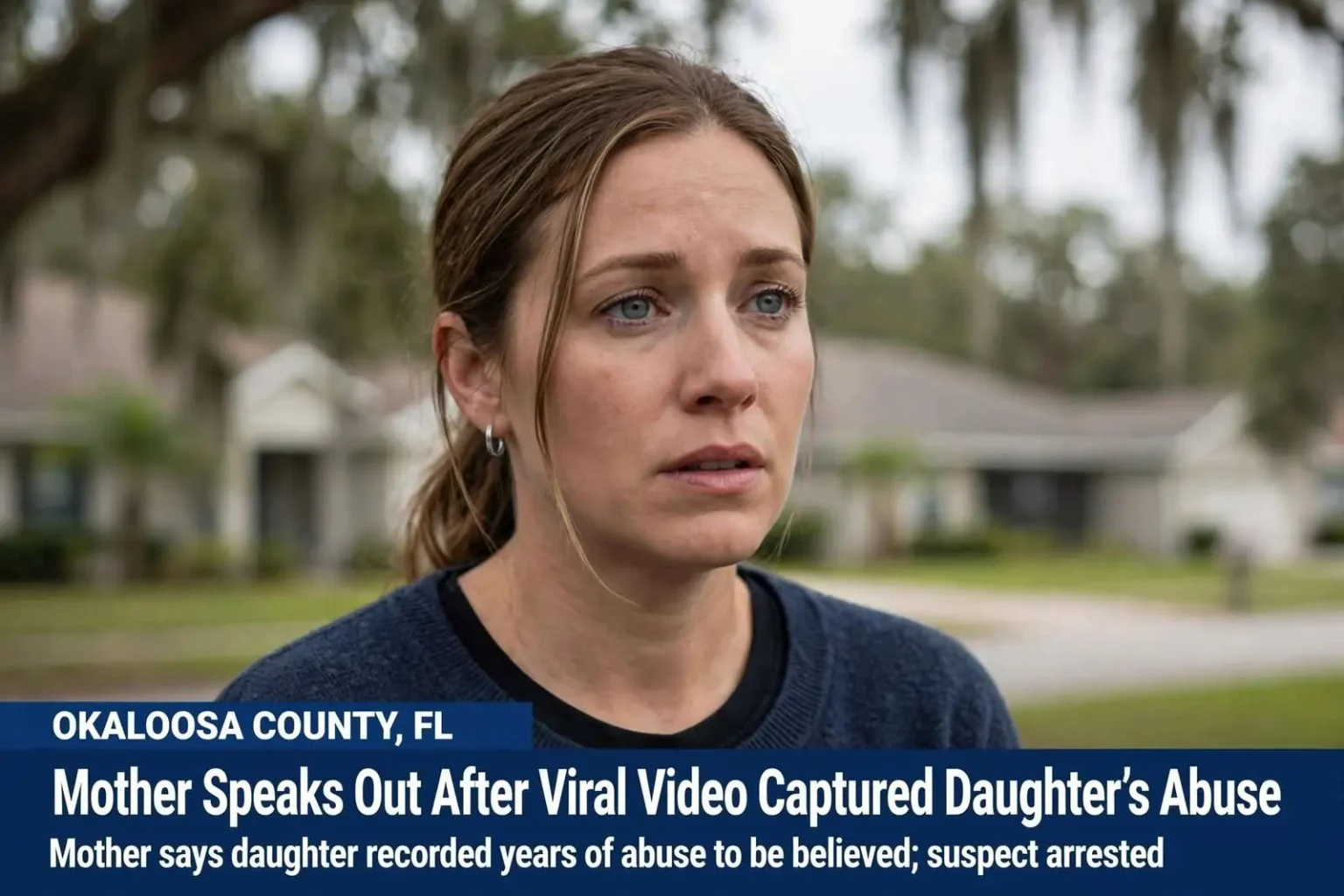
An Okaloosa County mother is speaking out after a home video recorded inside her daughter’s bedroom captured years of abuse — evidence she says finally made people believe the child. The case, built around footage the girl recorded herself, has drawn attention to how long allegations can go unconfirmed when they rest on a child’s word alone.
According to Okaloosa County Sheriff’s investigators, the video captured the girl being abused and her dog being threatened with a knife. The man seen in the video, Damon Becnel, was arrested and charged with child abuse and animal cruelty. Deputies took Becnel into custody after reviewing the recording, which became the center of the case against him.
Mother: ‘Nobody believed her’
Allison Tringas, the mother of the victim, does not have custody of her daughter but said watching the footage was devastating. “When I saw the video for the first time I puked,” Tringas recalled, describing a reaction she says still accompanies every memory of the recording.
She said the abuse went on for years, and that her daughter installed a camera in her bedroom only after no one believed her reports. That detail — a child resorting to recording her own room to document what she was telling adults — has become the case’s defining fact in the community’s response to it.
“The whole world will now have a glimpse of what my daughter has lived through,” Tringas said, explaining her decision to speak publicly. By coming forward, she said she hopes the case prompts adults to take children’s reports seriously before physical evidence becomes the only convincing form.
Tringas’ account raises the questions that child-welfare professionals confront routinely: children who disclose abuse are sometimes disbelieved, especially when the accused is a family member or trusted adult, and the burden of proof can fall on the least powerful person in the situation. Advocates for children stress that a disclosure is a process, not a single statement, and that the adults who receive it are the child’s first — and sometimes only — path to safety.
Prior investigations
The Florida Department of Children and Families confirmed three investigations have been conducted involving Becnel — one in 2018, one in 2019 and one still open at the time of reporting. The department’s confirmation of the repeated contact with the family has added to questions about how earlier inquiries were resolved and what information they produced.
DCF investigations typically examine allegations, interview children and adults in the household and close with findings that determine whether services, monitoring or court involvement follows. The department does not generally comment in detail on closed cases, but the existence of three separate investigations involving the same man has become a focus of the public discussion surrounding the arrest.
Child-welfare advocates note that repeated investigations without removal or intervention are among the hardest patterns in the system: investigators must weigh evidence that may be inconclusive against the disruption of removing a child, and allegations that cannot be substantiated leave children in the circumstances that generated the reports in the first place.
The family’s response
Becnel’s father, Tom Becnel, released a statement through a public relations agency saying his granddaughter was now in “a very comfortable, safe home” and asking for privacy as the family heals, adding that the incident was “not indicative of my family’s values or behavior” and that he hoped his son would get treatment.
The statement marked the family’s only public comment since the arrest, and it framed the household’s response around the child’s present circumstances and the prospect of treatment for the accused. Beyond the statement, the family has not addressed the specific allegations or the prior investigations.
All charges against Damon Becnel remain allegations unless proven in court. The criminal process that follows an arrest of this kind — first appearances, arraignments, evidence review and eventual trial or plea proceedings — will determine the legal outcome, and the charges as filed carry the presumption of innocence that attaches to every defendant.
The county and the agencies involved
Okaloosa County sits in the Florida Panhandle, anchored by Fort Walton Beach, Crestview and Niceville, with Eglin Air Force Base and Hurlburt Field dominating its economy and population. The Okaloosa County Sheriff’s Office handles law enforcement across the county’s unincorporated areas and contracted cities, and its investigations unit works child-abuse cases in coordination with the state’s Department of Children and Families.
Florida’s child-protection framework routes abuse reports to the DCF hotline, which screens allegations and dispatches investigators; law enforcement becomes involved when criminal conduct is suspected, and the two systems run in parallel — one determining a child’s safety and living arrangements, the other building a criminal case. Cases that reach arrest generally represent the intersection of both tracks: evidence sufficient for prosecutors, and a child protection plan in place.
The sheriff’s office has not detailed the sequence of events that led to the camera’s discovery or the arrest beyond its investigators’ account of what the video shows, and prosecutors will control what evidence becomes public as the case moves forward.
Why recordings change these cases
Child-abuse prosecutions often hinge on testimony from young witnesses, and defense challenges to children’s reliability are a standard feature of such trials. Recordings remove much of that battleground: video evidence of abuse is rare precisely because abusers act in private, and its existence transforms a case built on allegations into one built on documentation.
Child advocates say the rarity is the lesson of cases like this one. Most abused children cannot record their own rooms, and most disclosures arrive as words that adults must decide whether to believe. The systems built around those decisions — hotline screening, forensic interviewing, medical examination and multicounty child protection teams — exist to test disclosures without requiring children to prove them.
The mother’s account that her daughter turned to a camera only after adults failed to believe her underscores the gap that those systems are meant to close. In this case, the recording exists; in most, it does not. Advocates use cases like it to remind the adults in children’s lives that the first report is the moment to act, not the moment to wait for corroboration.
What happens next in the case
The charges of child abuse and animal cruelty each carry their own elements that prosecutors must prove, and the animal-cruelty count — arising from the threat against the girl’s dog — will proceed alongside the child-abuse charge. Okaloosa County’s court system will handle the case through the standard felony process, with a judge ruling on bond, evidence motions and, eventually, disposition.
Custody arrangements for the child are handled separately from the criminal case, through the dependency side of the family-court system where DCF’s findings carry the most weight. The father’s statement that the girl is now in a safe home aligns with the protection plan that follows an arrest of this kind, though the details remain confidential under Florida law protecting minors.
The open DCF investigation at the time of reporting means the state’s inquiry into the household continues even as the criminal case begins, a parallel process that will shape what happens to the child regardless of the criminal outcome.
Speaking out and its costs
Mothers and relatives who speak publicly about abuse cases involving their own children take on burdens that courtrooms rarely capture. Tringas’ decision to describe her reaction to the video, and her daughter’s decision to install a camera, put details into the public record that would otherwise remain confined to investigative files — a choice families make for reasons that range from warning other parents to holding institutions accountable.
The public accounting has centered on the years the allegations went unconfirmed. Three DCF investigations — in 2018, in 2019 and one open when the arrest was reported — establish that the system had repeated contact with the household, and the case’s aftermath has focused on what each of those contacts produced and why the recording became the turning point.
Florida, like most states, mandates that certain professionals report suspected abuse, and the state’s framework treats a report as the trigger for investigation rather than the end of the process. Cases that cycle through multiple investigations without resolution illustrate the difficulty of the determinations involved, and they feed the debate over whether the system errs too far toward family preservation or too far toward disruption.
The broader pattern the case reflects
Child-welfare researchers have long documented the pattern Tringas describes: children who disclose abuse and are not believed, sometimes repeatedly, before evidence or escalation confirms their accounts. Studies of disclosure show that delays, recantations and disbelief are common features of how children report abuse — particularly when the accused is someone the household trusts.
The case also reflects the role animals play in abuse dynamics. Threats against a child’s pet are a recognized control tactic in abusive households, which is why many states treat animal cruelty in such circumstances as part of the broader pattern rather than an isolated offense. Florida’s animal-cruelty statutes give prosecutors a separate charge to bring when the facts support it.
For the Okaloosa County community where the case unfolded, the arrest and the mother’s account have prompted the conversations that follow such cases — among parents, in schools and within the agencies that handle abuse reports. The recording that finally confirmed the girl’s account is the case’s central evidence, but the account that preceded it, and the adults who did not believe it, is the part that advocates hope the community remembers.
The criminal case against Damon Becnel will proceed through the courts, where the charges will be tested and either sustained or rejected. His father’s statement, the mother’s interviews and the state’s three investigations now form the public frame around a case whose most important participant is a child who, by her mother’s account, did what she could to be believed — and whose evidence, at last, cannot be dismissed.