University of South Alabama Orange Beach
One Dead, Several Injured After Two Boats Collide Near The Wharf in Orange Beach
A Mobile woman died and several others, including a Fairhope man, were injured when two boats collided on the Intracoastal Waterway near Wolf Bay in Orange Beach on July 18, ALEA says.
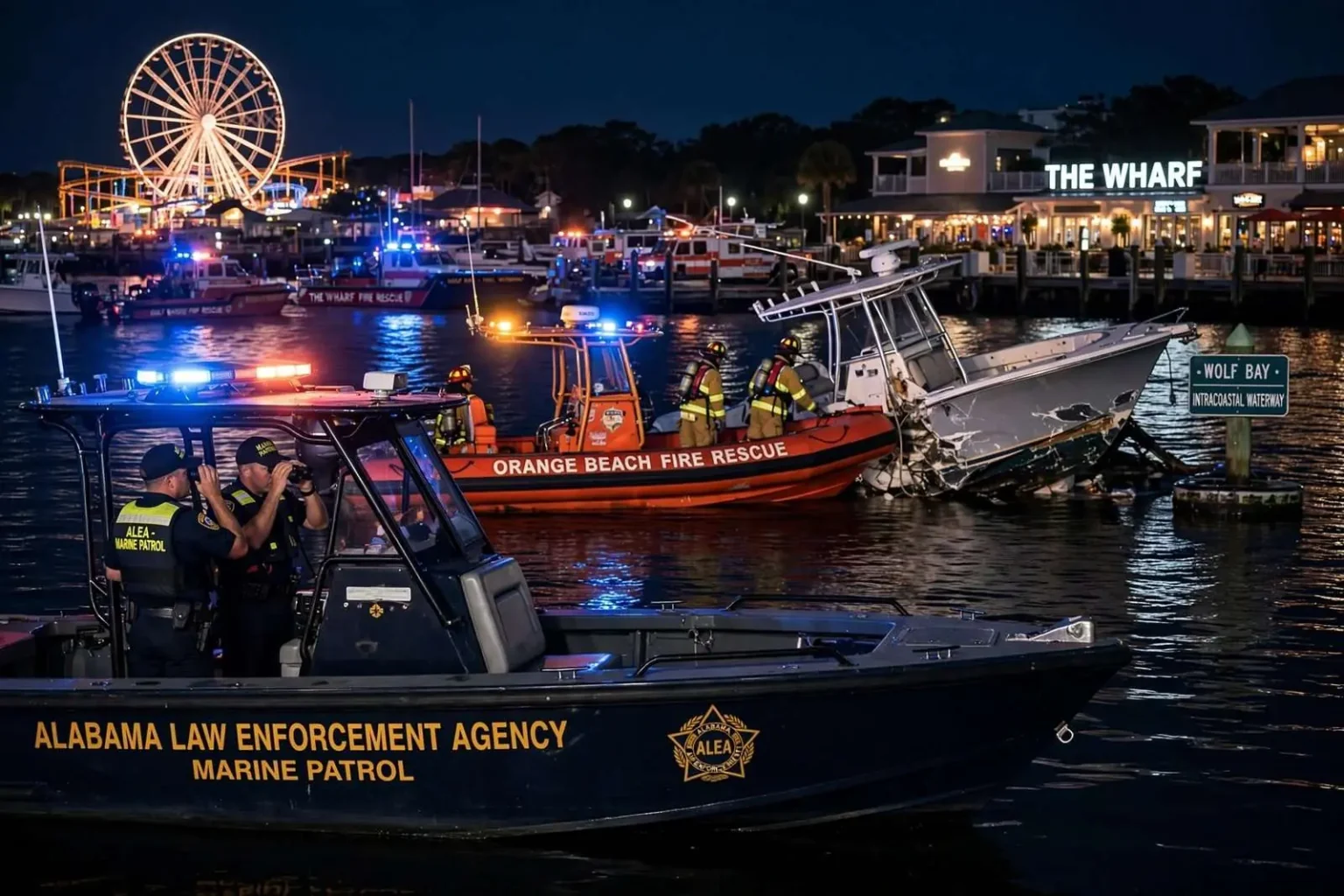
One woman died and several other boaters were injured after two vessels collided on the Intracoastal Waterway near Wolf Bay in Orange Beach on the evening of July 18, according to the Alabama Law Enforcement Agency. Kristin Delaney, 46, of Mobile, was critically injured in the crash and later died at South Baldwin Hospital. ALEA’s Marine Patrol Division has taken the lead on the investigation.
What Happened on the Water
ALEA said the collision happened around 8:10 p.m. Saturday between a 27-foot 2024 Albury Brothers boat and a 23-foot 2013 Key West boat, with eight people aboard each vessel for 16 people total. Kristin Delaney and Brooks Delaney, 51, of Fairhope, were both passengers on the Albury Brothers boat, which was operated by Drew Delaney, 49, of Mobile. Drew Delaney was not injured in the crash. Brooks Delaney was transported to Sacred Heart Hospital in Pensacola for treatment.
The Intracoastal Waterway near Wolf Bay is one of the busiest stretches of protected water on the Alabama coast — the channel that pleasure boats, fishing vessels and charter boats use to move between Perdido Pass, the passes around Mobile Bay and the marinas that line the shoreline between Orange Beach and Gulf Shores. On a July Saturday evening, it carries a steady stream of traffic in both directions, and the approaches near Wolf Bay, where boats funnel between open bay water and the canal, are among the stretches where experienced boaters keep a particularly sharp watch.
The Key West boat’s operator, Cameron Neil, 32, of Houma, Louisiana, was also injured and taken to Sacred Heart, along with passengers Talyn Faulkner, 25, of Raceland, Louisiana; John Lyle, 28, of Houma; and Rayford Reeves, 34, of Schiever, Louisiana.
The response that followed was a coordinated effort across multiple agencies. In total, nine patients were transported to area hospitals by Orange Beach Fire Rescue, Gulf Shores Fire Rescue, MedStar Ambulance and a medical helicopter. Orange Beach police officers assisted by helping locate the injured, securing the scene and establishing a landing zone for the helicopter. Everyone who was not injured, along with both boats, was returned to the marina at The Wharf.
A night like that one tests every link in the coastal emergency system. Marine rescue differs from a roadway crash in ways that multiply the difficulty: patients are scattered across two vessels and the water, some injuries are only apparent after boats are brought alongside, and the nearest definitive trauma care may be across a state line — as it was for those flown or driven to Pensacola. Getting nine patients from a dark channel to hospital care in one evening took fire boats from two cities, ambulances, a helicopter and police coordination working as one.
The Blue Marlin Grand Championship Connection
The crash happened as the Blue Marlin Grand Championship fishing tournament was wrapping up nearby that evening, and tournament scoring records show Brooks Delaney had competed as an angler in the event. It was not confirmed whether the vessels involved in the crash were connected to the tournament.
The timing placed the collision at the center of one of the busiest weekends the Orange Beach waterfront sees all year. The Blue Marlin Grand Championship, held at The Wharf, draws hundreds of boats and thousands of spectators to the lower Intracoastal for three days of offshore competition, and the weigh-ins that close each tournament day send a surge of traffic through the channel as boats return to the docks. That same weekend, the Blue Angels air show drew additional crowds, and marine traffic was heavier than on a typical summer Saturday.
Investigators and boating-safety officials have long paid particular attention to tournament weekends for exactly this reason. The hours after sunset on a big fishing day combine factors that rarely occur together: boats returning en masse, running lights complicated by the glow of waterfront venues, operators who have been on the water since before dawn, and channels crowded with vessels of very different sizes moving at very different speeds. None of that is a cause of any specific crash — ALEA has not said what led to this one — but the pattern explains why the waters around major tournament sites draw extra scrutiny from marine patrol officers.
Remembering Kristin Delaney
Update: Authorities have released more details about the victim and the ongoing investigation into the crash. Kristen Delaney is being remembered by friends and colleagues as a devoted mother, wife and longtime advocate for children in the Mobile community. She worked for Beard Equipment Company, her family’s John Deere and construction equipment dealership in Mobile. She also served for 18 years as a board member for the Child Advocacy Center, which thanked her for her commitment to keeping children safe.
Eighteen years on the board of a child advocacy center is, by any measure, a serious commitment. Centers of this kind coordinate the response to child abuse cases — bringing forensic interviewing, medical evaluation, advocacy and counseling under one roof so a child’s story is told once. Board service means years of budgets, fundraising and hard decisions, work that happens without headlines. That Delaney sustained it for nearly two decades, while also helping run a family business, says a great deal.
Delaney and her family, including her parents Brad and Melissa Beard, were longtime supporters of the University of South Alabama. She was instrumental in creating “Local Goodness,” a farm-to-table fundraising campaign benefiting USA Children’s and Women’s Hospital, and her family helped fund the hospital’s pediatric emergency center, which opened in 2024.
The pediatric emergency center connection gives her loss a particular poignancy for families across the region. USA Children’s and Women’s Hospital is the specialty children’s hospital for a wide swath of the central Gulf Coast — the place transported to when a child in Mobile, Baldwin or the surrounding counties needs emergency care beyond what a community hospital can provide. The facility’s pediatric emergency center, which opened in 2024 with support from the Beard family, extended that reach at the moment of greatest need. A hospital wing that will treat thousands of children in the years ahead now stands as a visible part of Kristin Delaney’s legacy.
“Local Goodness” carried the same fingerprints. The farm-to-table fundraising campaign tied the hospital’s mission to the Gulf Coast’s agricultural community, turning local produce and local restaurants into support for local sick children. It was the kind of initiative that requires someone who knows both the growers and the hospital people — a convener, in other words — and the fact that it took root and grew is a measure of her standing in both circles.
Margaret Sullivan, the university’s vice president of development and alumni relations, said the university community was “greatly saddened” by the loss and that Delaney “cares deeply about children.”
The words used by those who knew her — devoted, advocate, instrumental — form a consistent portrait: someone whose public identity was built less on the family business than on the institutions that protect children. For the communities she served, the measure of the loss will be practical as well as personal. Boards of organizations like the Child Advocacy Center do not simply replace two decades of institutional memory, and fundraisers do not simply replace the volunteer who made the phone calls that made them work.
The Investigation Continues
The 27-foot Albury Brothers boat involved in the crash has since been moved to a boat lift at Marine Police Headquarters in Orange Beach, where investigators are examining damage near the stern as part of the ongoing probe. The crash occurred during a busy weekend on the water, with two large fishing tournaments, including the Blue Marlin Grand Championship, and the Blue Angels air show drawing heavy boat traffic to the area.
Recovering and examining a vessel is standard procedure in a fatal marine collision, and it is exacting work. Investigators document hull damage before anything is moved, then study the boat out of the water — the height and direction of impact marks, the condition of the running lights, the position of throttles and controls, and the physics of how two hulls came together. Damage near the stern of one vessel can tell investigators a great deal about the relative headings and speeds of the two boats at the moment of impact, which in turn informs the reconstruction of the sequence of events.
Marine crash investigations of this kind can take weeks or months. The Marine Patrol Division must interview sixteen people — some of them injured, some of them grieving — reconstruct the movements of two vessels on a crowded channel, and reconcile those accounts with the physical evidence before it can say what happened. Investigators have not said whether weather, speed, visibility, right-of-way violations or any other factor played a role, and until that analysis is complete, the facts of the collision remain formally open questions.
What officials can say is what has not happened: ALEA has not released a cause for the collision and has not said whether any charges will be filed. The investigation remains open. In Alabama, determinations about criminal charges in a fatal boating crash rest on the findings of that investigation, and the distinction between an accident and a crime under state boating law — negligence, recklessness, impairment — is exactly the kind of judgment that cannot responsibly be made from the dock. Families on both sides of the collision now wait on a process that moves as slowly as its stakes require.
Boating Safety on a Crowded Coast
For boaters along the Alabama Gulf Coast, the crash is a grim marker in what has been a heavy summer on the water. The Intracoastal Waterway between The Wharf and Perdido Pass funnels an enormous volume of weekend traffic — cruisers, center consoles, pontoons and chartered fishing boats — through a channel crossed by bridges, bordered by marinas and intersected by the mouths of the bay system.
The fundamentals of channel safety take on added weight on summer nights. Navigation rules assign every meeting of two vessels a give-way and stand-on role, and after dark, running lights become the primary means by which operators judge what they are approaching and in which direction it is moving. Speed that feels unremarkable at midday — when every hull in sight is visible for a mile — can be too fast after sunset, when reaction windows shrink and the background glow of waterfront development makes small lights hard to pick out. Alcohol, operator inattention and inexperience remain, nationally, the leading contributing factors in fatal boating accidents, and marine patrol units along the coast increase patrols on holiday and tournament weekends for that reason.
The aftermath of the July 18 collision also illustrated how the coast’s emergency network comes together when the worst happens. Orange Beach Fire Rescue’s marine units, Gulf Shores Fire Rescue, MedStar Ambulance and the flight crew that carried the most seriously injured to Pensacola worked in sequence with police officers managing the scene — a chain that spans two cities, two states of care and a dozen jurisdictions. On the night of a crash with sixteen people in the water’s vicinity and nine patients to move, that chain held.
For the families of both vessels, though, the days since the crash have been about other things: hospital rooms in Pensacola, a life remembered across Mobile, and questions about the final minutes on the waterway that only the investigation can answer. The boats have been recovered, the injured are being treated, and the Marine Patrol’s work continues. What the Gulf Coast community can do in the meantime is what it does after every such loss on the water — mourn the dead, look after the injured, and take seriously, on every trip out, the rules and habits that keep a crowded channel from becoming a tragedy.