One Man Killed, Another Critically Hurt After Pedestrians Struck on the I-65 Ramp to Springhill Avenue
Mobile police say one man died and another was critically injured after two pedestrians were struck on the I-65 northbound off-ramp to Springhill Avenue about 9:29 p.m. Friday.
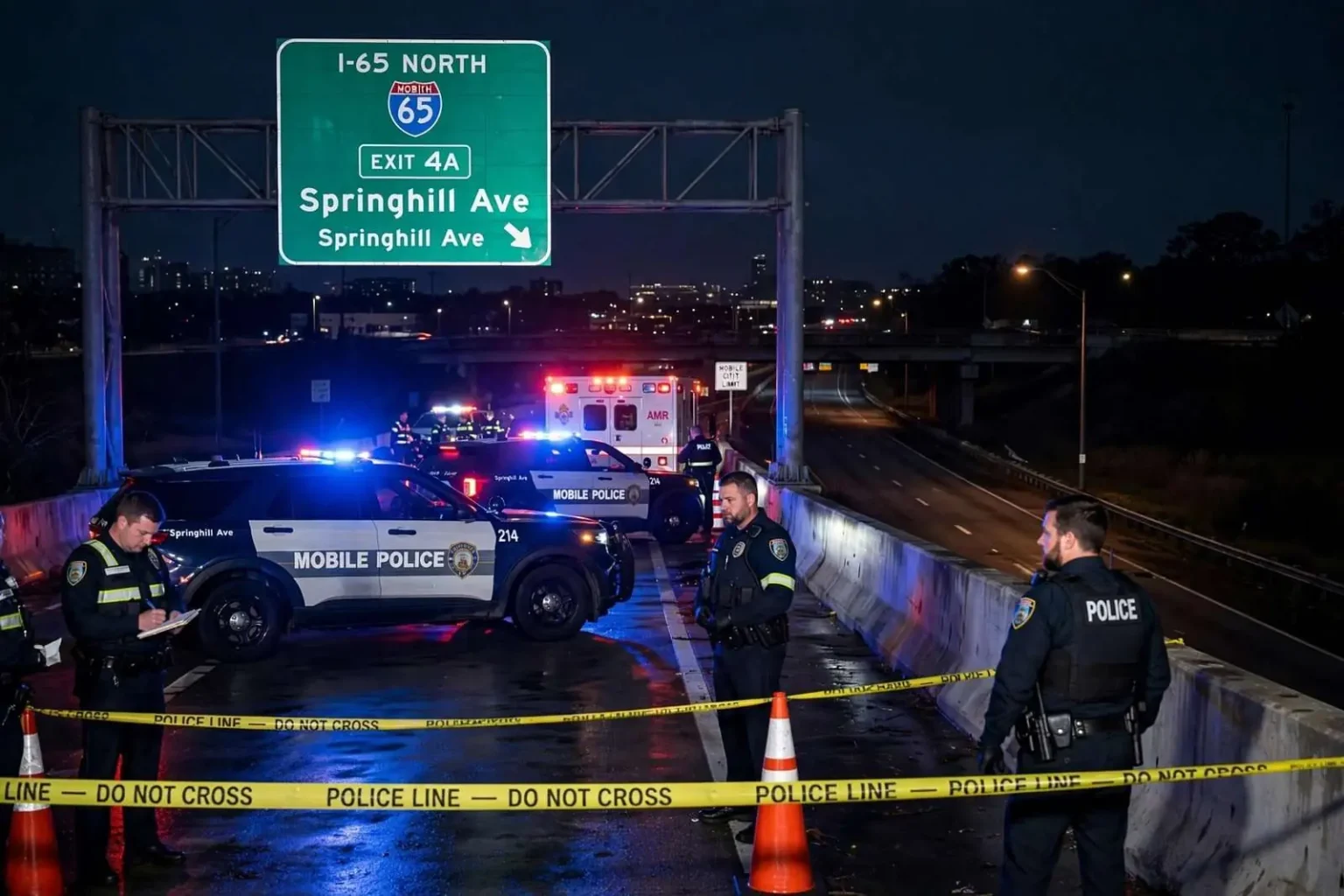
MOBILE — One man was killed and another was left with life-threatening injuries after two pedestrians were struck by a vehicle on the Interstate 65 off-ramp to Springhill Avenue late Friday night, according to the Mobile Police Department.
Officers were dispatched at approximately 9:29 p.m. Friday, Sept. 4, to the area of Interstate 65 northbound and the off-ramp to Springhill Avenue in reference to a person struck by a vehicle.
“Upon arrival, officers discovered an adult male deceased at the scene and another adult male suffering from life-threatening injuries,” the department said in a release. The surviving man was transported to a local hospital for treatment.
Police said the matter remains an active investigation and that no further information would be released at this time.
An Account That Sharpened Overnight
The initial picture Friday night was less complete than the account police released the following day, which is common in the first hours after a fatal collision.
Early reporting from the scene described a single-vehicle crash off Springhill Avenue near the I-65 exit, with a vehicle deep in a ditch and one person transported to a hospital. Officials closed the Springhill Avenue exit while the scene was worked.
The department’s subsequent release clarified that the call was for a person struck by a vehicle and that two men were involved — one who died at the scene and one taken to a hospital in critical condition.
Neither victim has been publicly identified. Police have not said whether the driver remained at the scene, whether any charges are anticipated, or what circumstances placed pedestrians on an interstate ramp.
Why Interstate Ramps Are Especially Dangerous on Foot
Interstate ramps combine nearly every factor that makes pedestrian collisions likely to be fatal.
Vehicles exiting a freeway are decelerating from highway speeds, and impact speed is the single strongest predictor of whether a struck pedestrian survives. Survival rates fall sharply above roughly 30 miles per hour and become very low at freeway-adjacent speeds.
Ramps are also built with no expectation of pedestrians. There are typically no sidewalks, no crossings, no pedestrian-scale lighting and no refuge areas. Sight lines are constrained by ramp curvature and by guardrails and embankments. A driver rounding a ramp at speed at night may have only a couple of seconds between the moment a person becomes visible and the moment of impact.
Darkness compounds all of it. Nationally, the substantial majority of pedestrian fatalities occur after dark, and headlights on low beam illuminate considerably less distance than the stopping distance required at highway speeds.
A Persistent Alabama Problem
Pedestrian deaths have been a stubborn category of traffic fatality in Alabama and across the country. Nationally, pedestrian fatalities climbed sharply over the past decade even during periods when overall traffic deaths were flat, a trend traffic safety researchers have linked to a combination of vehicle design shifting toward taller, heavier trucks and SUVs, increased nighttime driving, higher speeds on arterial roads, and infrastructure in many areas that was never designed to accommodate people on foot.
Mobile’s road network includes several corridors where interstate infrastructure meets dense urban surface streets. Springhill Avenue is a major east-west arterial connecting downtown Mobile with midtown and points west, and the interchange with I-65 is one of the busier interchanges in the city. Environments where a freeway ramp discharges directly into an urban arterial create the specific hazard of highway-speed traffic in a place where people are present on foot.
The Investigation
Fatal traffic investigations in Mobile are typically handled by specialized investigators who document the scene through measurements, photography, physical evidence and, increasingly, data recovered from vehicle event data recorders. That work supports a reconstruction that can establish speed, braking and pre-impact positions.
Because a second victim remains hospitalized in critical condition, the investigation’s scope may change depending on his condition. Charging decisions in fatal collisions generally rest with the Mobile County District Attorney’s Office and follow completion of the investigation rather than preceding it.
Mobile police have not indicated a timeline.
What Drivers and Pedestrians Should Know
While the circumstances here remain under investigation, the general hazard is well established. Drivers exiting freeways should treat ramps as transition zones requiring active scanning rather than as an extension of highway driving, particularly at night and particularly where a ramp feeds an urban street with pedestrian activity.
Pedestrians should avoid interstate rights-of-way entirely. Where a vehicle becomes disabled on or near a freeway, safety guidance is to remain in the vehicle with seat belts fastened and hazard lights on and to call for assistance rather than walking along the roadway, unless remaining in the vehicle presents a greater immediate danger.
South Alabama News will update this report as the Mobile Police Department releases additional information.
Update: Man Who Died Identified as Thomas Purifoy, 63
The Mobile Police Department has identified the man who was killed when a vehicle struck two pedestrians on the Interstate 65 off-ramp to Springhill Avenue as 63-year-old Thomas Purifoy of Mobile.
In a news release, the department said officers responded to the area at about 9:29 p.m. Friday, Sept. 4, for a report of a crash. When they arrived, they found a car in a ditch, one man dead and a second man with life-threatening injuries.
Investigators determined the car had been exiting Interstate 65 northbound onto Springhill Avenue when it struck the two men, who were walking in the roadway.
Police said the driver is cooperating with the investigation, which remains open. The department has not released an update on the condition of the second man, and has not said whether any charges are anticipated.