Ono Men’s Club Presents $2,000 Donation to Christian Service Center
The Ono Men's Club donated $2,000 to the Christian Service Center, continuing a tradition of giving back with funds raised on Ono Island to support food and emergency assistance in Gulf Shores, Orange Beach and Fort Morgan.
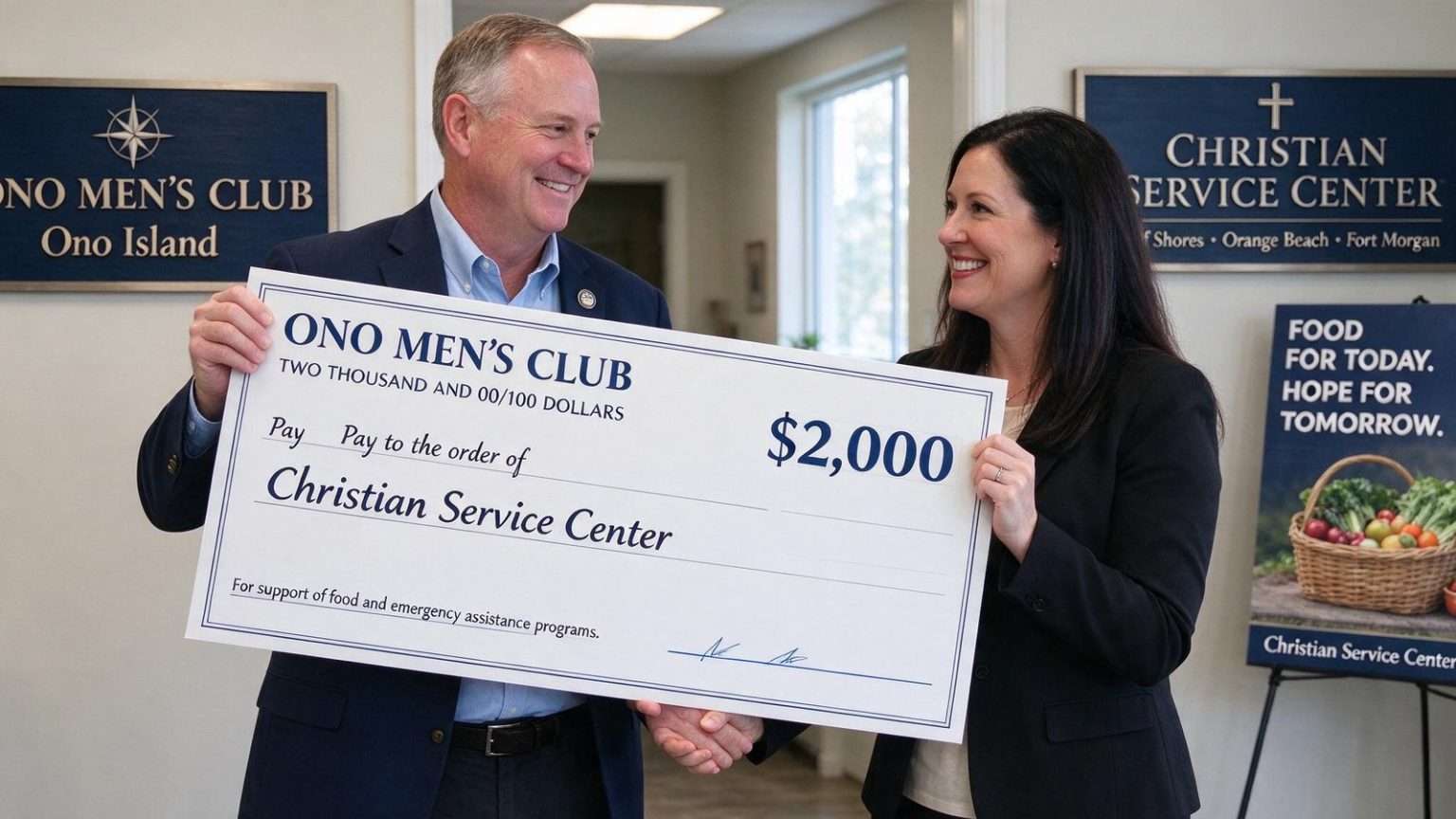
The Ono Men’s Club has presented a $2,000 donation to the Christian Service Center, continuing a tradition of philanthropy that has funneled thousands of dollars raised on Ono Island back into services for people in need across south Baldwin County. Michael Rary of the Ono Men’s Club presented the check to Jennifer Jackson of the Christian Service Center, marking the latest contribution in what club organizers describe as an annual practice of giving back to the surrounding community.
Each year, the Men’s Club raises funds through activities on Ono Island and directs a portion of that money toward local charitable organizations working directly with residents facing hardship. The presentation to the Christian Service Center followed that pattern, pairing the island’s private community with a public-facing charity whose work reaches every corner of the lower Baldwin County coast.
Supporting Food and Emergency Assistance Programs
The Christian Service Center provides food and emergency financial assistance to people in need throughout Gulf Shores, Orange Beach and Fort Morgan. Organizations like the Christian Service Center often serve as a first point of contact for families facing unexpected financial strain, whether from a medical emergency, job loss or another hardship, offering both immediate food assistance and help covering essential bills.
Donations like the one from the Ono Men’s Club help organizations such as the Christian Service Center maintain the kind of steady, reliable support that residents can turn to when they need it most. Predictable, unrestricted contributions are particularly valuable to small nonprofits: grants and designated gifts usually come with conditions, but a check like this one can be directed wherever the need is greatest that month — a food order, a past-due utility bill, a rent payment that keeps a family housed.
Community-funded assistance programs along the Alabama Gulf Coast frequently depend on contributions from local clubs, churches and civic groups to keep pace with demand, particularly in a region that sees significant seasonal fluctuations in population and need. The tourist economy inflates costs of living along the coast — housing especially — while many of the jobs that sustain the year-round population are seasonal or wage-sensitive, producing a persistent gap between what work pays and what the coast costs to live on.
A Recurring Tradition on Ono Island
The Ono Men’s Club’s latest gift reflects a broader pattern of community involvement from the club, which organizers say has contributed thousands of dollars over the years to charitable causes in the area from funds raised on Ono Island. Ono Island, a residential community near Orange Beach along Alabama’s Gulf Coast, is home to a financially comfortable population, and the Men’s Club has built its giving tradition on the recognition that the island’s prosperity sits inside a wider community where many neighbors struggle.
The mechanics are simple and durable. The club organizes fundraising activities among its members and their guests during the year, then selects recipient organizations — food pantries, service centers, youth programs and similar causes — for annual gifts. The result is a reliable stream of support for nonprofits whose budgets are otherwise a patchwork of grants, individual donations and volunteer labor.
The check presentation itself carried that relationship forward. Rary, representing the club, and Jackson, representing the center, have stood on opposite sides of similar presentations before, and the annual rhythm means the Christian Service Center can plan on the Ono Men’s Club’s support as a known quantity rather than a hopeful possibility — a distinction that matters when the center is budgeting how much food it can commit to purchasing each month.
The Need Behind the Numbers
The lower Alabama coast that the Christian Service Center serves looks prosperous from the highway, but the need within it is real and persistent. Gulf Shores, Orange Beach and Fort Morgan together form one of the most visited stretches of the Gulf, and the hospitality economy that drives the region — restaurants, hotels, charter boats, retail — employs a large share of the year-round population in positions that pay modest wages and follow seasonal rhythms. When the tourists thin out in winter, so do the hours, and the gap between income and rent widens.
Housing costs compound the problem. The same waterfront appeal that draws visitors and supports property values on the coast also drives rents above what service-industry wages comfortably cover, and working families who staff the region’s hotels and kitchens often live one unexpected expense away from crisis. A medical bill, a car repair, or a missed week of work in the off-season can set off a chain reaction that a food box and a partial utility payment from the Christian Service Center can interrupt.
That is the context in which a $2,000 gift from the Ono Men’s Club lands. In the hands of an efficient charity, a gift of that size translates into hundreds of meals or a month of emergency assistance for several families — and, just as important, into capacity: the ability to say yes to the next family that walks through the door without first worrying about whether the shelves will hold out.
How Coastal Philanthropy Works
The Ono Men’s Club operates within a wider ecosystem of giving along the Baldwin County coast, where civic clubs, church groups and business associations collectively supply much of the funding that keeps small nonprofits running. Large institutions and national charities have a presence in the region, but the everyday safety net — food pantries, emergency funds, school-supply drives — is stitched together locally, organization by organization, budget year by budget year.
Clubs like the Ono Men’s Club occupy a useful position in that ecosystem. Their members are established residents with deep local ties, which means they know which organizations do the work and can direct money accordingly, and their annual fundraising structure means recipients can anticipate the support. That reliability is worth more than its dollar amount: a nonprofit that can count on a gift each year can plan around it, while one that lives donation to donation cannot.
The relationship between Ono Island and the surrounding communities has generally followed this cooperative pattern, with island residents supporting the schools, service organizations and first-responder causes of the Orange Beach area and beyond. The $2,000 check to the Christian Service Center is one entry in that longer ledger, and the club’s framing of its giving — as an annual practice rather than a one-time gesture — is what gives each entry its weight.
What the Gift Supports
The Christian Service Center’s operations across Gulf Shores, Orange Beach and Fort Morgan cover the basics that determine whether a household in crisis stabilizes or spirals: food on the shelf for families who have run out, and emergency financial help for essential bills that cannot wait. The center’s staff and volunteers see the full range of coastal hardship — the elderly resident on a fixed income facing a utility cutoff, the young family doubled up with relatives after a job loss, the worker whose hours collapsed when the season ended.
For the Ono Men’s Club, the check presentation was the visible moment of a longer effort — the fundraising activities on the island that generated the money, and the members who organized them. For the Christian Service Center, it was another instance of the community support that makes its work possible. Both sides treated it that way: not as news that changes anything, but as the continuation of a partnership that has quietly moved thousands of dollars from one of the coast’s most comfortable communities into the hands of its neighbors who need help most.
Volunteers and the Work Itself
Money is only part of what keeps a organization like the Christian Service Center operating; the labor comes largely from volunteers who sort donations, pack food boxes, staff the front desk and sit with families while they apply for help. Along the Alabama Gulf Coast, that volunteer corps draws from the same population the clubs do — retirees, seasonal residents who stay year after year, and members of the area’s churches — and the connection between the two is direct: the same civic instinct that fills the center’s donation envelopes also fills its volunteer shifts.
The center’s model of assistance is deliberately practical. Rather than long applications or eligibility labyrinths, families in crisis are met with immediate help where possible — food that day, assistance with a specific bill — on the theory that the first hours and days of a hardship are when intervention does the most good. Emergency aid of that kind does not solve poverty, but it buys time: it keeps the lights on while a household finds work, keeps a family in its home while a benefits application processes, keeps children fed while a parent’s hours recover.
Gifts like the Ono Men’s Club’s fund that front-line work directly. Because the club places no restrictions on its annual gifts, the center can put the $2,000 where the current month’s demand is heaviest — extra food purchases ahead of the holiday season, help for families displaced by a storm, or the utility assistance fund that empties fastest in the heat of summer and the cold of winter.
Seasonality Shapes Everything
Coastal Baldwin County’s economy gives charitable work here a shape that inland organizations rarely see. Population roughly swells with the tourist season, then recedes; employment in hospitality follows the same curve; and demand for assistance tends to spike in the months when the tourists are gone. Nonprofits must therefore budget across a year in which their clients’ incomes swing dramatically, and the lean months arrive precisely when donated dollars from a tourism-driven community are least plentiful.
The Ono Men’s Club’s annual cycle of fundraising and giving, spread across the year, matches that reality better than a single seasonal drive would. Steady institutional support in the off-season — when the center’s shelves run down and its emergency fund empties — is often more valuable than larger contributions timed to the festive months, and the club’s tradition of regular giving has made it part of how the center plans through the year.
Storms add another dimension. The Gulf Coast’s hurricane seasons periodically convert working families into disaster-affected ones overnight, and organizations like the Christian Service Center become first responders of a financial kind, handing out food and emergency aid while insurance and federal assistance move at their own pace. Communities that maintain strong service organizations in calm years are the ones that weather those episodes best, which is how long-time coastal residents explain the value of annual gifts like this one.
A Small Check With a Long History
Viewed alone, a $2,000 check is a modest figure in the economy of a resort coastline. Viewed as part of a tradition — thousands of dollars over the years, raised island by island activity and delivered by hand to organizations doing the region’s quiet work — it represents something larger: a private community that has made support for its public neighbors a standing commitment rather than an occasional impulse.
Michael Rary’s presentation of the check to Jennifer Jackson was, in that sense, a ritual with substance behind it. The Ono Men’s Club will raise funds again through the year ahead, and the Christian Service Center will put this year’s gift to work in Gulf Shores, Orange Beach and Fort Morgan immediately. The arrangement between them — an annual practice of giving, meeting a daily practice of serving — is one of the quieter mechanisms by which the Alabama Gulf Coast takes care of its own.