Opinion: What Is Left to Govern Us When Facts No Longer Bind Us?
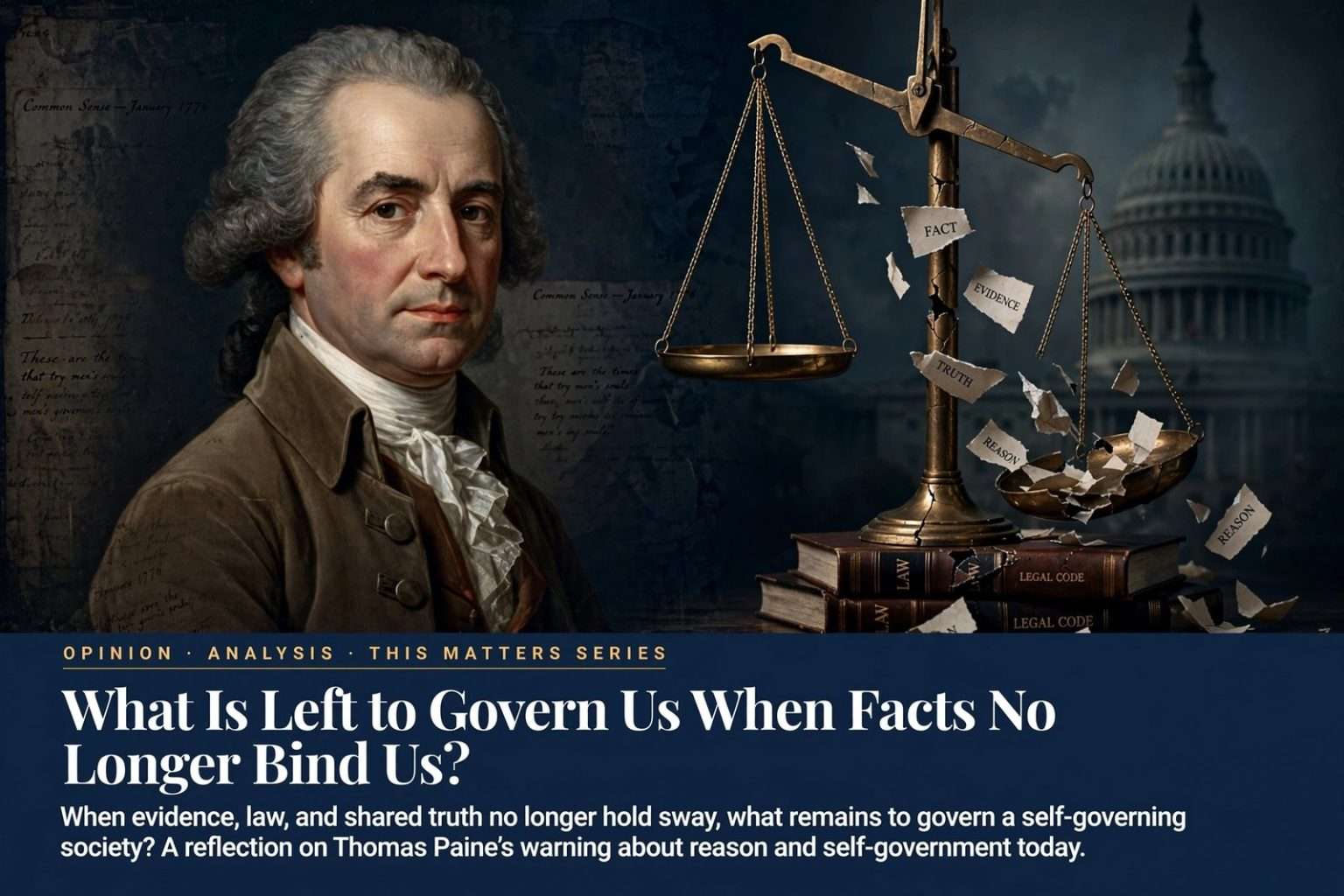
In his 'This Matters' column, Bill Britt draws on Thomas Paine to warn that self-government erodes once facts, law and shared principle stop holding real authority over public life.
This is an opinion and analysis piece.
What holds a self-governing society together when its members can no longer agree on basic facts? That is the question at the heart of a recent essay from columnist Bill Britt, part of his ongoing “This Matters” series, which examines Thomas Paine’s warnings about what happens when reason loses its grip on public life.
Britt’s argument starts from a simple premise: a free people cannot govern themselves once facts, law and shared principle stop having the power to correct them. Self-government, in this view, does not run on power alone. It runs on a common willingness to accept evidence, apply laws consistently, and let the truth change minds when the truth demands it.
The Question at the Center of the Essay
Britt poses it directly: What is left to govern a society when evidence can be waved away, laws applied only to some, and no truth carries enough weight to change anyone’s mind? His answer is a warning rather than a prediction. Once those checks erode, he argues, political disagreement stops being a debate over ideas and becomes something more dangerous — a contest of wills in which raw power, not persuasion, decides outcomes.
That is the thread Britt draws from Thomas Paine, the Revolutionary-era pamphleteer whose writings helped shape early American thinking about liberty and self-rule. Britt’s column revisits Paine’s warning about the moment reason loses its authority, using it to illustrate how fragile the foundations of self-government can be even in a long-established democracy.
Why It Matters
Britt’s essay does not point to a single event or policy dispute. Instead, it reads as a broader reflection on civic life: a reminder that democratic institutions depend on habits most people rarely think about, such as a shared respect for evidence and a willingness to be persuaded by facts rather than simply overpowered by an opponent.
Readers interested in the full essay can find Bill Britt’s “This Matters” column, which explores these themes in greater depth through the lens of Paine’s writing on reason, authority and the fragility of self-government.
About Thomas Paine
Paine is best known for “Common Sense,” the January 1776 pamphlet that made the popular case for American independence, and for “The American Crisis” series, which opened in December 1776 with the line “These are the times that try men’s souls.” His later work, “The Age of Reason,” published in parts beginning in 1794, argued for reason as the basis of belief.