Opposing sides debate future of Pensacola Confederate monument
Supporters and opponents debated the future of a Pensacola Confederate monument at Lee Square, with a city council vote expected later this month.
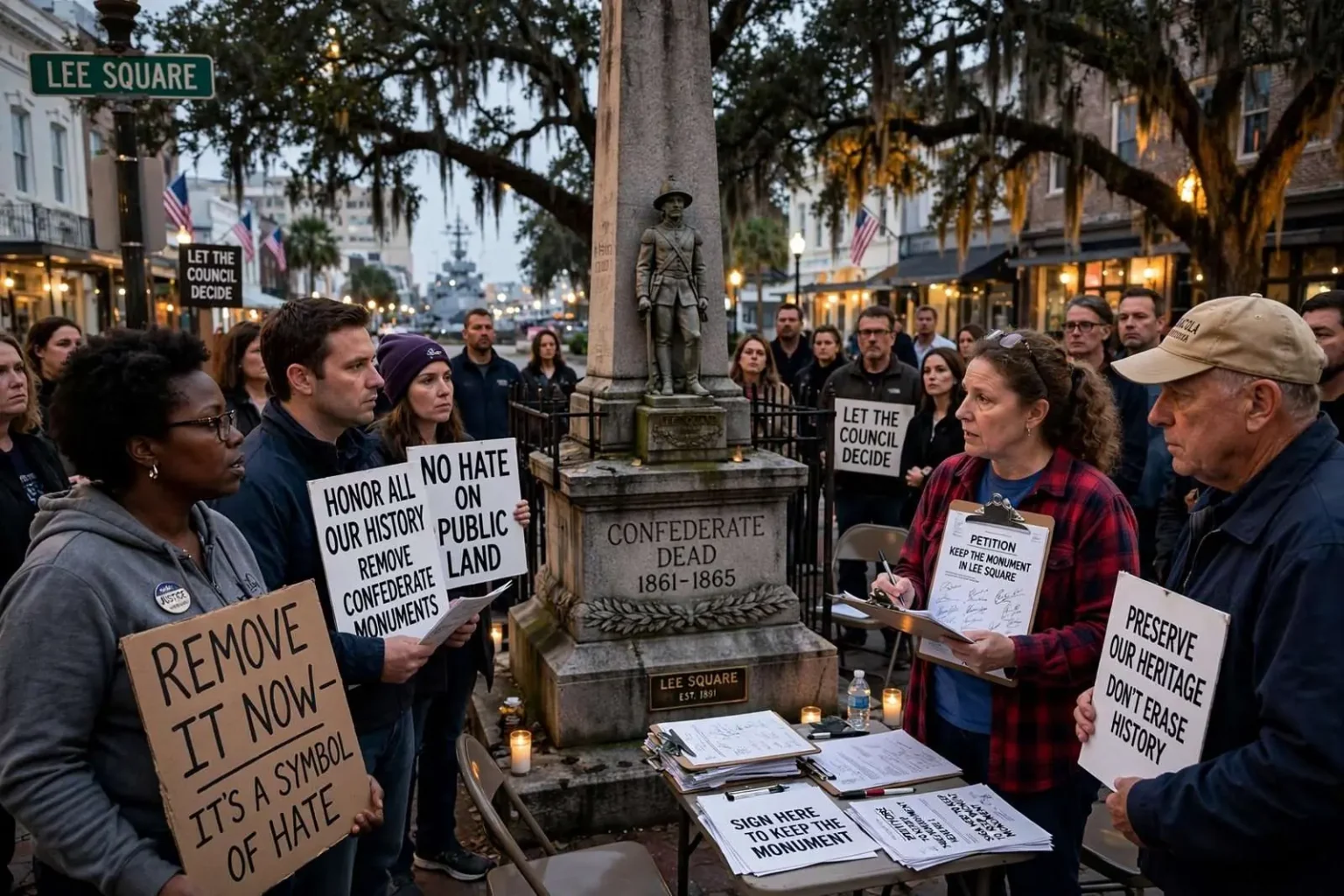
Supporters and opponents of a Confederate monument in Pensacola gathered Friday evening for a hours-long debate over whether it should be removed. The discussion took place at the Lee Square Confederate monument and at times grew heated, with passionate pleas on both sides.
“It should come down, point blank, period,” said Selivia Barnes, who argued the monument is a symbol of hate toward African Americans because Confederates fought to preserve slavery. Sara Bibeau spent the day collecting signatures to keep the monument in place. “It’s not about white supremacy and racism,” Bibeau said. “It was just believing in a cause at the time.” She said she hopes the community continues to come together to debate the issue.
A Monument at the Center of a National Argument
The Lee Square monument stands at the heart of a debate that has swept cities across the South: what to do with Confederate memorials that occupy public ground. Erected in an era when such monuments were raised in courthouse squares and city parks across the former Confederacy, the Pensacola memorial honors the Confederate dead at a site that bears the name of Robert E. Lee. Its supporters see a tribute to ancestors and heritage; its critics see a granite endorsement of a rebellion fought to preserve slavery.
Those two readings collided in person on Friday evening, with the monument itself looming over the argument. Gatherings of this kind have become familiar scenes in Southern cities — candle-lit vigils, counter-demonstrations, petition drives and public comment sessions — as communities from New Orleans to Charlottesville confront the question of whether public land can honor the Confederacy without dishonoring the residents those cities serve.
In Pensacola, the conversation carries the added weight of local history. The city’s past spans Spanish colonial rule, territorial days and the Civil War, and the military installations that surround it — including the naval air station across the bay — have long made heritage a visible part of daily life. Where the Confederate monument fits in that story, and whether it belongs on public ground at all, is precisely what the two sides spent Friday evening disputing.
Two Visions of the Same Stone
For Barnes and those who share her view, the question is moral rather than historical. The Confederacy’s cause, she argued, was the preservation of slavery, and a monument honoring that cause is by definition a symbol of hate toward African Americans — no matter the intentions of the people who raised it generations later. From that perspective, removal is not erasing history; it is refusing to keep celebrating it on public ground.
For Bibeau and the petition signers, the monument means something else entirely. Their argument frames the memorial as an expression of belief — however misguided others may judge it — by the people of a particular time, and its removal as a judgment imposed on the past by the present. “It’s not about white supremacy and racism,” Bibeau said. “It was just believing in a cause at the time.”
Between those positions lies the practical question the city government must answer: who owns the monument, who controls the square it stands on, and what process decides its fate. In Pensacola, as in most Florida cities with such memorials, the answer runs through the city council — and to the council this debate now moves.
The Petition and the Vigil
The group seeking to keep the monument plans to remain at Lee Square through Sunday, turning the weekend into a show of sustained presence. Bibeau’s signature drive gives the effort a concrete measure of support — names on paper that can be presented to city officials as evidence of public sentiment. Sustained gatherings at a monument site are a tactic used on both sides of this debate nationally: presence is the point, a demonstration that the issue is not going away and that the community is watching.
For opponents of the monument, the weekend gathering of their counterparts is itself an argument for urgency — a reminder that what they see as a symbol of hate continues to draw defenders. For supporters, the vigil days are a chance to make the case face to face with passersby, gathering signatures and conversation in equal measure.
Bibeau’s hope, as she expressed it, is that the community continues to come together to debate the issue — a call for dialogue rather than decree. The Friday evening crowd answered that call in its own way: hours of argument, sometimes heated, but conducted in the open, at the site itself, between neighbors who will share the same city whatever the council decides.
The City Council’s Decision Ahead
Later this month, the city council is expected to discuss and possibly vote on moving the monument and renaming Lee Square to Florida Square. That two-part proposal addresses both halves of the dispute: the monument’s presence and the name of the ground beneath it. Relocation — rather than destruction — is the compromise many Southern cities have reached or considered, moving a memorial to private land or a cemetery where historical commemoration can continue without the endorsement of public property.
Renaming the square carries its own symbolism. Lee Square honors the Confederacy’s most famous general; Florida Square would name the space for the state itself, a change that would signal the city’s answer to the heritage question even before the monument’s fate is settled. Together, the two votes would redraw a small corner of Pensacola’s landscape — and make a statement about what the city chooses to honor in its public squares.
Council members weighing the question face the same pressures visible in the Friday crowd. Constituents who signed Bibeau’s petition want the monument to stay; constituents who agree with Barnes want it gone. Public comment sessions, phone calls and petition drives will deliver both messages in volume before the vote, and whichever way the council rules, the decision is likely to leave a lasting mark on the city’s civic conversation.
A Debate Larger Than One Square
Pensacola’s argument is a local chapter of a national reckoning. From New Orleans, which removed its monumental quartet of Confederate and white-supremacist tributes after heated public hearings, to university campuses and county courthouses across the South, communities have been revisiting the monuments their predecessors installed — most of them erected decades after the Civil War ended, in eras of Jim Crow and Confederate nostalgia.
Defenders of the memorials invoke ancestry, soldiers’ sacrifice and the danger of judging the past by present standards. Opponents invoke the monuments’ timing, their purpose and the message their placement on public ground sends to Black residents. Both sides claim history as their ground — one as heritage, the other as an honest account of what the Confederacy was — and the dispute has proven one of the most durable in American civic life.
What happens at Lee Square in the coming weeks will place Pensacola on the map of cities that have made a decision. If the council moves the monument and renames the square, it will follow the path of other Gulf Coast communities that have relocated or recontextualized their Confederate memorials. If it does not, the debate — like the signature drive and the vigil — will continue. Either way, the hours-long, sometimes heated exchange that unfolded Friday evening at the monument’s base made one thing plain: Pensacola’s residents are not indifferent, and the argument over what their public square should say is being conducted in full voice.
The Ground Beneath the Debate
Lee Square itself is part of the argument. The small parcel in downtown Pensacola has carried the Confederate general’s name as long as the monument has stood on it, and public squares carry meaning by their naming alone — a fact the proposal to rename it Florida Square implicitly acknowledges. Cities across the South have confronted the same question with street names, school names and park names, on the theory that what a community calls its public places is a public statement in itself.
The monument’s location on city ground is also what makes the city council the decisive forum. A memorial on private property, however objectionable critics find it, is private speech; a memorial on public land is a statement made in everyone’s name. That distinction is why the Friday debate, however passionate, could only build the case — the decision belongs to the elected officials who will take it up later this month.
Relocation proposals, when they advance, raise practical questions of their own: where the monument would go, who would pay to move it, and what destination would satisfy both the residents who want it gone from the square and the residents who want it preserved somewhere. Cemeteries and battlefields are the destinations most often proposed in Southern cities, places where commemoration of the dead sits more easily than in the center of daily civic life.
Voices That Will Outlast the Vote
Whatever the council decides, the words spoken at Lee Square on Friday evening will remain part of the record. Barnes’s demand that the monument come down “point blank, period” and Bibeau’s insistence that the memorial reflects belief rather than bigotry are the two poles of a conversation Pensacola has been having in fragments for years — at public comment podiums, in letters to the editor, at dinner tables — but rarely so directly, and so long, in one place.
The hours-long format mattered. Rather than a protest or a rally, Friday’s event was a debate in the oldest sense: residents standing in front of their neighbors making their cases, answering objections and letting the argument run until it was spent. Gatherings like that one have marked the monument debates in cities across the country, and they tend to leave participants — whatever their position — more committed to being heard than before.
The weekend vigil will keep that engagement alive through Sunday, and the council’s discussion later this month will convert the sentiment of the square into a formal decision. Between now and then, both sides will be working: collecting more signatures, organizing more voices, and pressing their case with the officials who hold the vote. Pensacola’s monument debate has moved from the square to the council chamber — but as Friday evening demonstrated, it began, and will be remembered, among the people who stood at its base and argued it out in person.