Orange Beach Festival of Art Returns March 11-12 for 49th Year on Wolf Bay
The award-winning Orange Beach Festival of Art returns March 11-12 with 100 artist booths, live demos and free admission on Wolf Bay.
ORANGE BEACH, Ala. — The Orange Beach Festival of Art, the Coastal Arts Center’s annual fine art show, returns March 11-12 for its 49th year at the Coastal Arts Center and Waterfront Park on Wolf Bay — and it arrives with a growing national reputation. The event has become one of the signature cultural weekends on the Alabama coast, drawing artists and festival-goers from across the region to a waterfront setting that few outdoor shows anywhere can match.
The festival sits at the intersection of Orange Beach’s two identities: a resort town known for its white-sand beaches and fishing fleet, and a community that has invested steadily in cultural amenities over the past two decades. The Coastal Arts Center, overlooking Wolf Bay, houses studios, galleries and teaching spaces, and the surrounding Waterfront Park provides the kind of natural amphitheater that festival organizers elsewhere spend years trying to replicate. Attendance is spread across two days, giving visitors time to browse, watch demonstrations and take in performances without rushing.
An award-winning showcase
For the second time, the festival has been ranked among the Top 200 artist-selected shows in the country by Sunshine Artist magazine (2019 and 2022). The ranking matters in the outdoor-show world because it is based on the ballots of participating artists themselves — the people who travel the circuit and know which festivals treat them well, draw serious buyers and run smoothly. A Top 200 placement helps a show attract stronger applicants year after year.
Readers of ALABAMA Magazine have named it “Best of Bama” three years running from 2019 to 2021 and again in 2022 for best art gallery, and the Coastal Arts Center has taken home “Best of Baldwin” awards for Best Art Gallery and Best Event Venue four years straight. The string of recognitions reflects the center’s role beyond the festival weekend: it operates year-round as a gallery, teaching space and event venue, hosting classes, exhibits and community programs that keep the arts visible in Baldwin County between festivals.
The awards also track the growth of the arts in Orange Beach generally. The city has supported cultural programming alongside its parks and recreation efforts, and the Coastal Arts Center has grown into a regional draw, serving residents of Baldwin County as well as the visitors who fill the beach town’s condos and rental houses. For a community of Orange Beach’s size, the range of cultural offerings is unusual, and the festival is its showcase event.
100 booths, three stages
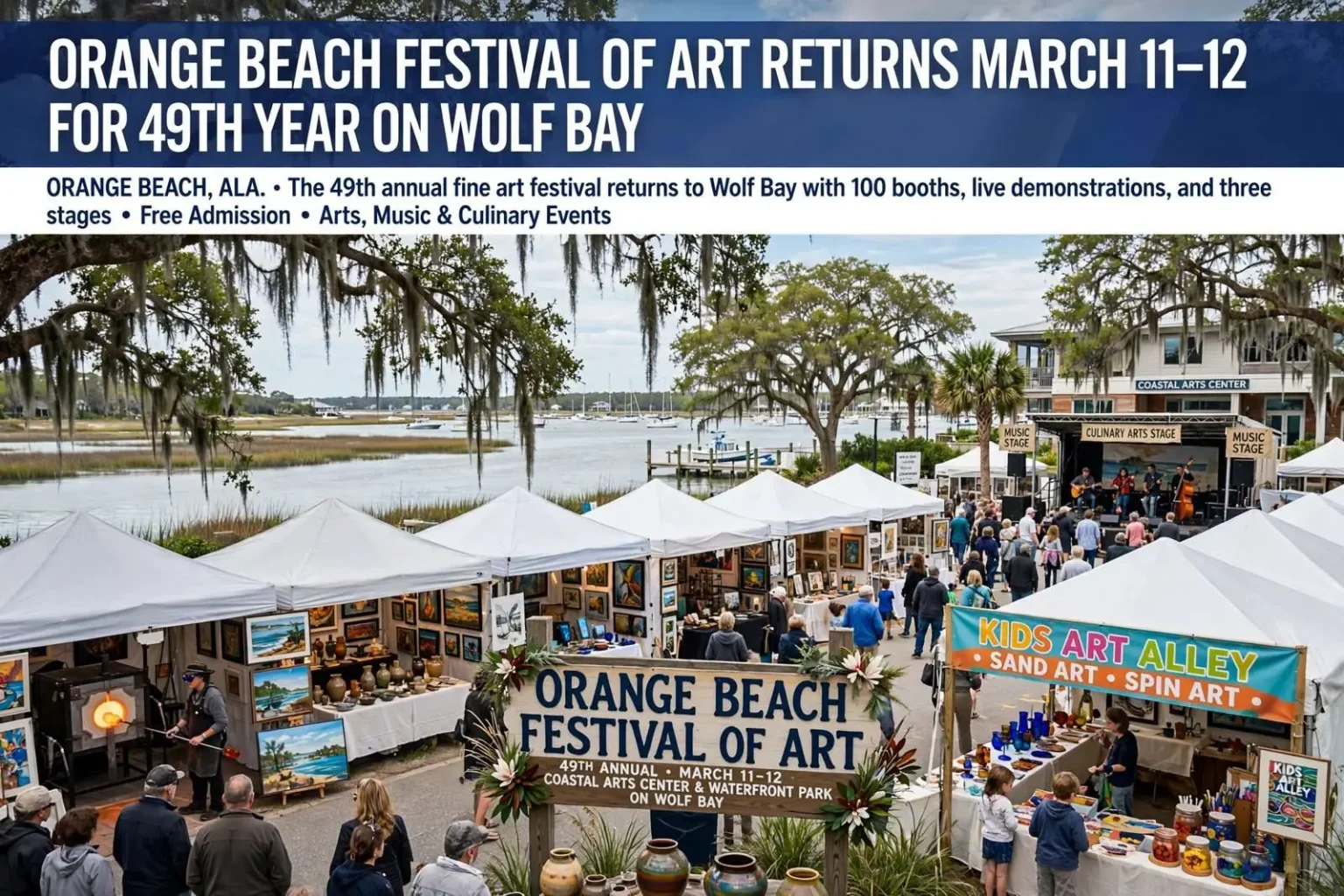
This year’s festival features 100 booths of local and regional fine art, live visual arts demonstrations, and performances across the Music, Performing Arts, and Culinary Arts stages. The booth lineup is curated, with applications reviewed and artists selected so that the show covers a range of media — painting, pottery, glass, wood, jewelry, fiber and more — without overwhelming the grounds.
Festival-goers can watch hot glass blowing and clay sculpting, and catch acts ranging from mime and magic to bands and ballet. The live demonstrations are a signature element of the show: the glass blowing in particular draws standing crowds, since watching molten material shaped into finished pieces is a process most people never see up close. The culinary stage rounds out the lineup, turning food into a performance and connecting the festival to the Gulf Coast’s deep food traditions.
The three-stage format spreads the grounds out and gives the show its festival feel. Music runs through both days, performing arts acts rotate on their own schedule, and the culinary presentations give visitors a reason to plan their route rather than simply wander. Organizers design the layout so that booths, stages and demonstration areas flow into one another along the waterfront, keeping foot traffic moving and sight lines open to the bay.
Families get their own lane: Kids Art Alley offers craft experiences including sand art and bicycle spin art, plus visits with animal ambassadors from the Orange Beach Wildlife Center exhibit. The wildlife center, part of the city’s network of attractions, brings its ambassador animals to the festival each year, giving children a close look at native species alongside the art activities. The family programming is deliberate: organizers see the festival as an entry point for young artists, and the kids’ activities are designed to let children make things rather than just look at them.
The caliber of participating artists is high — many have earned national and international recognition. Among them, clay artist Larry Allen recently had his intricate vessels selected for feature in Disney’s film “Wakanda Forever.” Having artists of that profile in the booth lineup reflects the show’s standing on the circuit; nationally recognized artists schedule their seasons around the shows that sell and the ones they enjoy, and Orange Beach has worked its way onto that list.
A Patron of the Arts program lets buyers support the Friends of the Arts Inc. through Gold, Silver, and Bronze levels with advance purchasing commitments for the festival. The patron program works on a simple mechanic: committed buyers pledge spending in advance, receive recognition for their support, and then make their purchases directly from artists during the show. It guarantees sales for a roster of artists and channels steady funding to the nonprofit that keeps the center running.
Admission to the festival is free. The no-gate policy is a longstanding tradition for the event, funded through sponsorships, vendor fees and the patron program rather than ticket sales, and it keeps the show accessible to the entire community. Free admission also means the festival draws a broad cross-section of Baldwin County — families making an afternoon of it, serious collectors arriving early on Saturday, and visitors from across the Gulf Coast who plan their spring trips around the weekend.
The festival in context
Reaching a 49th year puts the Orange Beach Festival of Art in rare company. Outdoor art shows are fragile enterprises — dependent on weather, volunteer labor and artist participation — and the ones that approach the half-century mark have usually become institutions that anchor their community’s cultural calendar. Along the Alabama Gulf Coast, the festival’s timing in March makes it a curtain-raiser for the spring season, arriving as the beaches fill for spring break and before the heavy summer crowds.
Wolf Bay itself is part of the draw. The bay, connected to the Intracoastal Waterway and Perdido Bay system, is one of the scenic anchors of eastern Baldwin County, and the Waterfront Park setting gives the show a backdrop of water, live oaks and marsh. Festival organizers have used the setting in their marketing for years, and it is a large part of why artists rank the show highly — few circuit stops offer a booth site overlooking the water.
The Coastal Arts Center’s year-round programming means the festival is both an annual event and an ongoing institution. Between shows, the center offers classes in glass, clay and other media, rotates gallery exhibits, and hosts community events. The festival weekend funnels attention and support into that year-round mission, with proceeds and patron commitments helping fund the programs that continue after the booths come down.
For visitors planning the weekend, organizers suggest arriving early, particularly on Saturday, when parking fills fastest and the light over the bay is at its best for viewing the art. The show runs both days, rain or shine, and the combination of 100 booths, three stages, kids’ activities and live demonstrations is designed to reward a full afternoon — or two — along the waterfront.
How artists get into the show
The jury process is central to the festival’s reputation. Artists apply with images of their work, and a selection panel reviews the submissions to assemble a balanced lineup across media and price points. The system protects the show’s quality — preventing the craft-fair drift that dilutes many outdoor events — and it is what artists mean when they describe a festival as artist-selected. For buyers, the practical effect is confidence: the work in the booths has already passed a review, and the artists on the grounds are the ones who made it.
Regional participation is a hallmark of the lineup. The Gulf Coast supports a deep bench of working artists, from the New Orleans and Florida Panhandle circuits to Baldwin County’s own studio community, and the festival draws from that geography as well as from the national show circuit. Local artists get the home-crowd advantage, while traveling artists bring work that residents would otherwise see only in galleries in larger cities. The mix keeps the show fresh from year to year, which organizers cite as a reason repeat attendance stays strong as the festival approaches its 50th year.
Why the arts matter along the coast
The festival also plays a role in Baldwin County’s broader economy. Coastal Alabama’s tourism economy has long been built on beaches, fishing and golf, but the cultural side of the ledger has grown steadily, with the Orange Beach festival, Fairhope’s arts community, and galleries across the Eastern Shore contributing to a year-round identity that outlasts the summer season. Cultural tourism brings visitors in the shoulder months, supports restaurants and lodging outside peak weeks, and gives residents amenities that factor into the region’s quality of life.
Education is the other quiet benefit. Between the center’s classes, the school programs that feed into the festival, and the hands-on activities in Kids Art Alley, the arts infrastructure around the show reaches students who may never have visited a gallery otherwise. Organizers have long described the festival as the place where many local children first meet a working artist, and the ambassadors, demonstrations and craft tables are built around exactly that encounter.
The 49th edition arrives, then, with both momentum and a milestone ahead. Next year’s 50th festival is already the subject of quiet anticipation among organizers and artists alike, and this year’s show is the last stop before that anniversary. For the community that has supported the event for nearly five decades, the weekend on Wolf Bay is equal parts exhibition, reunion and preview of the celebration to come.