Orange Beach Walks Away From $14 Million RV Park Deal That Once Carried a Pirate Show Dream
Orange Beach has scrapped a $14 million RV park purchase once tied to a Dolly Parton Pirates Voyage dinner theater, ending months of debate over Highway.
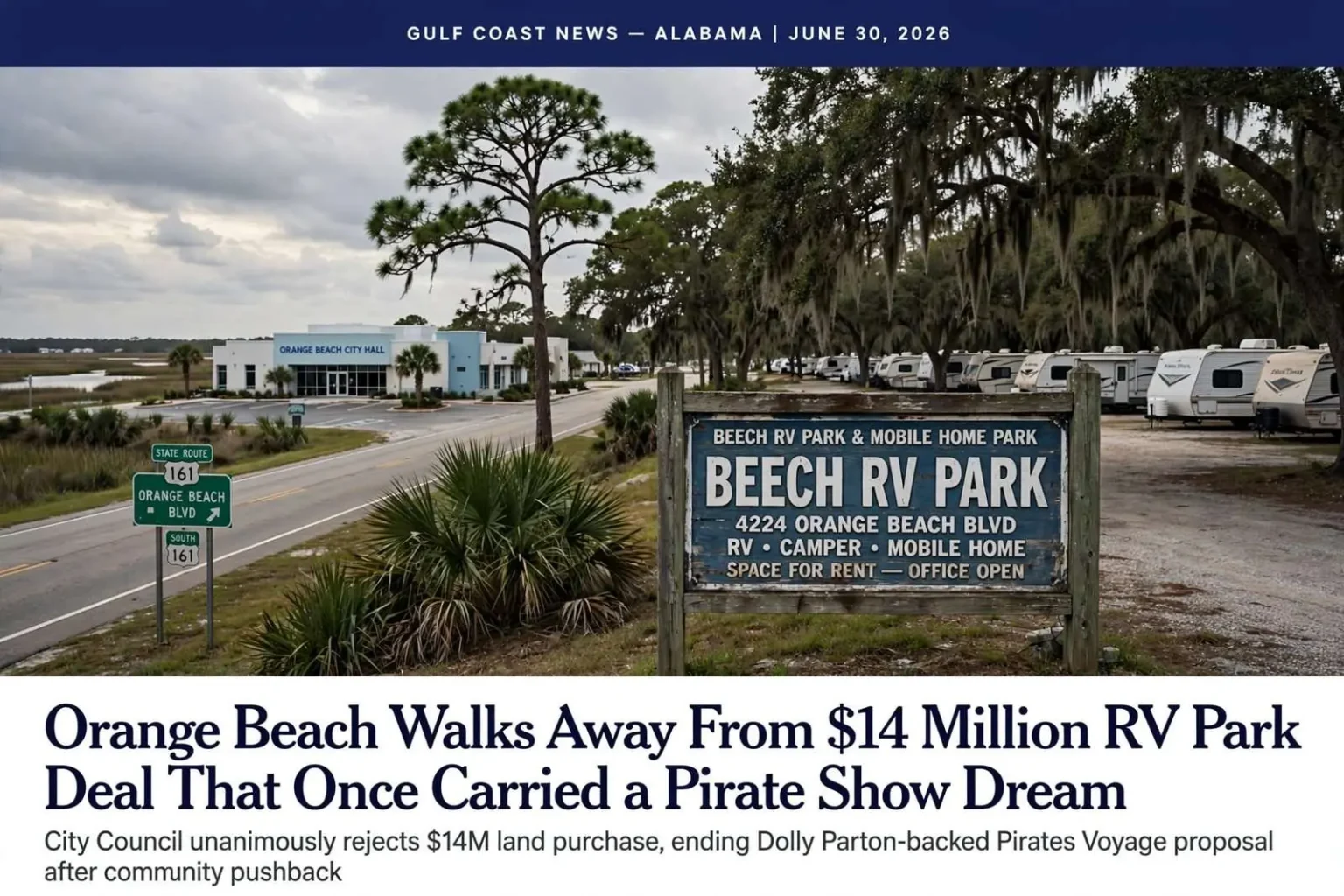
Orange Beach will not be buying the RV park property that for much of this year sat at the center of the city’s most heated development debate. On a Monday afternoon in late June, the City Council voted unanimously not to even pay for an appraisal of the roughly 24-acre Beech RV Park property on Alabama State Route 161, effectively closing the book on a potential $14 million municipal purchase that had been floated as a possible home for a Dolly Parton-branded Pirates Voyage dinner theater.
The vote was the final chapter in a saga that stretched from a packed May town hall through weeks of uncertainty about whether the attraction’s developers would ever submit formal plans. By the time the council met, the theater proposal itself was already dead — pulled by its backers less than two weeks earlier — and the only question left was whether the city wanted the land. The answer, emphatically, was no.
How a pirate show came to Orange Beach
Pirates Voyage Dinner & Show is a Dolly Parton-backed dinner attraction with existing locations in Myrtle Beach, South Carolina; Pigeon Forge, Tennessee; and Panama City Beach, Florida. The shows seat families around a large indoor lagoon, where costumed pirate crews stage acrobatic battles for treasure over a four-course meal, complete with trained sea lions. The operator, World Choice Investments, had been quietly scouting the Gulf Coast for its next location.
The site it zeroed in on was the Beech Camper & Mobile Home Park, a 23-to-24-acre property at 4224 Orange Beach Boulevard, directly across from City Hall on one of the busiest corridors on the island. A planned unit development request filed with the city described a theater of roughly 59,000 square feet — large enough to stage multiple shows a day during the summer season — on land that would have required a roughly $14 million purchase.
World Choice Investments CEO Jack Lawrence told regional news outlets that Orange Beach “would be a great location” for the brand to expand, and said the company was still weighing its options even as opposition built. “Whether it’s Orange Beach or another great community, we know our show will bring with it great family entertainment and economic impact to the area,” Lawrence said.
The town hall that changed the math
If the company expected a routine entitlement process, it did not get one. In May, residents filled the Orange Beach Performing Arts Center for a standing-room-only town hall on the proposal, and the tone was overwhelmingly hostile. Speakers questioned nearly everything about the project: the traffic it would generate on Highway 161, drainage into nearby Terry Cove, impacts on trees and wildlife habitat, and whether a 59,000-square-foot tourist arena fit the city’s 2020 comprehensive plan at all.
City officials put numbers on the fears. Mayor Tony Kennon, citing state transportation figures, said Highway 161 was already operating at roughly 70 percent of its capacity, and city staff estimated a sold-out show would send roughly 285 additional vehicles onto the corridor at once. An online petition opposing the theater’s location gathered more than 1,300 signatures within days.
Kennon, for his part, defended the city’s review process and noted that some kind of development on the property was likely no matter what happened with the theater. He also revealed that the city had discussed buying part of the site for drainage and conservation purposes — an idea that would resurface, in much larger form, within weeks.
The backlash did its work. Days after the town hall, the Pirates Voyage management firm pulled its planned unit development request from the Orange Beach Planning Commission agenda, choosing not to risk a denial that would have forced it to start the application process over. The planning commission had already deferred the matter several times, and the company faced a June deadline to appear or lose its place in the queue.
The developer walks, the Flora-Bama owner steps in
According to Kennon, the theater company’s decision came roughly two weeks after that town hall. “They just decided they were going to pull out mainly because they did not want to do it against the community’s wishes,” the mayor said.
What followed was a brief and unusual interlude in which the property — still under contract by the developer group — was shopped to a familiar local figure. John McInnis, the owner of the Flora-Bama, put the property under contract out of interest in doing something else with it. When those plans did not come together, he offered the city a chance to buy it at the same price he had agreed to pay: $14 million.
City council members said they learned of the offer on Wednesday, June 24, through a letter from McInnis, and the letter spurred the council into an afternoon special meeting the following Monday. The due diligence window on the underlying contract was set to expire within days, around the July 4 holiday, leaving the city almost no time to act.
“They had put the property under contract for $14 million but that the due diligence period ended either on July 3 or July 4, so we would have to make a quick decision on whether we wanted to purchase it, and subsequently a few of the council members asked whether an appraisal had been done, and we found out that appraisal had not been done,” Place 2 Councilwoman Ginger Harrelson said.
Harrelson said she was unwilling to spend $15,000 on a rush appraisal and then turn around within days and commit to a nine-figure-adjacent land deal — well, a 14-million-dollar one — without knowing what the land was actually worth. “The timeline was just too short for me to feel comfortable with $15,000 for an appraisal and then having to turn around in a matter of days to make another decision on whether to purchase,” she said.
The council’s cold-eyed math
The number that ultimately killed the deal, though, was not $14 million. It was the $4 million figure city officials said Baldwin County’s own appraisal records suggested the land was worth — a gap of $10 million between asking price and assessed value.
City Administrator Ford Handley urged the council before the vote not to take the deal, telling members that by the time the city could actually use the property, the total cost would run far beyond the purchase price once improvements, equipment and operating expenses were counted. Paying $14 million for land the county appraised at $4 million, on a deadline measured in days, was not a transaction the administration was willing to recommend.
The council accordingly voted down a proposal to spend $15,000 on an independent appraisal of the property — the procedural step that would have been the first move toward a purchase. Without an appraisal, there would be no purchase, and everyone in the chamber understood it.
“I guess at the end they realized that it just wouldn’t work, and then they offered it to the city if we would like it, and officially we turned it down,” Kennon said. “Whether we bought it or not was strictly a Council decision, and I think today in the meeting they pretty much decided it was too expensive.”
Minutes after the vote, Kennon pronounced the city’s plans for the property dead. “I assume there will be no reason to move forward on the property,” he said during the meeting. McInnis, meanwhile, still had until the following Saturday to walk away from his own contract with the RV park’s owner, and a spokesperson for his business did not respond to a request for comment at the time.
What happens to the land now
That question remains open. Mayor Pro Tem and Place 4 Councilman Jeff Silvers said he was unsure what the property’s future holds, but he did not rule out the city revisiting it someday. “We may have a future need, but right now I don’t have a need to spend that kind of money,” Silvers said. “What was odd was it was a short time frame we needed to agree to, and we hadn’t even had an appraised value on it, so that was odd.”
Kennon had earlier suggested the city might want a piece of the parcel for drainage and conservation purposes — a scaled-down version of the purchase the council ultimately declined. Whether the property’s owner now fields other offers, or whether the land simply continues as an RV park along one of the busiest beach corridors in the state, is up to the private market.
What is clear is what the episode revealed about Orange Beach in 2026. A city that has spent two decades courting tourism dollars drew a hard line when a nationally branded attraction threatened to remake a corridor residents consider their own front yard. The opposition was never about pirates, residents insisted — it was about 285 cars at a time on a road already running at 70 percent of capacity, about drainage into Terry Cove, and about the pace at which their town is being transformed.
The developers heard that message and chose not to fight it. The council, faced with a $14 million price tag on $4 million worth of land and a clock ticking toward the Fourth of July, agreed. And with that, one of the strangest civic debates on the Alabama Gulf Coast — a Dolly Parton pirate show, a city hall parking perspective, and a floating idea of what a beach town should be — quietly ended with a unanimous vote not to spend $15,000 to learn what everyone already suspected: the price was simply too high.
Related coverage from South AL News
- Kennon Apologizes to Orange Beach Council as Public Feuding Pauses, Bodycam Fight Continues
- Two Orange Beach Council Members Never Signed the Kennon Ethics Complaint. Here's Why.
- Kennon Boycotts Executive Sessions; Orange Beach Councilor Says He Should 'Consider Whether Continuing to Serve Is in the Best Interest'
- 'What Hornet Nest Have You Jumped Into?' New Orange Beach Councilman Steps Into City Hall's Bitterest Fight