Osman’s Restaurant: A Bosnian Family’s Journey to Halls Mill Road
Since 2000, Osman's Restaurant on Halls Mill Road in Mobile has served from-scratch fare, founded by Bosnian refugees who reached the city.
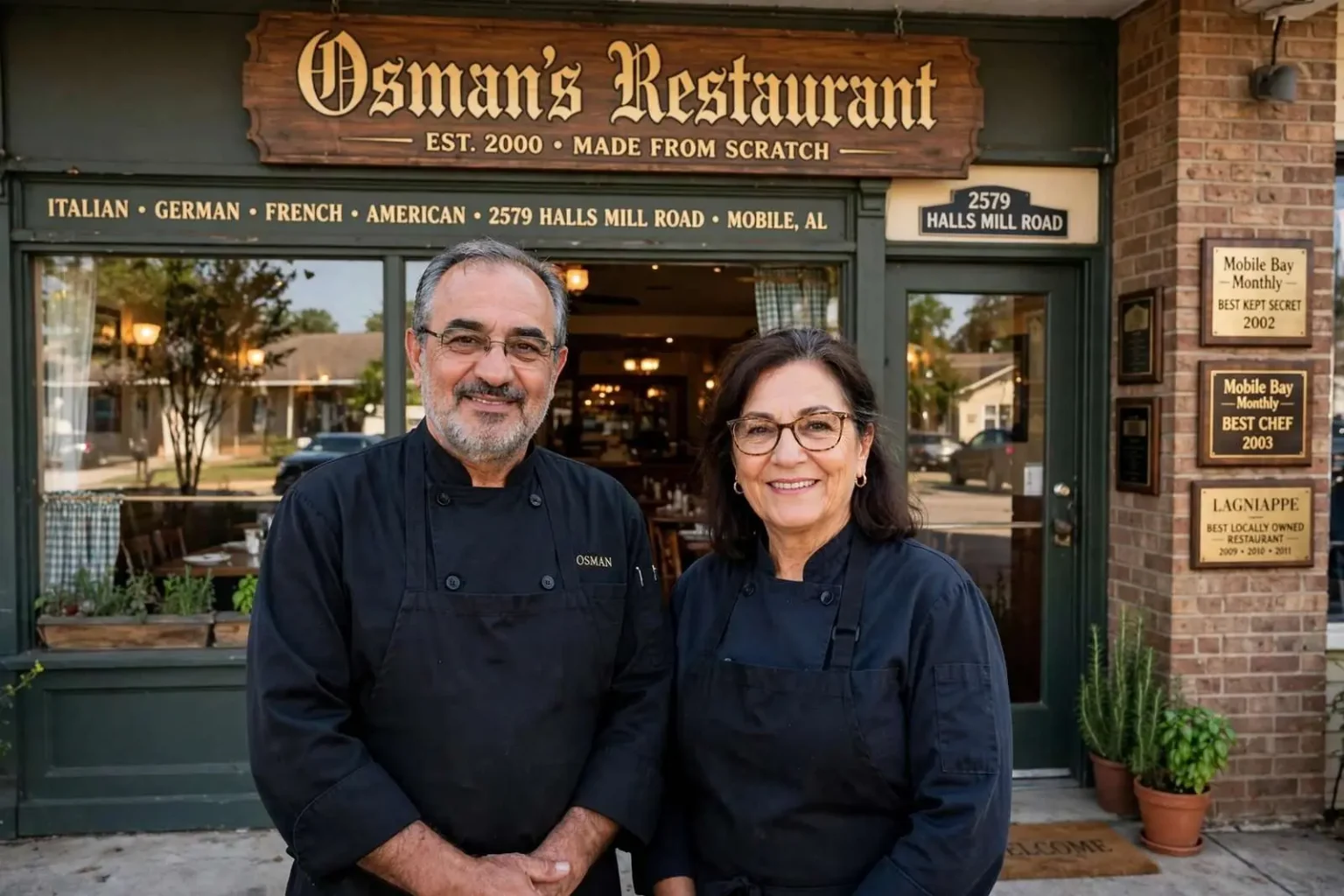
Osman’s Restaurant at 2579 Halls Mill Road in Mobile has served made-from-scratch Italian, German, French and American cooking since 2000, the culmination of a family’s journey from Bosnia and Herzegovina to the Gulf Coast. Owners Osman and Mirjana Ademovic graduated from culinary school in 1982 in Banja Luka, Bosnia. When conflict swept the region in the early 1990s, the family fled to Germany in 1992. Germany would not allow them to stay, and with nowhere left to go, the family was accepted as refugees by the United States. Catholic Social Services brought the Ademovics and their daughters to Mobile in 1997.
The story behind Osman’s is one of the more remarkable immigration stories in Mobile’s dining scene. The Ademovics arrived with professional culinary training and years of experience behind them, but without a restaurant, a kitchen or a customer base in a city they had never seen. What they had was their craft, and what they found was a community willing to welcome newcomers who had crossed a continent to rebuild their lives.
In Mobile, the couple worked in the kitchens of The Pillars and The Admiral Semmes Hotel, two of the city’s storied dining and hospitality landmarks, saving their earnings until they could open a place of their own. The work was demanding, the hours long, and the goal distant. But restaurant kitchens reward the same discipline that culinary school had taught them in Banja Luka years earlier, and by 2000 the savings were there.
From Banja Luka to the Gulf Coast
The distance the family covered is hard to overstate. Bosnia and Herzegovina in the early 1990s descended into war that displaced millions, and refugee resettlement became the only path forward for many families. Germany, among the most common destinations for those fleeing the Balkan conflict, hosted the Ademovics temporarily before policy forced another move. Acceptance by the United States refugee program, and placement by Catholic Social Services in Mobile, gave the family its final destination.
Mobile’s history made it a natural fit for resettlement. The Port City has absorbed waves of newcomers for three centuries, from French, Spanish and African arrivals to Lebanese, Greek, Vietnamese and Eastern European families who built businesses along its corridors. Catholic Social Services, which has long coordinated refugee placement in south Alabama, connected the Ademovics with housing, employment leads and the early support that lets families stand on their own feet.
Within three years of their arrival, the family had gone from working in other people’s kitchens to running its own. In 2000, Osman’s Restaurant opened at 2579 Halls Mill Road, serving Italian, German, French and American cuisine with everything made from scratch. The restaurant took the owner’s first name and the family’s cooking philosophy with it: no shortcuts, no freezers full of prepared food, just the old-school European training the couple had carried across the Atlantic.
The Menu and the Neighborhood
The four-cuisine menu reflects both the owners’ training and the breadth of classic European and American cooking. Diners can find the German dishes of central Europe, the Italian standards of the Mediterranean, French technique and American comfort food, all prepared in-house. That range is unusual for a small, family-run kitchen and speaks to the depth of the couple’s formal education in the culinary arts.
Halls Mill Road runs through a working residential section of Mobile, a few miles inland from the downtown historic districts where the Ademovics once cooked for hotel guests. Restaurants that open along neighborhood corridors live or die by repeat customers, and Osman’s built exactly that kind of following, diners who came weekly, brought friends and marked birthdays at the same tables.
The restaurant quickly earned a loyal following and a shelf of honors to match. Mobile Bay Monthly named it the city’s best-kept secret in 2002 and awarded the restaurant its Best Chef honor in 2003. Lagniappe, the Mobile-area publication, has repeatedly named it Best Locally Owned Restaurant, including in 2009, 2010 and 2011.
A Quarter Century on Halls Mill Road
Restaurants that survive their first decade are the exception rather than the rule in the industry, and ones that reach their second decade in a mid-sized market like Mobile are rarer still. Osman’s longevity comes from the combination that defines many family restaurants: a husband-and-wife team with no outside investors, a menu priced for working families and a reputation spread almost entirely by word of mouth.
Made-from-scratch cooking is also a competitive distinction. As chain kitchens increasingly rely on pre-portioned, centrally prepared ingredients, independently owned restaurants that bake, stock, simmer and sauce on site offer a dining experience that cannot be franchised. Regulars at Osman’s have long cited that difference, the taste of food made the way it is made in a home kitchen, by the same two people, year after year.
The honors accumulated along the way tell the story of a restaurant that outgrew its “best-kept secret” label. Being named Mobile’s best-kept secret in 2002, only two years after opening, meant local food writers had already discovered what neighborhood regulars knew. The Best Chef award in 2003 recognized the kitchen itself, and the string of Best Locally Owned Restaurant honors from Lagniappe in 2009, 2010 and 2011 confirmed that the restaurant had become an institution rather than a novelty.
The Refugee Experience and American Small Business
The Ademovics’ path mirrors that of many refugee families who have remade themselves as small business owners in the United States. Resettlement agencies provide the first months of support, but long-term success depends on what families bring with them: skills, work habits and the willingness to start over in an unfamiliar place. For the Ademovics, culinary training earned in Banja Luka in 1982 became the foundation for everything that followed.
Their daughters, who made the journey from Bosnia to Germany to Mobile as children, grew up in and around the family business as it took shape. Family-run restaurants of this kind often function that way, with every generation contributing to the operation, whether in the dining room, the kitchen or the books.
Stories like this one also trace the quieter side of Mobile’s international ties. The city’s connection to the Balkans is not widely known, but families displaced by the wars of the 1990s settled across the Gulf South, and several of the region’s most respected independent kitchens trace their roots to that migration. Osman’s stands out because it turned displacement into longevity.
Visiting Osman’s
Osman’s Restaurant is located at 2579 Halls Mill Road in Mobile, Alabama. For information, current hours and reservations, call 251-479-0006. Diners planning a first visit should expect the rhythms of a true neighborhood restaurant rather than a downtown showplace: a dining room filled with regulars, a menu that crosses four culinary traditions and food prepared from scratch by the owners themselves.
More than two decades after the Ademovics opened the doors on Halls Mill Road, the restaurant remains what it set out to be in 2000: a family’s answer to the question of what comes after losing a homeland. The answer, it turns out, was a Mobile institution.
What Made-From-Scratch Means in Practice
In a scratch kitchen, the day starts long before the first customer sits down. Stocks are simmered, doughs are mixed, sauces are built from raw ingredients and dressings are whisked by hand. Nothing arrives ready to plate. That labor is the reason independent restaurants of this kind taste different, and it is also the reason menus at such places tend to stay focused: every item added to a scratch menu adds hours of preparation.
The four traditions represented on Osman’s menu each demand their own techniques. German cooking leans on braises, roasts and hearty sides; Italian cooking on pasta, tomato-based sauces and Mediterranean herbs; French cooking on sauces and careful butchery; American cooking on the grills and comfort plates diners expect. Running all four from one kitchen is a test of organization as much as skill.
For the Ademovics, the approach was never a marketing strategy. It was simply the way they had been trained, in a culinary school program in Banja Luka where scratch cooking was not a trend but the definition of the profession. When they opened their own place, doing anything else was not under consideration.
Why the Honors Matter
Awards from local publications play an outsized role in how Mobile diners choose independent restaurants. Without national advertising budgets, family restaurants depend on recognition from outlets readers trust, and the Mobile Bay Monthly designations of 2002 and 2003 arrived at exactly the moment a new restaurant needs its reputation to spread beyond its own street.
The Lagniappe honors in 2009, 2010 and 2011 demonstrated staying power rather than novelty. Winning the same readers’ poll three consecutive years requires more than a strong opening; it requires consistency through staff changes, economic swings and the passage of time. By the end of that run, Osman’s had been in business for over a decade and had earned its place in the regular rotation of Mobile diners.
Recognition also validates the gamble refugee families take when they invest savings in a business. The Ademovics put the earnings from years of hotel and restaurant work into a storefront on Halls Mill Road with no guarantee of success. The shelf of plaques that followed is proof the gamble paid off, and proof that the city that received them as refugees came to rely on them as restaurateurs.
Nearly a quarter century on, Osman’s remains a destination for diners across the Mobile area who want food made by hand, and a reminder that some of the Gulf Coast’s best kitchens were built by families who traveled the farthest to reach them.