Democrats Restore Laffitte as Sheriff Nominee
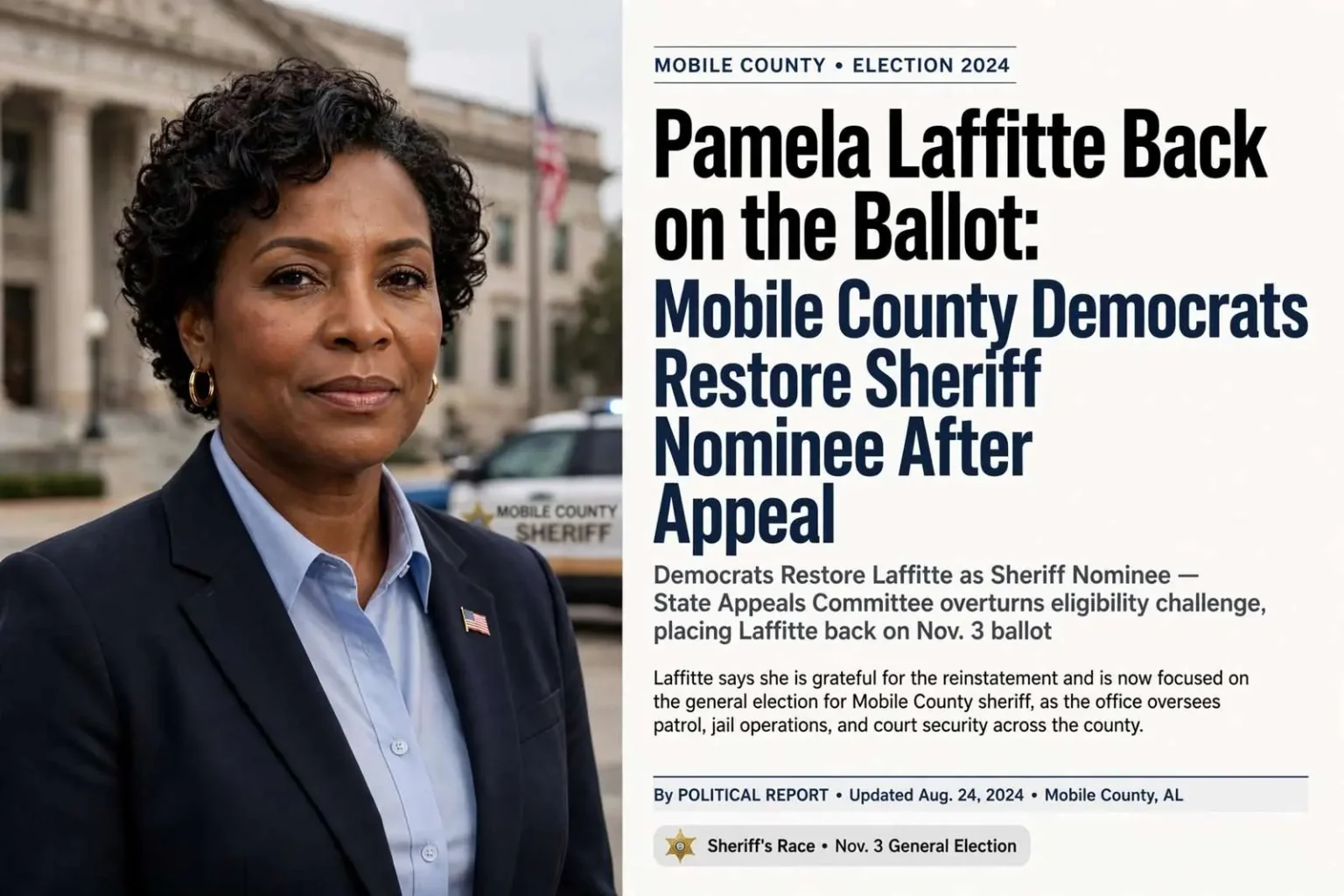
Pamela Laffitte is officially back in the race for Mobile County sheriff. The Mobile County Democratic Party has restored Laffitte as its nominee after the Alabama Democratic Party’s Appeals Committee ruled in her favor, ending a weeks-long dispute over whether she qualified for the ballot.
“I am grateful for the Alabama Democratic Party’s decision to reinstate my name on the general election ballot,” Laffitte said, “and I look forward to earning the support and vote of the people of Mobile County.” Laffitte had been removed from the ballot following a challenge that questioned her eligibility to appear in the Nov. 3 general election, prompting an appeal that ultimately returned her name to the certified list of candidates.
The ruling marks a decisive turn in a nomination fight that played out across party committees, public meetings and appeals filings in the weeks leading up to the fall election. With the appeals committee’s decision, Mobile County Democrats close the book on the dispute and turn their focus to the November contest against the Republican nominee.
What the Dispute Was About
The challenge centered on Laffitte’s eligibility to appear on the Nov. 3 general election ballot — a dispute that briefly cost her the party’s nomination before the state party’s appeals process reversed the local decision. Details of the original challenge involved questions raised during the local party’s certification process and were reviewed by the state appeals panel before the reinstatement was issued.
The reinstatement returns her to the race and sets up a countywide contest for the office that leads the Mobile County Sheriff’s Office, one of the largest law enforcement agencies in Alabama. The agency patrols unincorporated Mobile County, manages the county jail complex and provides security for the courts, employing hundreds of sworn officers and civilian staff across its divisions.
The appeals committee’s decision follows the formal structure of Alabama Democratic Party bylaws, which allow candidates to challenge local party rulings at the state level. The committee’s finding reinstates Laffitte’s certified nomination and requires the local party to treat her as the official nominee heading into the general election.
A High-Stakes Election Year for Mobile County
The sheriff’s race headlines a busy fall ballot for Mobile County voters, with the general election set for Tuesday, Nov. 3. Mobile County voters will also weigh in on statewide offices, legislative seats and any local referenda that appear on the November ballot, making turnout expectations a focus of both major parties in the final weeks of the campaign.
The sheriff’s office oversees law enforcement in unincorporated Mobile County, operates the county jail system and provides court security — responsibilities that have drawn intense public attention in recent years amid debates over jail conditions, staffing and transparency. County leaders, advocacy groups and residents have called for reforms ranging from mental health response to body-worn camera policies, giving the sheriff’s race an unusually high public profile.
With Laffitte’s name restored, voters will now choose between the major-party nominees in a contest that could shape county law enforcement policy for years to come. The next sheriff will inherit ongoing projects, staffing decisions and oversight questions that have occupied county leaders throughout the current term, making the office one of the most consequential down-ballot races on the Mobile County ballot.
Mobile County Democratic Party Regroups
For the Mobile County Democratic Party, the appeals decision closes a chapter that briefly pulled attention away from policy debates and toward procedural questions of candidate eligibility. Local party officials say they are now turning their full focus to organizing for the fall, including voter outreach, phone banking and coordinated campaign events alongside other Democratic nominees up and down the ballot.
The Mobile County Democratic Executive Committee had been caught between enforcing the original challenge and preparing for a contested general election. With the appeals ruling in hand, the committee can move forward with a single nominee, allowing campaign volunteers and resources to be directed toward a unified message rather than internal dispute resolution.
How the Sheriff’s Office Serves Mobile County
The Mobile County Sheriff’s Office is one of the largest law enforcement agencies in Alabama, with jurisdiction across hundreds of square miles of unincorporated territory. The agency operates the Mobile County Metro Jail, which houses inmates from multiple municipalities under contract, and provides courthouse security at the Mobile County Government Plaza and other judicial facilities in downtown Mobile.
Beyond patrol and corrections, the sheriff’s office runs specialized units covering narcotics, marine patrol along the Tensaw and Mobile rivers, K-9, SWAT, and school resource operations across the county’s unincorporated schools. The office also manages civil processes, including evictions, subpoenas and the service of court orders, giving the sheriff’s role a broad administrative footprint beyond traditional patrol work.
What the Reinstatement Means for Voters
For Mobile County voters, the appeals committee’s decision means they will see Laffitte’s name on the Nov. 3 ballot alongside the Republican nominee for sheriff. Voter guides, sample ballots and absentee ballot materials have been updated to reflect the restored nomination, and election officials have worked to make sure any early or absentee ballots already issued include the corrected slate.
Local civic groups and voter education organizations have emphasized the importance of reviewing updated sample ballots before heading to the polls, since changes at the top of a race can affect turnout and straight-ticket voting decisions. The Mobile County Probate Office, which administers elections, has published the certified list of candidates for the fall.
Looking Ahead to November
With the legal question settled, the campaign now turns to issues and outreach. Mobile County residents can expect candidate forums, town halls and televised debates in the weeks ahead as both nominees make their case to voters. Local media, including southalnews.com, will continue to track candidate announcements, fundraising reports and policy platforms as they develop.
Election Day is set for Tuesday, Nov. 3, with polls open across Mobile County from 7 a.m. to 7 p.m. Voters with questions about registration, polling locations or absentee voting can contact the Mobile County Probate Office or visit the Alabama Secretary of State’s website for the latest official information.
Background on Alabama’s Ballot Appeals Process
Alabama’s two major political parties each maintain internal procedures for resolving disputes over candidate eligibility, including appeals pathways that run from local executive committees to state-level panels. The Alabama Democratic Party’s Appeals Committee is the body empowered to review local decisions that remove or refuse to certify a nominee, and its rulings are generally considered final within the party.
Appeals can involve questions about residency, party loyalty, qualification paperwork or other eligibility criteria specified in state law and party bylaws. The committee typically considers written filings, hears arguments and issues a written decision. Once the state panel rules, the local party is bound by the outcome unless a court steps in.
This fall’s Mobile County sheriff’s race is the latest in a series of Alabama contests that have featured late-stage eligibility disputes. Past state legislative and statewide races have produced similar appeals, underscoring how procedural battles can reshape ballot access even after the primary season ends.
Mobile County’s Recent Political Landscape
Mobile County has trended competitive in statewide and federal races over the past decade, even as it remains reliably Republican at the top of the ballot. Local contests, particularly for countywide offices such as sheriff, district attorney and probate judge, often see more vigorous two-party competition because they focus on issues that touch residents’ daily lives, including public safety, court operations and tax administration.
The Mobile County Sheriff’s Office covers a jurisdiction that includes industrial corridors along the Mobile River, sprawling residential subdivisions in the western and northern parts of the county, and large swaths of forested and waterfront land. The diversity of the jurisdiction — from the busy corridors around the Mobile Regional Airport to quiet communities such as Grand Bay, Semmes and Wilmer — gives the sheriff wide discretion in how resources are deployed across the county.
Outlook for the General Election Campaign
With the appeals dispute behind her, Laffitte and her supporters can now shift attention to door-to-door canvassing, fundraising and building a campaign infrastructure capable of reaching Mobile County’s roughly 250,000 registered voters. Volunteers are expected to fan out across neighborhoods in unincorporated Mobile County as well as the major population centers of Mobile, Prichard, Saraland, Satsuma and Chickasaw, even though the sheriff’s office only has direct jurisdiction outside city limits.
Her Republican opponent is expected to do the same, with both campaigns targeting the same pool of persuadable voters who often decide down-ballot countywide races. Local civic organizations, neighborhood associations and faith groups are also likely to host forums and community conversations as Election Day approaches, giving residents opportunities to hear directly from both candidates about their plans for the office.
Alabama Sheriffs as Constitutional Officers
Unlike police chiefs, who typically answer to a mayor or city council, sheriffs in Alabama are constitutional officers elected directly by the voters of their county. That status, rooted in Alabama’s 1901 Constitution, gives the office a measure of independence from other county government bodies: a sheriff is not hired or fired by the county commission and sets policy for the department within the bounds of state law and the county budget approved for the office. Alabama sheriffs serve four-year terms, and the office carries broad statutory authority over law enforcement, jail operations and civil process service within the county, which is part of why sheriff’s races routinely draw more attention than other countywide contests on the ballot.
That independence also means a change in the sheriff’s office can bring more visible shifts in department priorities than a change in, say, a city police chief appointed by elected officials who remain in office regardless of the outcome. Voters choosing a sheriff are, in effect, choosing the person who will set enforcement priorities, jail policy and hiring practices for the next four years, which is one reason candidate eligibility disputes like the one that temporarily sidelined Laffitte’s nomination tend to draw outsized scrutiny from party officials and voters alike.
Absentee and Early Voting Ahead of November
Alabama does not offer no-excuse early in-person voting, but voters who qualify under the state’s absentee statute can request a ballot by mail ahead of the Nov. 3 general election. Deadlines for absentee applications typically fall about a week before Election Day, while the deadline to register to vote in the general election is usually set roughly a month out under state law. Election officials in Mobile County have said they are working to ensure any ballots already prepared or mailed reflect the corrected slate of candidates following the appeals committee’s ruling, a step that is standard practice whenever a late change affects the certified list of nominees.
The certification itself still carried a wrinkle. Mobile County Probate Judge Mark Erwin did not immediately act on the party’s renewed certification, saying he was seeking an opinion from the Alabama Attorney General’s Office on the underlying eligibility question. That opinion had not been issued before the Aug. 24 ballot certification deadline, leaving Erwin with the Democratic certification letter that includes Laffitte, and he said he expected her to appear on the ballot even though the legal question remains unresolved.
The dispute centers on Alabama Code § 45-4-9230.05, a Mobile County-specific law applying to anyone qualifying for sheriff on or after June 1, 2024. It requires sheriff candidates to have five or more years of prior service as a sworn law enforcement officer having the power of arrest, along with county residency, voter registration and no felony conviction.
Laffitte’s background includes more than 26 years with the Mobile County Sheriff’s Office, where she worked as a corrections officer and rose to corrections sergeant, according to her campaign materials. She has also pointed to her graduation from corrections and jail training programs and prior service as an auxiliary reserve deputy, and has argued that corrections officers fall under the broader umbrella of law enforcement because they carry handcuffs and can make arrests in courtrooms or re-arrest inmates who escape custody.
“I am not going anywhere,” Laffitte said in June after the challenge surfaced. “The title of Corrections Officer inherently falls under the umbrella of Law Enforcement.”