
Parked CSX Train Snarls Second-Dose Vaccinations at Mobile’s Alabama Cruise Terminal
A CSX train parked on the tracks trapped vehicles for hours as over a thousand people arrived for second-dose Moderna shots in Mobile.
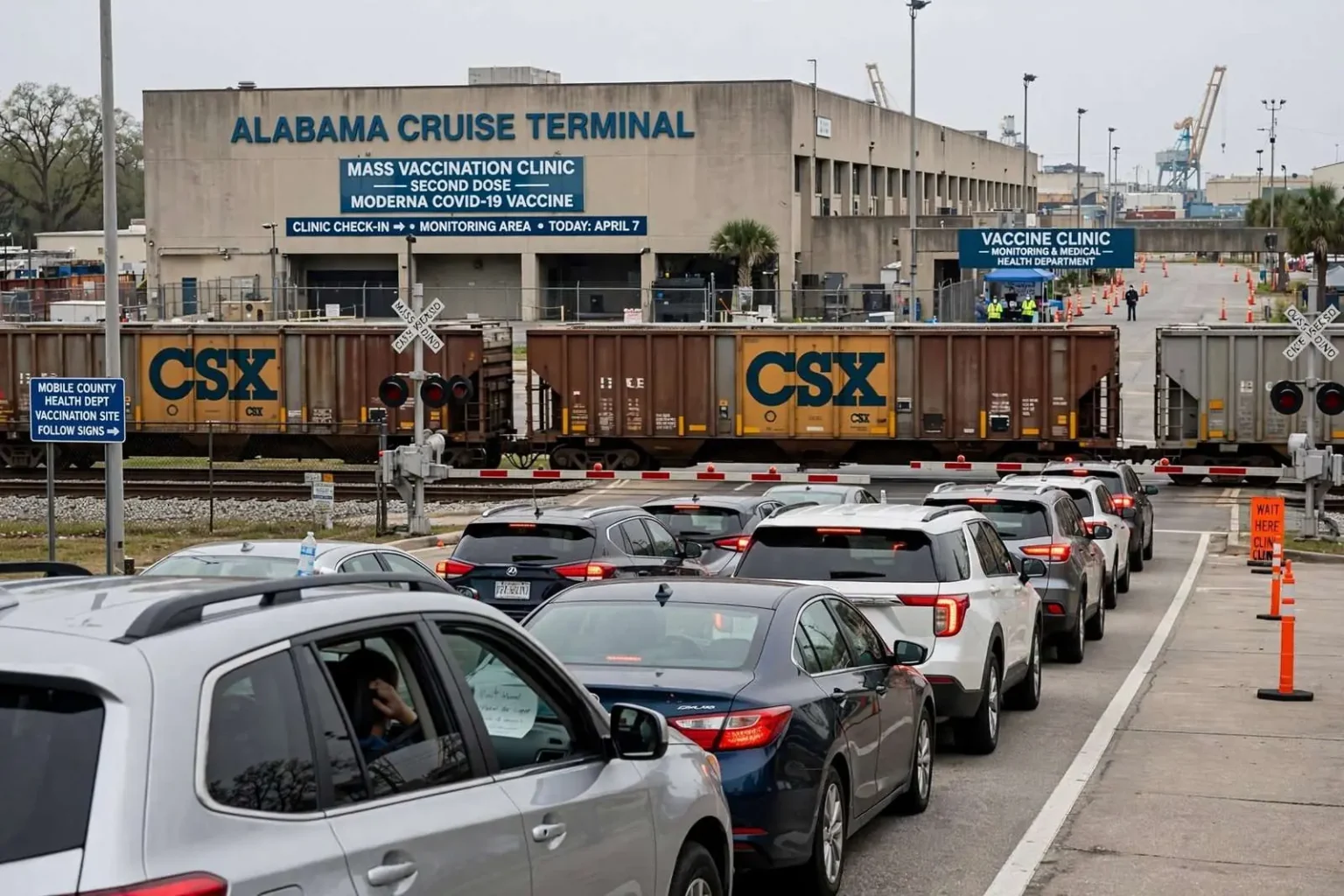
A CSX freight train parked on the tracks turned an already busy day into hours of frustration for more than a thousand people returning to the Alabama Cruise Terminal in downtown Mobile for their second doses of Moderna’s COVID-19 vaccine. The April 7 clinic drew everyone due for a second round of shots, and long lines were expected. What wasn’t expected was the train, which sat on the tracks for hours.
Vehicles that had already entered the terminal grounds were trapped between roughly 10 a.m. and 1 p.m., while those still waiting to get in were forced to weigh whether to leave without being vaccinated. The result was a day that turned a routine medical appointment into a test of patience at exactly the moment when completing a vaccination series mattered most.
Second doses are not optional extras in the Moderna regimen. The two-shot series is designed around an interval — a first dose to introduce the immune system to the virus’s spike protein, and a second dose weeks later to drive protection to its full strength. Public health guidance throughout the early vaccination campaign stressed that the second dose was where durable immunity was built, and clinics like the one at the cruise terminal were scheduled precisely so that everyone who received a first dose weeks earlier could complete the series on time.
The Alabama Cruise Terminal, the port facility on the Mobile River that normally greets cruise passengers, had been pressed into service as a mass vaccination site — one of the largest venues in the city, with driveways and grounds sized to move heavy vehicle traffic. On ordinary clinic days, cars flowed through in an orderly relay: check-in, a short wait, the shot, then a monitoring period before drivers pulled out. The facility’s rail access, which serves the port’s freight operation, was simply part of the landscape — until the morning a train parked across the access line and did not move.
“This Is Ridiculous”
The people stuck inside the terminal grounds could do nothing but wait, engines off, as the scheduled monitoring periods stretched into hours. The people outside could see the line but not reach it.
“I mean, this is ridiculous,” said Robert Noll, who said it was the third visit on which he’d been stuck for more than an hour. His frustration had a history: for patients juggling work schedules, childcare, and the simple logistics of a drive across Mobile County, a vaccination appointment that consumed an entire morning was a burden multiplied across more than a thousand households.
Another vaccine recipient, Tessie LeBlanc, had waited more than two hours without breakfast by the time she spoke to reporters. Her morning captured the experience of the trapped cars in miniature — appointments made weeks in advance, alarms set early, and then a boxcar wall between the driver’s seat and the dose waiting on the other side of the tracks.
For clinic staff inside the terminal, the stranded vehicles created a parallel problem. Nurses ready to administer shots watched the entry line stand still while the supply of vaccine doses, thawed and scheduled for the day’s appointments, waited alongside them. Mass vaccination clinics of that era worked against the clock in both directions — doses had limited windows for use once prepared, and no-shows meant wasted protection that other residents on waiting lists could have received.
A safety hazard, not just an inconvenience
Some worried the blocked crossings created a safety hazard beyond mere inconvenience. A vaccination clinic is, by design, a place where people receive an injection and then wait nearby to be monitored — and where medical staff are on hand to respond if anyone has an adverse reaction.
“Someone could have a reaction that could cause them to need more medical attention, and then the train prevents that,” said Jerryln London.
Her point cut to the heart of the morning’s real risk. Anaphylactic reactions to vaccines are rare, but mass clinics stock epinephrine and staff monitoring areas precisely because they are possible, and the standard protocol calls for immediate response. With the crossings blocked, an ambulance summoned to the terminal would have faced the same wall of freight cars that held back the vaccine recipients — a delay measured not in minutes of irritation but potentially in the time it takes for a severe allergic reaction to escalate.
The same geometry applied to anyone in the trapped line needing help for any reason — a medical emergency, a vehicle problem in the April heat, a family situation at home. A parked train does not discriminate among the reasons someone might need to leave in a hurry.
The health department weighs options
A Mobile County Health Department spokesperson said officials would work out alternatives for people who couldn’t wait out the train, and would announce plans through social media and its website. The health department said those who left without their second dose would have options to complete their vaccinations.
That assurance was the day’s most consequential news for the people who peeled out of the line and drove home. In the early months of the vaccination campaign, the guidance surrounding second doses was strict — the same product, the same interval, and little flexibility — and residents who missed a scheduled dose feared they would have to start the series over. The department’s pledge that options would be available meant no one would lose their place in the process because of a parked train they could not control.
The choice to communicate through social media and the department’s website reflected how mass vaccination logistics worked at the time. With thousands of appointments across a rolling calendar and residents depending on up-to-the-minute instructions, the department’s digital channels had become the fastest way to reach everyone at once — announcing schedule changes, alternative sites, and what to bring when rescheduling.
For the department, the morning was a stress test of the largest public health operation in its history. The agency had spent the preceding months standing up drive-through testing, then pivoting its staff and its sites to vaccination — hiring and training injectors, managing dose allocations that arrived from the state on weekly schedules, and running clinics at a scale no routine public health program had ever demanded. A blocked rail crossing was the kind of disruption no planning document anticipated, and the response — hold the line, work the alternatives, communicate fast — showed an operation learning in real time.
Why the train mattered
CSX did not respond to inquiries about why the train sat parked for so long. The silence left the practical questions unanswered: whether the parking was routine freight operations, a scheduling backlog, or a crew or mechanical issue, and whether the railroad knew it was pinning the entrance to a vaccination site holding more than a thousand people.
Freight trains pass through downtown Mobile as a matter of course — the city’s port, one of the busiest on the Gulf, depends on rail connections that run through the urban core, and residents are accustomed to waiting at crossings for a passing consist. What made April 7 different was duration. A train that blocks a crossing for five minutes is a fact of life; a train that parks across the access to a medical facility for three hours is a different category of problem, and one that drew attention precisely because of what was on the other side.
The episode also illustrated a vulnerability that few had considered before it was demonstrated: a mass vaccination site’s traffic plan is only as good as the roads around it, and those roads belong to the economy around them. The terminal’s design could process hundreds of cars an hour, but not a single car could cross a rail line that freight operations happened to occupy.
What residents took from the day
By early afternoon the situation resolved, and the cars that had waited out the train completed their appointments. Those who left early carried the health department’s promise that their second doses could still be arranged — a promise that mattered both to the individuals involved and to the community’s broader goal, because every incomplete series represented protection that would fall short of what the vaccine was designed to deliver.
The stories from the line outlasted the morning. Noll’s third visit stuck for more than an hour, LeBlanc’s two hours without breakfast, and London’s warning about a blocked ambulance became the shorthand by which locals remembered the spring’s vaccination campaign — the part of pandemic history that was not about science or supply chains, but about waiting in a line of cars while a freight train sat between them and a dose of vaccine.
The clinic went on, the doses went into arms, and the health department’s alternatives went out over social media and its website before the day was done. But the morning at the Alabama Cruise Terminal became a small case study in how a city’s vaccination campaign depended not only on medicine and planning, but on a railroad’s schedule — and on what happens when the two collide on an April morning.


