Pate Takes the Stand in Mobile Reckless Murder Trial, Denies Being Impaired
Aubrey Aaron Pate testified he was not impaired despite admitting to drinking and using marijuana before a 2022 crash that killed Mobile postal worker Victor Birch.
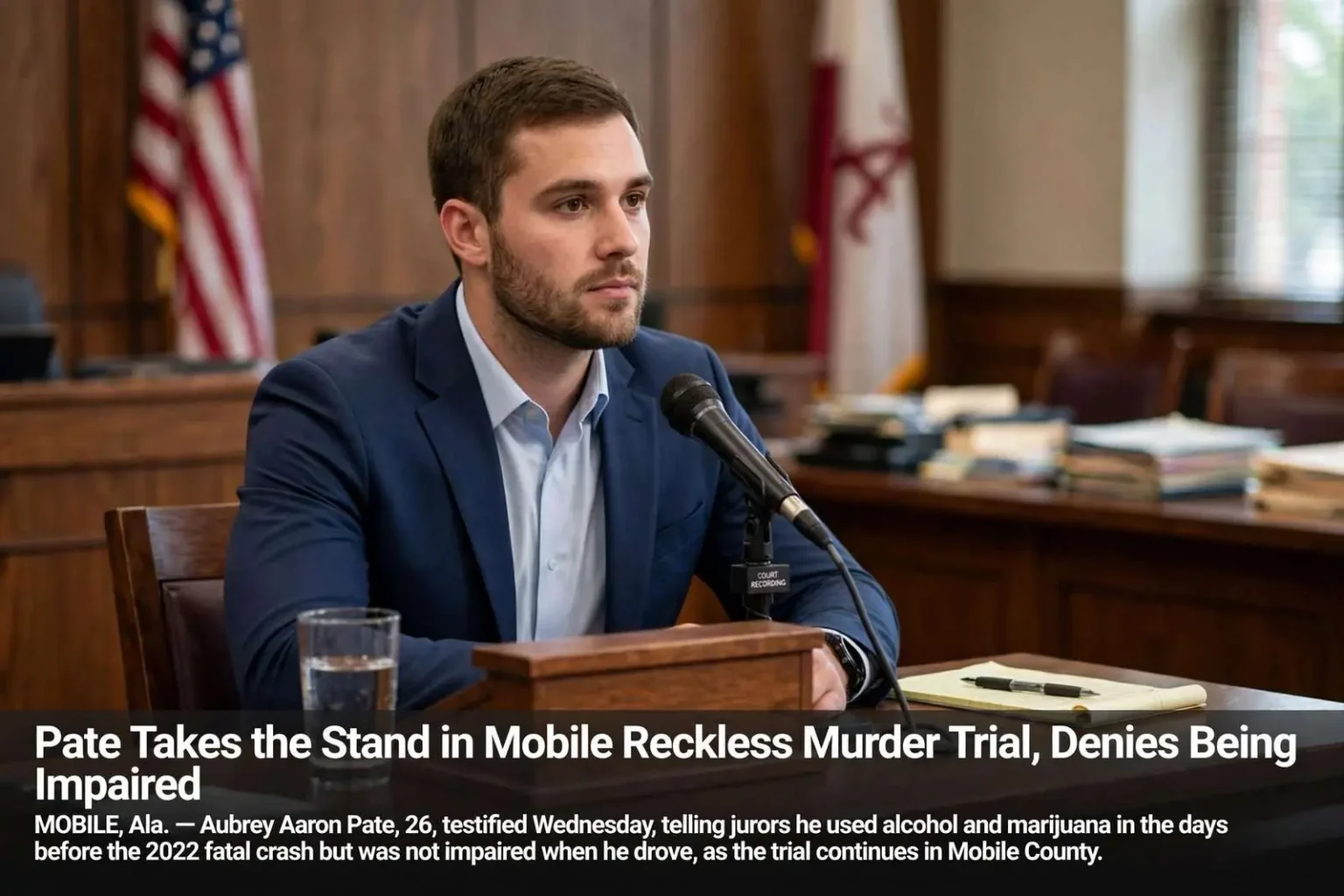
MOBILE, Ala. — The Wilmer man on trial in the 2022 death of a Mobile postal worker testified in his own defense Wednesday, telling jurors he had used alcohol and marijuana in the days before the fatal crash but maintaining that he was not impaired when he got behind the wheel. Taking the stand is the defining gamble of any criminal defense, and in a reckless murder trial — where the state must prove a state of mind as well as a death — the defendant’s own account of the hours before the crash becomes the centerpiece of the case. Pate spoke calmly, jurors heard, and acknowledged the substance use that prosecutors have placed at the center of their theory while insisting it had no bearing on his driving that morning.
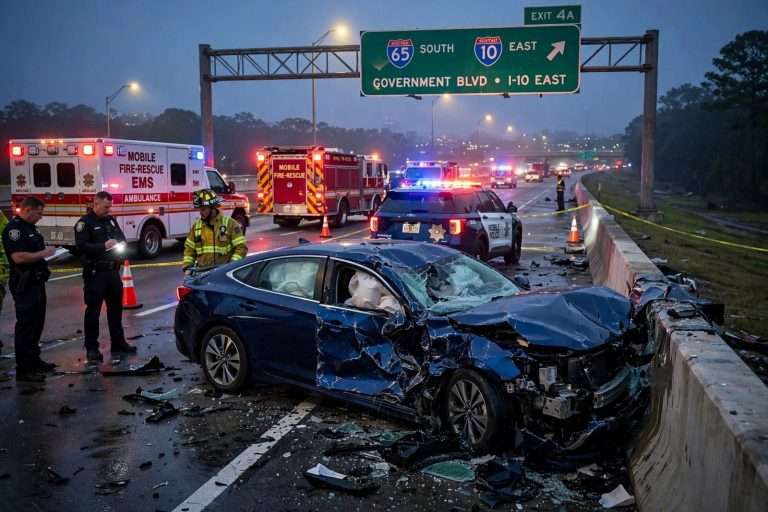
Aubrey Aaron Pate, 26, faces a reckless murder charge stemming from a head-on collision on the bridge over the Industrial Canal on Rangeline Road early on Sept. 25, 2022. The crash killed Victor Birch, a well-known postal worker who was active in a local running group. The bridge, a narrow span that carries Rangeline Road traffic over the Industrial Canal in Mobile’s northern industrial corridor, leaves little margin for a car that drifts across the center line — a fact that has hung over the case since investigators first mapped the wreckage. Birch’s death landed hard in the communities where he delivered mail and the running circles where he was a familiar face.
Reckless murder is among the most serious charges Alabama prosecutors can bring in a traffic death. Unlike standard DUI homicide statutes, which can require prior convictions or specific blood-alcohol thresholds, the reckless murder count asks jurors to find that the defendant acted with conscious disregard for a risk of death — a frame that allows the state to argue for the punishment of a murder conviction without proving intent to kill. Conviction carries a potential sentence measured in decades, which is why the scientific disputes in this trial carry stakes far beyond the usual expert disagreement.
Pate testified that he and two friends shared a single marijuana joint two days before the crash, and that the night before, he had one beer. His defense team argues the amount of drugs and alcohol in his system was far too small to have affected his driving. The strategy puts the defendant’s candor to work: by admitting the substance use up front, the defense hopes to persuade jurors that the quantities involved were trivial and that the state’s impairment theory rests on assumptions rather than measurement. The gap between admitting use and conceding impairment is where this trial will be decided.
Toxicologist Estimates Blood Alcohol Content
Dr. Curt Harper, a toxicologist with the Alabama Department of Forensic Sciences, testified that the state’s official lab report did not detect alcohol in Pate’s system. However, Harper said he used a separate calculation method applied to a blood sample drawn hours later at the hospital, working backward to estimate how much alcohol Pate’s body would have already metabolized. Based on that method, Harper placed Pate’s blood alcohol content at the time of the crash between .05 and .095. The estimate straddles Alabama’s .08 legal limit for ordinary drivers, and its breadth — a range of nearly half again the lower figure — gives both sides something to argue.
Harper also testified he agreed with the findings of fellow state forensic analyst Michael Weaver, who previously told jurors that three different components of marijuana were found in Pate’s system. “It is my opinion there are indicators displayed in his system of impairment that was caused by alcohol and cannabinoids,” Harper testified. The conclusion pairs the two substances the defense has characterized as negligible, and it hands prosecutors an expert opinion that the combination, not any single substance, accounted for impairment.
The backward calculation Harper used — known in the field as retrograde extrapolation — is a long-standing point of contention in DUI litigation. The method applies population averages for how quickly the body eliminates alcohol to estimate a person’s level at an earlier time, and its accuracy depends on assumptions about drinking patterns, food, body composition and the timing of the sample. Defense attorneys routinely challenge such estimates because a range built on averages can swing widely for an individual, and a sample drawn hours after a crash may reflect far more uncertainty than the state’s presentation suggests. Jurors in this trial will have to decide how much weight an estimate deserves when the lab itself detected no alcohol.
The marijuana evidence raises a parallel scientific question. Chemical markers of cannabis can remain detectable in blood and urine for days or weeks after the psychoactive effects have passed, which is why the presence of three components in a sample says less about impairment at the wheel than the state would like. Whether jurors accept the defense’s argument that a single joint two days earlier could not have impaired Pate — or the state’s expert opinion that the markers, combined with alcohol, show impairment indicators — may turn on how each side explains the science in closing arguments.
Crash Reconstruction Expert Describes High Speed, Late Braking
Ronnie Redding, a former Alabama state trooper who now runs a crash-reconstruction consulting business, testified that data pulled from the pickup truck’s event data recorder — commonly known as a “black box” — showed Pate traveling between 77 and 81 mph before the crash, and that he did not brake until roughly half a second before impact. Event data recorders capture speed, throttle position and braking in the seconds before a collision, and they have become central evidence in modern crash cases because they replace recollection and estimate with machine readings. A speed near 80 mph on a bridge built for far slower traffic, followed by braking a half second before impact, is the kind of data prosecutors build impairment arguments around: whatever the chemistry of the driver’s blood, the recorder shows a vehicle that did not respond the way an attentive one would.
Redding created an animation for jurors illustrating how he believes the two vehicles collided. “He did a lane change, with the pickup carrying into the northbound lane for 3.5 seconds, and then he swerved,” Redding testified. The animation translates the recorder’s numbers into a moving diagram that jurors can watch rather than parse from a data table — a presentation choice that makes reconstruction evidence vivid, and one that defense attorneys often criticize as more persuasive than precise. The 3.5 seconds of lateral drift before the swerve suggests the pickup traveled a substantial distance across the center line while the crash was already in motion.
On cross-examination, defense attorney Michael Hickman challenged the accuracy of the animation, noting that it depicts flat, open terrain even though the crash occurred on a bridge. The objection goes to fairness rather than science: an animation that misrepresents the roadway’s actual geometry — the bridge rails, the limited shoulder, the approach curves of the Rangeline Road span — can lead jurors to visualize a crash that never quite happened as depicted. Hickman’s questioning suggested the defense intends to argue that the crash’s setting, not just the driver’s condition, shaped what the recorder captured.
Hickman also confronted Redding with testimony he gave at a pretrial hearing, in which he said the pickup truck had been in its “normal lane” before the crash, contradicting his trial testimony about a lane change already underway. “It’s there in black and white,” Hickman said, showing Redding a transcript of the earlier testimony. Impeachment with a prior transcript is a standard but potent courtroom maneuver, and jurors watching an expert walk back a printed statement tend to weigh his remaining conclusions with a more skeptical eye.
Redding acknowledged the discrepancy. “I misspoke,” he said. “It was not in its normal lane. In fact, it was in the midst of its lane-change maneuver.” The concession preserved the substance of his analysis while admitting the error, and it framed the defense’s cross-examination as a dispute over description rather than the underlying data. Whether jurors treat the correction as minor or as a reason to doubt the rest of the reconstruction may matter as much as the black box numbers themselves.
The trial, which opened earlier this week in Mobile County, is expected to continue with additional testimony as prosecutors and defense attorneys present their full case to jurors. Still ahead are the closing arguments where the two competing narratives — a driver impaired by alcohol and marijuana, or a driver whose admitted substance use was irrelevant to a crash of speed and lane position — collide before the jury begins deliberations. The verdict will determine whether Pate leaves the courtroom facing a murder sentence or a very different future, and it will be watched closely by the family and colleagues of the postal worker whose death brought the case here.