Pensacola artist repaints defaced George Floyd mural at Graffiti Bridge
Pensacola artist Brandon Vessels repainted a George Floyd mural at the Graffiti Bridge after it was defaced, drawing community support during local.
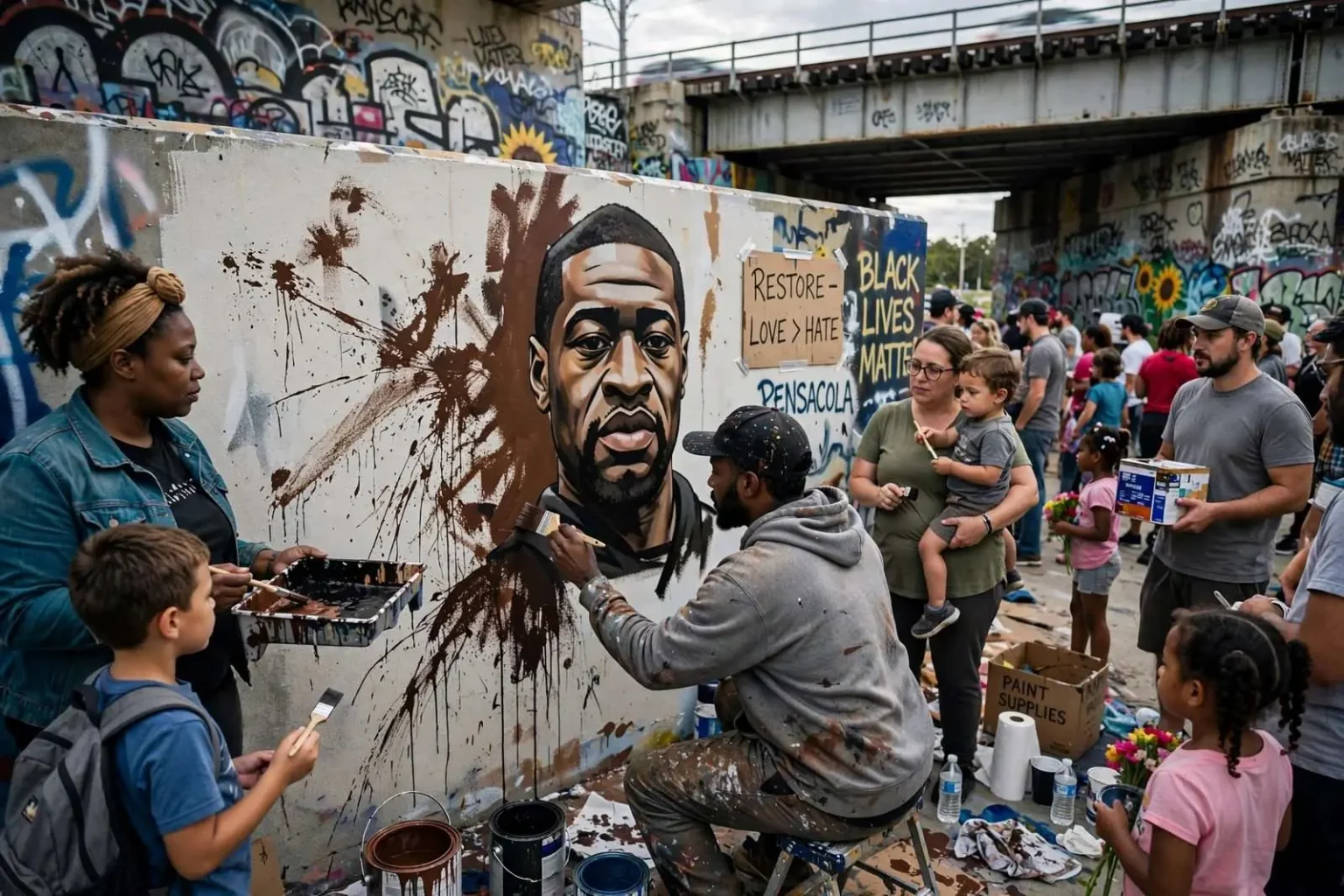
PENSACOLA, Fla. — A local artist returned to Pensacola’s Graffiti Bridge on Thursday to repaint a mural of George Floyd after it was apparently defaced the night before. The repainting came as demonstrations against police brutality and racism continued across the country following Floyd’s death in Minneapolis, and it turned the bridge — already one of the city’s most public canvases — into the focal point of an emotional day.
A Mural Found Marred
The mural was found covered in splashed brown paint, its portrait of Floyd obscured overnight by what the artist who created it quickly concluded was no ordinary act of bridge culture. Graffiti Bridge, the railroad overpass that spans 17th Avenue near Pensacola Bay, has operated for years as the city’s sanctioned canvas, where layers of paint accumulate daily and where painting over someone else’s work is part of the space’s ongoing, unwritten conversation.
That history is what made the damage stand out to the artist who created the mural. “It was literally just hate, I think,” said artist Brandon Vessels. He repainted the mural, understanding that artwork at the Graffiti Bridge is often painted over, but said the intent this time felt different.
“It wasn’t covered with art,” Vessels said. “It was covered in brown paint smeared and splattered all of it. It wasn’t an artistic statement.” The distinction he drew goes to the heart of how the bridge works: new murals routinely replace old ones there, but they do it with paint applied as art, in view of the public, not with anonymous splashes intended to erase and insult.
The defacement came at a moment when Floyd’s name had become the center of a national reckoning. His death in Minneapolis in late May 2020 had set off protests in cities across the country — including gatherings in downtown Pensacola — and murals bearing his face had appeared on walls, bridges, and boarded storefronts from coast to coast. In Pensacola, the Graffiti Bridge portrait became the local expression of that wider moment, and its defacement was read by those who gathered to restore it in exactly that context.
The Community Shows Up
Vessels drew support from drivers who honked as they passed and from families who came out to help. The bridge carries active traffic over it and beside it, and throughout the day the response from passing cars — a running chorus of horns — turned the repair work into something between a vigil and a street celebration.
Among those who came was Shanequa Patterson, who said it is painful to explain to her four sons what happened in Minneapolis. “I want my sons to be able to go outside and not have to worry about not making it back to me in the morning,” Patterson said. Her words connected the defaced wall to the fear that many parents in the crowd expressed as the demonstrations entered their second week — that the images from Minneapolis were not distant news but a commentary on their own children’s lives.
Families brought children, cameras, and their own paint contributions, and the repair became a communal act rather than a solitary repair job. The presence of parents with young kids gave the afternoon a tone that those present said mattered as much as the restored image: a demonstration, in paint, that the mural’s message had support in the community even if it had enemies under cover of darkness.
Vessels said he was grateful for those who came together. “It feels great because that’s exactly what I wanted,” he said. “I wanted people to come out and show love and support for this man’s life … he died in vain.” The artist’s framing placed the day’s work not as a restoration project but as a response — a way for Pensacola to answer an act of vandalism with visible, collective effort.
A Few Hours of Work, a Crowd That Stayed
The painting was finished after a few hours as a crowd rallied and chanted. The pace of the work — a mural restored in a single day by volunteers and the original artist — stood in contrast to the weeks it can take for public murals to be commissioned, approved, and completed through official channels. The bridge’s informality is its strength: no permit, no committee, no delay between the act and the answer.
Pensacola police stopped by briefly, only to ask protesters not to block traffic. The officers’ visit passed without incident, and the interaction reflected the arrangement that has mostly governed the bridge for years — police presence on the roadway side, art and expression on the walls, and a city that has largely tolerated, and at times embraced, the landmark’s ever-changing surface.
The demonstration remained peaceful. That outcome, on a day when several cities around the country saw confrontations, gave Pensacola’s version of the national moment a distinct character: paint, chanting, honking horns, and a mural back on the wall by the time the afternoon light faded.
What the Graffiti Bridge Means to Pensacola
The Graffiti Bridge occupies a particular place in the city’s identity. Formally an ordinary railroad overpass, it has been painted continuously for decades — first surreptitiously, then with the general blessing of the property’s owners and the city — until it became a running public bulletin board for birthdays, memorials, team spirit, political statements, and art. Residents leave messages on it the way other towns paint water towers: it is where the city talks to itself.
Because the surface changes daily, the bridge is a kind of weather vane for the community’s attention. In the days after Floyd’s death, as in the days after hurricanes and other events that have shaped the region, the walls filled with responses. The Floyd mural joined a tradition of memorial art on the bridge, and its quick restoration demonstrated the community’s stake in what the walls say.
The defacement also tested the bridge’s informal social contract. The space works because of a mutual understanding — artists get a public canvas, and in exchange the conversation stays creative even when it is contentious. A splash of anonymous brown paint, applied without art and without a signature, broke that contract from the outside, which is why the response came so quickly and so visibly.
Art in the Middle of a National Moment
The restoration Thursday took place against the backdrop of continuing demonstrations nationwide following Floyd’s death in Minneapolis, and Pensacola’s own gatherings had drawn hundreds in the preceding days. Murals became one of the movement’s most visible forms of expression in that period — portraits on city walls in Houston, Minneapolis, and Washington, and in hundreds of smaller cities — because they make a message physically present in a neighborhood, impossible to scroll past.
That is also why murals become targets. A wall can be repainted in an afternoon, but the effort to erase a message — and the community’s decision to answer it — is itself part of the public record. By the time Thursday’s light faded, the bridge carried a restored portrait, hours of video and photographs from those who came to help, and the honks of hundreds of passing drivers, each of which had added a small public vote to the day.
For the families who came out, the afternoon offered a way to respond that felt constructive in a week of anger — pick up a brush, stand with neighbors, and watch the wall come back. For Vessels, it was the response he had hoped for when he painted the mural in the first place. And for the bridge, it was another layer of paint in a story that stretches back decades, refreshed at one of the most consequential moments the canvas has ever recorded.
The Day’s Sequence, Reconstructed
The sequence of the day captured how quickly the bridge community moves. The defacement was discovered after a night in which brown paint was apparently splashed and smeared across the portrait, word spread by morning, and Vessels returned with paint and brushes before the day was out. By afternoon a crowd had gathered, families had joined in, and the mural was finished after a few hours of work accompanied by chanting and the steady sound of horns from the roadway.
For those present, the contrast between the two acts — a few minutes of anonymous splashing overnight, and hours of open, communal repainting in daylight — became the point. The person who defaced the mural worked alone and unseen; the restoration worked in public, on camera, with children helping and strangers joining. Both messages went up on the same wall, and the second one covered the first.
Peaceful Expression in a Tense Week
The peaceful character of the Pensacola gathering stood out in a week when demonstrations in other cities had sometimes given way to confrontation. The police who stopped by asked only that protesters not block traffic, and the crowd obliged, keeping the demonstration on the bridge and its surroundings while traffic continued to pass overhead.
That dynamic — an expressive crowd, a police presence limited to traffic management, and a resolution without arrests — matched the pattern Pensacola had seen at its earlier demonstrations during the same period, where marches through downtown had emphasized speeches, signs, and chants. The bridge event added art to that repertoire, and the crowd’s willingness to keep the space open to traffic kept the focus on the wall itself.
What Remains on the Wall
By the end of the day, the practical question — whether the mural would survive — had been answered as much as it could be: the portrait was back, brighter than before, with more hands credited in its paint than the original had carried. Nothing on the Graffiti Bridge is permanent, and everyone involved in Thursday’s work knew the surface would keep changing, as it always does.
But the day established something about the community around the bridge. A mural defaced overnight was not left to fade; it was restored within a day, by a crowd, with the artist leading and families finishing the edges. In the exchange between one act of paint and another, the second one said more — and it said it in daylight, out loud, with the horns of the city’s afternoon traffic answering back.