
Pensacola Man Accused of Beating Child With Extension Cord
Julius Dees faces aggravated child abuse charges after a child reported welts from an extension cord beating, Escambia County authorities say.
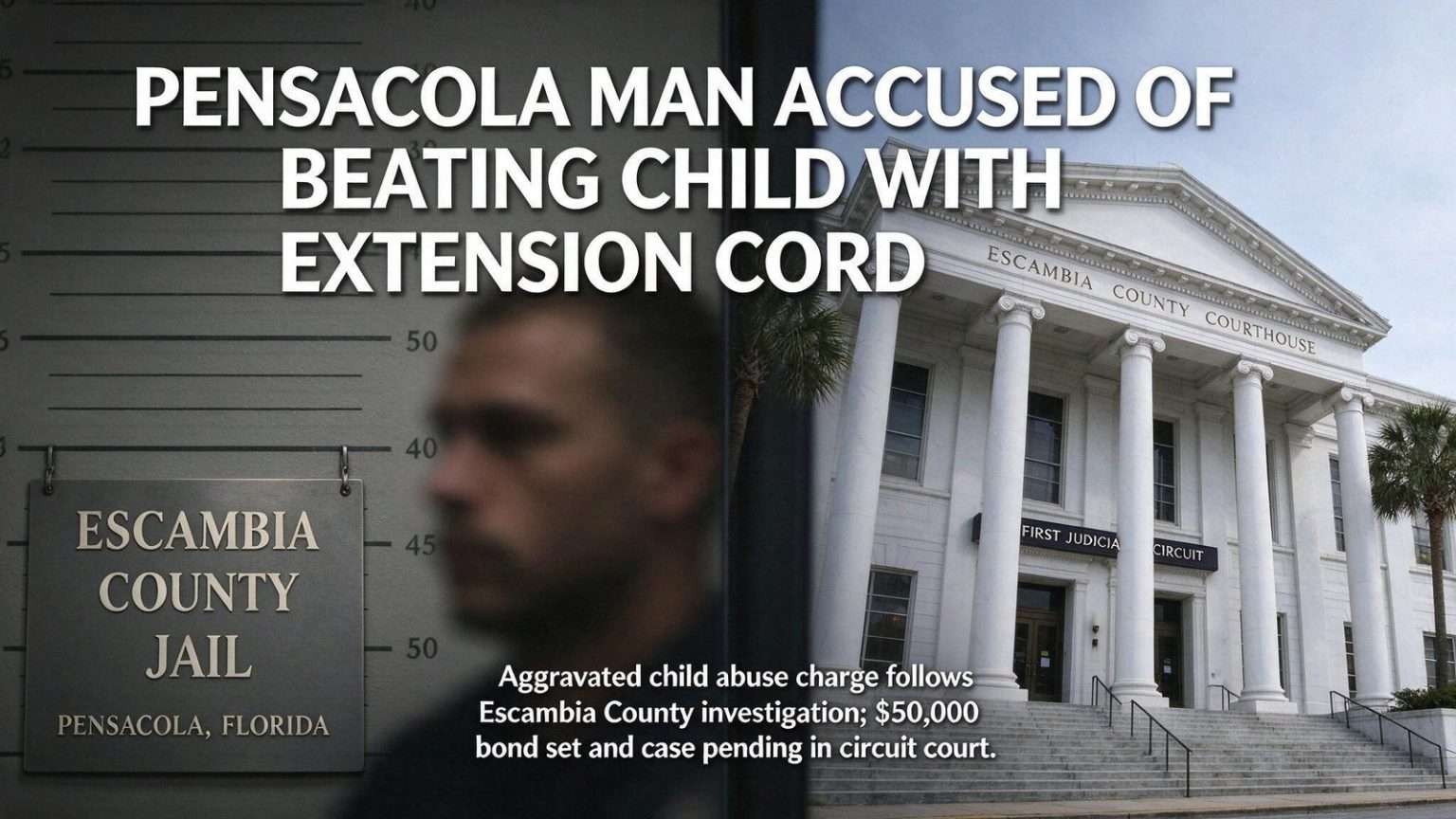
A Pensacola man has been arrested on aggravated child abuse charges after a child reported being beaten with an extension cord, according to Escambia County authorities. The arrest followed an investigation into allegations that came to light after the child described what had happened to him. The case is being handled by the Escambia County Sheriff’s Office, which investigates serious crimes across the county and supports local agencies when cases involve children and families.
Julius Dees, 33, was taken into custody after the child told investigators he was ordered to undress and was then struck repeatedly with the cord. The child was left with welts on his back, chest, left shoulder and right arm, officials said. The injuries were documented as part of the investigation, and the child’s account formed the basis of the charge. Authorities have not indicated how many times the child was struck.
Dees’ relationship to the child was redacted from the public arrest report, but investigators noted the case meets domestic violence criteria. Under Florida public records practice, details that could identify a child victim of domestic violence are routinely withheld from documents released to the public. That approach is meant to shield children from further harm while still allowing the public to follow the outcome of a case through the courts.
The Florida Department of Children and Families was notified of the investigation, and arrangements were made for the child to stay in his mother’s custody for the remainder of the summer. The state agency is responsible for child protective investigations in Florida, and its involvement signals that the child’s ongoing safety was assessed as part of the response. Notification of the agency is standard in cases where abuse allegations involve a caregiver or a member of the child’s household.
Dees was booked into the Escambia County Jail on $50,000 bond. The charge against him remains pending in court, and no trial date has been announced. Booking records for the jail, located in downtown Pensacola, are maintained by the Escambia County Sheriff’s Office.
What aggravated child abuse means in Florida
Aggravated child abuse is defined in Florida law as the willful torture, malicious punishment, or unlawful caging of a child, or as an aggravated battery committed against a child. It is classified as a first-degree felony, the most serious tier below life felonies. A conviction can carry a prison sentence of up to 30 years, along with substantial fines, which is why the charge is treated as among the gravest in the criminal code involving child victims.
Because the charge is a first-degree felony, the case is prosecuted in circuit court rather than county court. In Pensacola, that means the First Judicial Circuit, which covers Escambia, Okaloosa, Santa Rosa and Walton counties. The State Attorney’s Office for the circuit will review the arrest report and the evidence gathered by deputies before deciding how the case proceeds at arraignment.
How the investigation unfolded
Investigators with the Escambia County Sheriff’s Office opened the case after the child described what had happened to him. Children in these cases are typically interviewed by specialists trained in forensic questioning, a method that limits how many times a child has to repeat the account and reduces the risk of leading questions. Escambia County is served by Gulf Coast Kids House, a children’s advocacy center in Pensacola that provides a child-friendly setting for such interviews and coordinates among law enforcement, prosecutors and child welfare staff.
The physical evidence in the case consisted of the welts described on the child’s back, chest, left shoulder and right arm. In abuse investigations, medical professionals document injuries with photographs and written findings that can later be presented in court. The pattern and location of injuries often matter, because investigators distinguish accidental injuries from marks left by objects such as cords, belts or switches.
The extension cord described in the child’s account became a central detail of the allegations. Law enforcement agencies across the Gulf Coast regularly investigate cases in which household objects were used to punish children, and prosecutors treat the use of an implement capable of leaving marks as a key factor in charging decisions. The line between a simple battery charge and an aggravated charge typically hinges on the severity of the injuries and the manner in which they were inflicted.
Because the case meets domestic violence criteria, it will be handled under the protocols Florida applies to household violence cases. Those protocols are designed to keep victims separated from defendants, to connect families with services, and to track cases that carry a heightened risk of repeat violence. Escambia County courts maintain dedicated resources for domestic violence cases, including advocates who work with victims as cases move forward.
Investigators also consult with prosecutors early in cases involving injuries to children. Charging decisions weigh the age and size of the child, the object involved, the number and severity of injuries, and whether the account given by the child is consistent with the physical findings. An arrest on aggravated charges indicates that investigators and prosecutors believed the allegations, if proven, met the statutory threshold for the more serious offense rather than a lesser count.
The Florida Department of Children and Families maintains a statewide hotline for reporting suspected abuse, and its child protective investigators respond around the clock. When an allegation involves someone in the child’s home, the agency assesses whether the child can remain safely in the household while the case is pending. In this case, the decision was made to place the child in his mother’s custody for the remainder of the summer, an arrangement the agency and investigators worked out as part of the safety planning process.
What happens next in the case
As with any felony arrest in Florida, Dees will go through a first appearance before a judge, generally within 24 hours of booking. At that hearing, the judge reviews the probable cause supporting the arrest, confirms or adjusts the bond amount, and addresses any conditions of release. In domestic violence cases, judges commonly issue no-contact orders as a standard condition while the case is pending, and they may order the defendant to stay away from the child’s home and school.
A $50,000 bond means Dees can be released from the Escambia County Jail if he posts the required amount, typically through a bail bond agency for a nonrefundable fee. Bond conditions in child abuse cases can include supervised contact only, surrender of firearms, and restrictions on being near the child. Violating a condition of release can result in the bond being revoked and the defendant being returned to custody.
The State Attorney’s Office will now review the case file, including the child’s statements, the documented injuries and any supporting evidence gathered by deputies. Prosecutors may file charges directly by information or, in some felony cases, present evidence to a grand jury. The defense will have access to the evidence through the discovery process before any trial, and plea negotiations are possible at any stage of the proceedings.
Cases of this kind often take months to move through the court system. Plea negotiations, pretrial motions and continuances are common, particularly when the evidence depends on testimony from a child. Prosecutors in the First Judicial Circuit work with victim advocates to reduce the stress on young witnesses, and Florida law provides special procedures for child testimony in certain circumstances, including alternatives to testifying in open court in front of a defendant.
For families in the Pensacola area, the case is a reminder of the reporting channels available when a child may be in danger. Suspected abuse can be reported to the Florida Department of Children and Families hotline, which operates 24 hours a day, or directly to local law enforcement. Reports can be made anonymously, and Florida law grants immunity from civil and criminal liability to people who report suspected abuse in good faith.
Child welfare officials stress that early reporting is often the difference between a case handled through services and one that escalates to serious injury. In Escambia County, a network of agencies — including the sheriff’s office, the Department of Children and Families, Gulf Coast Kids House and local medical providers — coordinates on reports of abuse so that children are interviewed, examined and protected with as little disruption as possible.
The Escambia County Sheriff’s Office has not released additional details about the investigation, citing the sensitive nature of the case and the age of the victim. Dees remains presumed innocent unless and until he is convicted in court, and the aggravated child abuse charge against him will be adjudicated in the county’s circuit court system. Updates on the case will come through court filings maintained by the clerk of court in Pensacola, where docket information for felony cases is available to the public.


