Pensacola man found guilty of murder in grandfather’s beating death
A Pensacola jury found Marcus Knight guilty of second-degree murder in the 2019 beating death of his grandfather, James Royster, on East Lee Street.
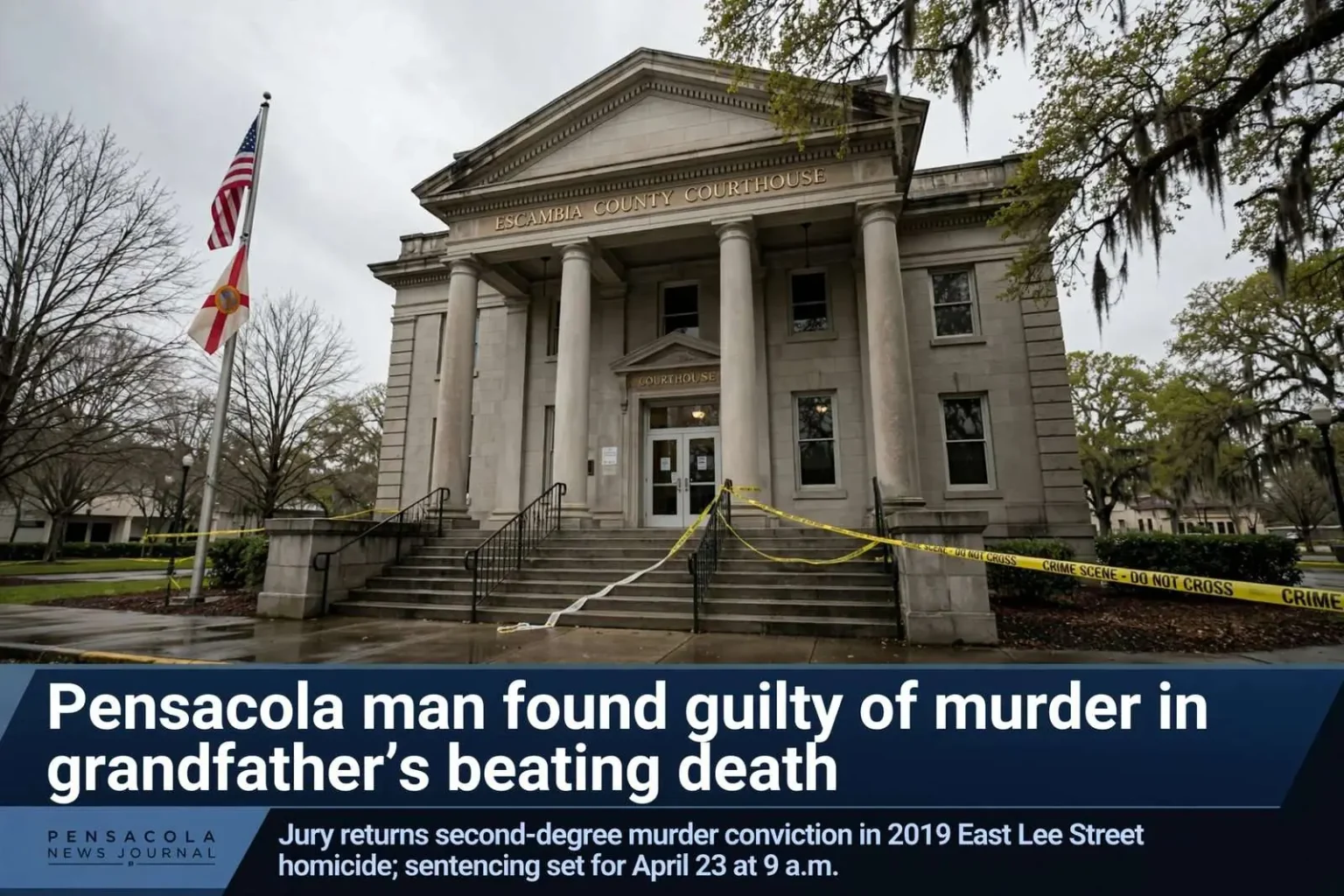
PENSACOLA, Fla. — A jury has found a Pensacola man guilty of second-degree murder in the beating death of his grandfather, closing the trial phase of a case that began when the victim was found dead inside an East Lee Street home more than a year earlier. Marcus Knight was accused of killing 66-year-old James Royster, who was found dead in a home on East Lee Street on May 8, 2019, and after hearing the evidence, jurors returned the second-degree murder verdict that now sends the case to sentencing.
The case moved through the criminal justice system in stages that stretched across months. Knight was initially arrested on May 8, 2019 — the same day Royster’s body was found — on a theft charge, according to court records, a booking that held him in custody while detectives continued the work of establishing what had actually happened inside the home. Several weeks of investigation followed before prosecutors took the step of charging him with murder on May 31, transforming an arrest for a property crime into a homicide prosecution built on the evidence gathered in the interim.
The distinction between the charges mattered throughout. Second-degree murder under Florida law means a killing committed without premeditation — an act driven by imminently dangerous conduct showing a depraved mind, rather than the planned killing that defines first-degree murder. The verdict the jury returned reflected that line: jurors were persuaded beyond a reasonable doubt that Knight caused his grandfather’s death by beating, but the second-degree verdict indicates the panel did not find the premeditation that a first-degree charge would have required.
The investigation, from theft arrest to murder charge
The sequence of the case — a theft arrest on the day the body was found, a murder charge three weeks later — is a familiar pattern in homicide investigations. When officers first arrive at a death scene, the full picture is rarely clear. An initial charge secures custody of a suspect while investigators conduct autopsies, gather forensic evidence, reconstruct timelines, and interview everyone connected to the victim and the address. Only when that work comes together do prosecutors file homicide charges, and in Knight’s case, the May 31 murder charge signaled that the investigation had produced the evidence needed to take the case to trial.
East Lee Street sits in the heart of Pensacola’s historic eastside neighborhoods, a grid of streets near the city’s downtown where the discovery of a body on a spring morning in 2019 drew an immediate law enforcement response. The Escambia County criminal justice system handled the case from there — the initial booking, the weeks of investigation, the murder charge, and ultimately the trial where testimony and evidence were laid out for the jury that returned the verdict.
For Royster’s family, the verdict concluded a process that began with the worst kind of phone call in May 2019. Grandparents killed by their own grandchildren are among the most painful cases prosecutors handle, family relationships complicating both the investigation and the prosecution, and the jury’s decision brought legal resolution to a death that had hung over the family for the months between the discovery and the trial.
What follows the verdict
Following the verdict, bond was revoked — the standard consequence of a conviction, since a defendant found guilty by a jury has no remaining basis for pretrial release — and Knight was returned to custody to await sentencing. The court also ordered a pre-sentence investigation, the routine but consequential step in which the Florida Department of Corrections compiles a report on the defendant’s history, circumstances, and the details of the offense to guide the judge’s sentencing decision.
The pre-sentence investigation gives the sentencing judge a document that reaches beyond the trial record: the defendant’s criminal and personal history, statements from the defense, and input from the victim’s family, whose opportunity to be heard is part of the process Florida law guarantees. In a second-degree murder case, the sentencing range under Florida law runs to life imprisonment, with the exact term determined by the judge weighing the offense, the defendant’s background, and the guidelines framework the Legislature has constructed.
Sentencing was set for 9 a.m. on April 23, the hearing where Knight will learn the term of imprisonment that follows the second-degree murder conviction. Until then, he remains in custody without bond, and the case that began with a body found on East Lee Street on May 8, 2019 moves toward its final chapter in an Escambia County courtroom.
Second-degree murder and what the verdict required of the jury
The second-degree murder charge the jury weighed carries specific legal meaning in Florida. To convict, prosecutors had to prove that Knight unlawfully killed Royster by an act imminently dangerous to another and evincing a depraved mind, without premeditated design. The framework distinguishes the degrees of homicide: first-degree murder requires planning or the commission of the killing during certain enumerated felonies, while manslaughter covers killings that lack the depravity second-degree murder demands. The jury’s route to a guilty verdict ran through that middle ground — a killing proven, premeditation not.
Trials of this kind in Escambia County follow the standard architecture of a Florida felony prosecution: jury selection, opening statements, the state’s case built from autopsy findings, scene evidence, and witness testimony, the defense’s cross-examination and case, and closing arguments that frame the same facts in competing narratives. The jurors who heard the case were asked to reconcile the fact of Royster’s death — undisputed — with the questions of who caused it and with what state of mind, and their second-degree verdict answered both.
Beating deaths present particular evidentiary challenges, since the medical examiner’s findings do much of the narrative work. The autopsy establishes cause of death, the pattern and severity of injuries, and often the rough timing; scene evidence establishes where the attack occurred and with what; and the investigation’s interviews establish the relationship dynamics and the events of the day in question. In this case, the state assembled that picture over the weeks between the initial theft arrest and the murder charge, and then over the longer stretch between the charge and the trial.
The family relationship at the center of the case
The relationship between the defendant and the victim — grandfather and grandson — shaped the case from its first hours. Family-member homicides are investigated with the same rigor as any other, but they present dynamics all their own: shared addresses and property, histories that only relatives know, and a survivor network made up of the same people the investigation must treat as both family and potential witnesses. The theft charge Knight was booked on the day the body was found hints at the property dimension that often accompanies killings within families, where finances and possessions are part of the story the evidence tells.
James Royster was 66, an age at which most grandparents in Pensacola neighborhoods like the one along East Lee Street are several years into retirement, known to their neighbors, their churches, and their extended families. The circumstances of his death — found inside his own home, beaten, discovered on a May morning — made the case a subject of local attention from the start, and the arrest of his grandson on the same day intensified it. The trial’s outcome, months later, brought the legal side of that story to its conclusion.
The verdict also represents the work of the ordinary machinery of justice: detectives who kept investigating after the initial arrest, prosecutors who waited for the evidence before filing the homicide charge, defense attorneys who put the state’s case to its proof, and twelve jurors who weighed it all. Whatever sentence the judge imposes in April, that machinery — slow, procedural, and public — is what transformed the discovery of a body into a conviction.
What the sentencing hearing will decide
The April 23 sentencing hearing set for 9 a.m. will be where the judge fixes the concrete consequences of the jury’s verdict. In Florida, second-degree murder is punishable by up to life in prison, and the hearing will follow the customary sequence: the pre-sentence investigation report presented to the court, arguments from the prosecution on the sentence the case deserves, arguments from the defense for leniency or a lower term, and the victim’s family given its chance to speak about what was taken from them. The judge then imposes the term within the lawful range, and the formal judgment enters the record.
The pre-sentence investigation the court ordered plays a central role in that hearing. Prepared by the Department of Corrections, the report assembles the defendant’s criminal history, social background, the circumstances of the offense as documented, and any statements submitted by the parties and the victim’s family. Judges rely on it to see the full person behind the conviction — and its preparation is one reason sentencing follows a verdict by weeks rather than days.
With bond revoked after the verdict, Knight will appear at that hearing from custody, and the sentence the judge imposes will determine the years that follow. The case’s timeline — from the discovery of James Royster’s body on May 8, 2019, through the theft arrest the same day, the murder charge on May 31 after weeks of investigation, the trial, and now the April 23 sentencing — traces the full arc of a Florida homicide prosecution, from a morning of sirens on East Lee Street to the moment a judge pronounces the final word in the case.