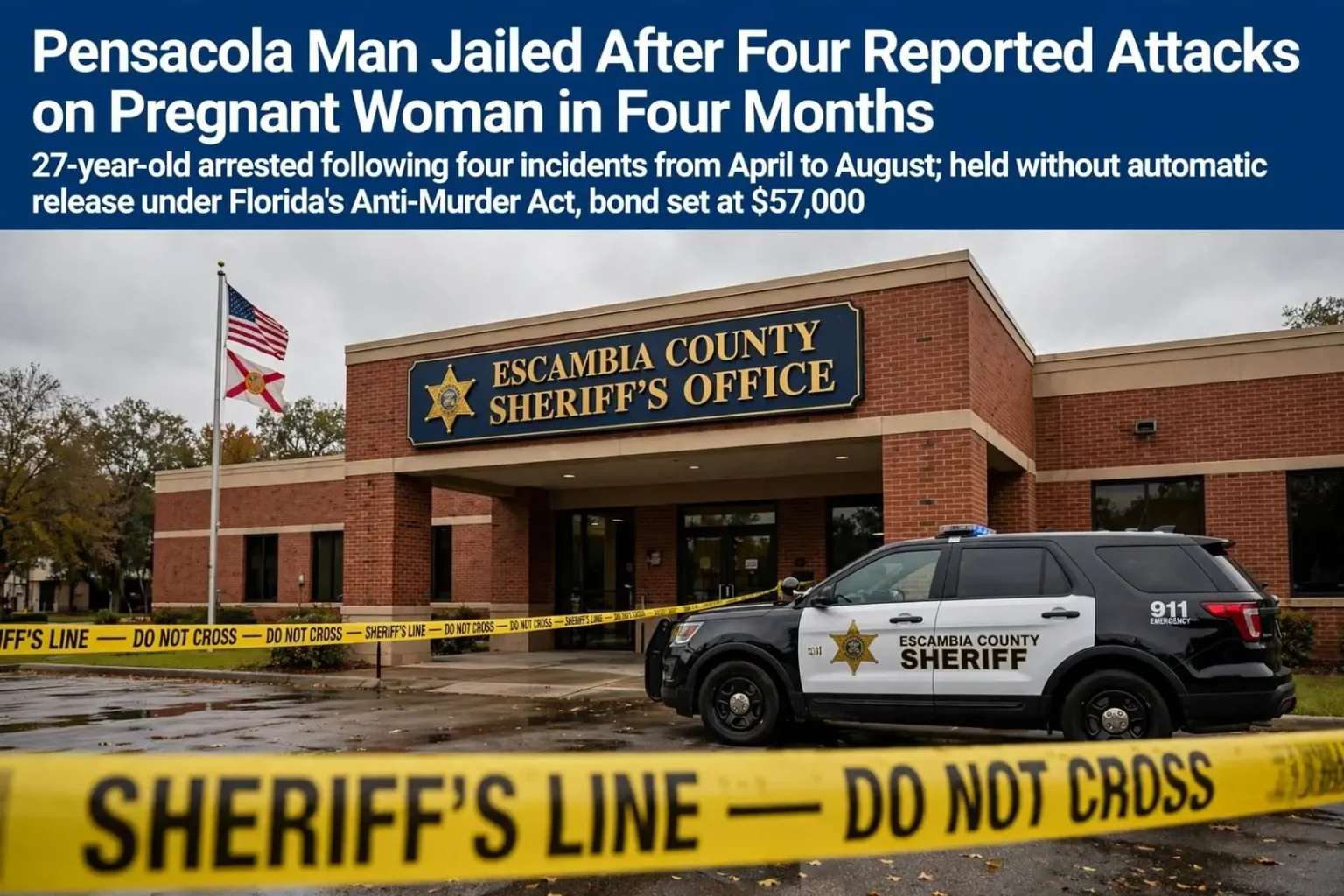
Pensacola Man Jailed After Four Reported Attacks on Pregnant Woman in Four Months
Escambia County deputies arrested Shaquan Gainer, 27, after four reported domestic violence incidents involving a pregnant woman.
A Pensacola man was arrested and booked into the Escambia County Jail after deputies linked him to a string of four reported domestic violence incidents over roughly four months, according to the Escambia County Sheriff’s Office. Shaquan Gainer, 27, faces one count of burglary, two counts of aggravated battery, battery and property damage.
His bond was set at $57,000, and authorities placed an anti-murder act hold against him in Santa Rosa County. The hold stems from Florida’s Anti-Murder Act, a law passed in 2007 that requires judges to find probable cause and make specific findings of public safety before a person accused of a qualifying violent felony can be released on bond, even when a standard bond amount has been set.
The arrest came after Escambia County deputies assembled an account, laid out in the arrest report, of repeated reported attacks on the same woman — a person who, according to the document, was pregnant during some of the incidents. The allegations come from statements and records cited in the arrest report; charges against Gainer had not been tested in court at the time of his arrest.
Pattern Described in the Arrest Report
According to the arrest report, the series began April 17 when a deputy responded to a disturbance and found a visibly upset woman who declined medical treatment. She told investigators that during an argument Gainer blocked her from leaving a room and punched her in the face several times, and that he knew she was pregnant at the time.
Deputies returned June 27 after another disturbance complaint. The woman said Gainer struck her across the face with a gallon water bottle, that she grabbed a kitchen knife to force him out, and that he then pointed a silver handgun at her before she fled with her children to a neighbor’s home. Investigators wrote that she was five months pregnant and was later transported to Sacred Heart Hospital because of pregnancy complications.
Deputies said Gainer damaged her television and tore up her apartment before leaving on foot. The destruction described in the report became the basis for the property damage charge in the case, and the confrontation itself, involving the bottle strike and the handgun, formed the core of the aggravated battery counts.
Two more reported episodes followed in August: an Aug. 11 incident in which the woman said Gainer punched her in the face and grabbed her neck while questioning her, and an Aug. 15 break-in through her unlocked back door during which he threw and broke a 55-inch television before leaving as she called law enforcement.
The August reports, coming within days of each other, are what investigators said finally tied the sequence together into the arrest that followed. By the time deputies took Gainer into custody, the arrest report had grown to document four separate reported incidents across April, June and August, each involving the same woman.
How Escambia Deputies Built the Case
Cases built from repeated domestic violence reports depend on the accumulation of documentation — deputy responses, victim statements, photographs of injuries and property, medical records and prior call history. The Escambia County Sheriff’s Office, which patrols the unincorporated areas of the county and assists municipal agencies, processes thousands of domestic-related calls each year, and each report in a series like this one becomes a building block toward the charge structure filed at arrest.
By charging burglary in connection with the August break-in, prosecutors treated the entry through the back door as a felony regardless of the property destroyed inside, reflecting how Florida law handles unauthorized entry into a dwelling. The aggravated battery counts attach to the June confrontation, where the allegations involve serious injury potential to a pregnant woman, and the battery and property damage counts cover the remaining reported incidents.
The bond amount and the Anti-Murder Act hold together mean Gainer’s release is not automatic even if he posts the $57,000. Under the 2007 law, named for its origins in cases where violent offenders on bond committed murders while awaiting trial, a defendant facing a qualifying violent felony must appear before a judge who reviews the case and must find probable cause and address dangerousness before any release conditions take effect.
Escambia County, which includes Pensacola and the county’s western reaches, has historically posted some of the higher domestic violence rates in Florida, a pattern local agencies have addressed with dedicated domestic violence units, victim advocates and coordination with shelters and support services across the Panhandle. The sheriff’s office has emphasized repeat-victimization cases like this one as the focus of those efforts.
Domestic Violence and Pregnancy
Public health research has consistently identified pregnancy as a period of elevated risk in abusive relationships, with studies finding that violence that begins or escalates during pregnancy is associated with worse outcomes for both mothers and infants. Advocates say abusers frequently exploit a victim’s pregnancy precisely because it deepens dependence — financial, emotional and logistical — and makes leaving harder.
The woman’s hospitalization at Sacred Heart Hospital for pregnancy complications after the June incident, as described in the arrest report, illustrates the medical dimension of that risk. Sacred Heart’s Pensacola campus serves as a major regional hospital for Northwest Florida, and its emergency department handles injury cases from across Escambia and Santa Rosa counties.
Florida law includes specific felony provisions for battery on a pregnant person, and prosecutors can pursue enhanced charges when a victim’s pregnancy is known to the offender. The arrest report’s account that Gainer knew the woman was pregnant during the April incident is a detail that prosecutors will weigh in deciding how to structure the case as it moves through the court system.
Advocates across the Panhandle stress that leaving an abusive relationship is most dangerous at the moment of departure and in the weeks that follow, which is why protective injunctions, safety planning and rapid-response protocols exist in Escambia and Santa Rosa counties. Injunction filings in Northwest Florida remained among the highest in the state during the period these incidents were reported.
The Charges and What Comes Next
The charge sheet Gainer faces — one count of burglary, two counts of aggravated battery, battery and property damage — covers distinct aspects of the four reported incidents, and the felony weight of the case will depend on how prosecutors in the State Attorney’s Office for the First Judicial Circuit formally charge the matters. That office covers Escambia and Santa Rosa counties, and its domestic violence division reviews cases involving intimate partners before formal charges are finalized.
The Anti-Murder Act hold in Santa Rosa County means a judge there will conduct the required probable cause and public safety review connected to that county’s involvement in the case. Holds from other counties attach to defendants regularly when an alleged course of conduct spans jurisdictions, and they remain in place until the issuing jurisdiction’s court resolves them.
Like all defendants, Gainer is presumed innocent, and the account in the arrest report represents the state’s version of events assembled from victim statements, deputy observations and evidence documentation. Defense counsel will have the opportunity to challenge the allegations, and any resolution — plea or trial — awaits the completion of the discovery process. First-appearance proceedings in Escambia County typically occur within 24 hours of booking.
Support Systems for Victims in Northwest Florida
The children who fled with their mother to a neighbor’s home during the June incident, according to the arrest report, point to the second population affected in domestic violence cases. Advocates note that children who witness violence at home experience lasting effects even when they are not physically harmed, and schools and service agencies in Escambia County maintain referral pathways for students living in such circumstances.
Northwest Florida is served by a network of domestic violence shelters and advocacy organizations that provide emergency housing, injunction assistance and court accompaniment. The state’s certification system for domestic violence centers funds 24-hour hotlines and safe houses in each region, and Escambia County’s center serves one of the busiest service areas in the Panhandle.
Law enforcement agencies have also adopted lethality screening protocols in recent years, using standardized questions at the scene of a domestic call to identify victims at the highest risk of being killed by their abuser and connecting them immediately with advocacy services. The pattern described in the arrest report — escalating violence, weapons involved, a pregnant victim — is the profile those screenings are designed to catch.
Sheriff’s officials urged anyone experiencing domestic violence to report incidents as they occur, noting that early reports allow investigators to document patterns that individual incidents alone cannot show. The four-month sequence alleged in the Gainer case, they noted, was pieced together from the record of repeated responses to the same address and the same victim.
A Case That Illustrates the Cycle
Domestic violence cases of this shape — repeated reports, escalating conduct, a victim who remains in contact with the offender — are the pattern that advocates and law enforcement describe when they talk about the cycle of abuse. The four reported incidents in the arrest report span April to August, and each of them, according to the document, followed the same basic structure: an argument, violence, and property destruction before the offender left.
What happened after the arrest will be determined in Escambia County’s courts, where the case will proceed through the standard felony process. The victim, according to authorities, has the support of the county’s advocacy network as that process unfolds.
For now, the case stands as one more entry in the region’s ongoing struggle with domestic violence, documented in the same arrest reports that deputies file thousands of times a year — and, in this instance, in the cumulative record that finally produced an arrest.