
Pensacola Mother Arrested After Teacher Finds Bruising on Child’s Face
A Pensacola mother faces aggravated child abuse charges after a teacher found bruising and lacerations on her daughter's face; she is held without bond.
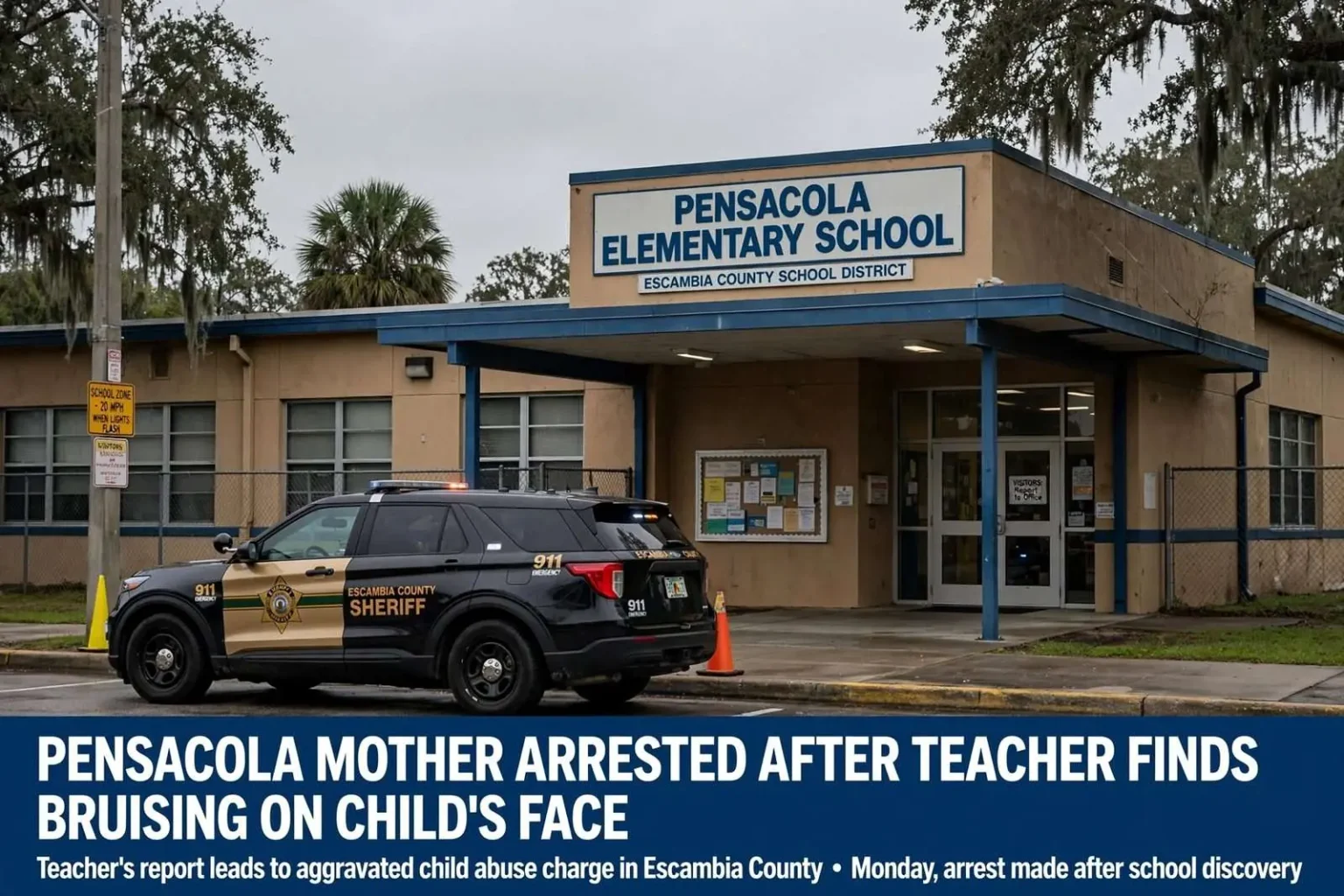
A Pensacola mother has been arrested and charged with aggravated child abuse after her daughter’s teacher found the girl with lacerations and bruising on her face, according to Escambia County authorities — a case that moved from a classroom to an arrest in a matter of hours.
Brittany Washington, 30, was booked into the Escambia County Jail Monday afternoon and held without bond on the aggravated child abuse charge, one of the most serious offenses Florida law attaches to the injury of a child.
The injuries were discovered at school, where the girl’s teacher saw the lacerations and bruising on her face and reported it, setting in motion the protocol Florida schools follow when abuse is suspected. School personnel are among the front line of child protection in Florida: educators, teachers’ aides and school nurses are mandated reporters under state law, required by statute to report suspected abuse or neglect to the Florida Department of Children and Families, and cases regularly reach authorities because a teacher or staff member noticed what a child had been hiding.
After the injuries were discovered at school, an investigator with the Florida Department of Children and Families took the child to Gulf Coast Kid’s House, a children’s advocacy center serving Escambia County. The child told investigators that Washington became angry and struck her in the face with a stick, knocking her to the ground.
A medical exam revealed additional scratch marks and bruises on the girl’s body, investigators said, extending the evidence beyond the facial injuries that first drew the school’s attention.
What happens at a children’s advocacy center
Gulf Coast Kid’s House, on Pensacola’s east side, is the community’s central facility for investigating child abuse. The advocacy center model brings together, under one roof, the child-protection investigators, law enforcement detectives, prosecutors, victim advocates and medical and mental health professionals who would otherwise interview a child separately — a design meant to ensure that a child tells her story once, in a single, properly recorded forensic interview, rather than being questioned repeatedly by each agency involved.
The center’s exam rooms allow for medical evaluations like the one described in this case, in which physicians document injuries with an eye toward both the child’s treatment and the evidentiary record. Advocates who work at centers like the Kid’s House stay with the child and family through the entire process, from the first interview through any court proceedings, because the hours after a disclosure are among the most disorienting a child and a non-offending parent or guardian ever face.
The placement of the interview at the advocacy center rather than a police station or school office is deliberate. Children questioned in a calm, child-friendly setting by trained interviewers provide more reliable accounts, and the recorded interviews conducted at centers like the Kid’s House are routinely used as evidence, sparing children from having to repeat painful details in front of strangers.
The charge and what it carries
Aggravated child abuse under Florida law involves the willful torture, malicious punishment or caging of a child, or the willful infliction of great bodily harm — a first-degree felony that carries years in prison on conviction. Prosecutors distinguish it from lesser child-abuse offenses by the severity of the harm and the intent involved, and the injuries described in this case — facial lacerations, bruising and additional injuries documented by medical exam — fit the profile of the aggravated charge.
Washington was held without bond following her booking Monday afternoon, a detention decision that reflects both the seriousness of the charge and the court’s obligation to protect the child while the case proceeds. Bond decisions in aggravated child abuse cases weigh the nature of the alleged offense, the defendant’s access to the victim and the risk to the community, and a no-bond hold keeps the case on the track of a formal first appearance before a judge, where conditions of release can be argued.
The charges remain allegations until proven in court, and the prosecution will carry the burden of proving every element of the offense beyond a reasonable doubt. As in any criminal case, the defendant is entitled to counsel, to challenge the evidence and to a trial by jury, and the account the child gave investigators will be tested through the court process rather than assumed.
The school’s role in the case
The case’s beginning — a teacher’s observation — is a reminder of the role schools play in child protection across Escambia County and Florida as a whole. Teachers see children every day, five days a week, and are often the first adults outside the household to notice injuries, hunger, flinching, or the sudden changes in behavior that research links to abuse and neglect. Florida’s mandatory reporting law requires school employees to report suspected abuse to the state’s hotline, personally, and protects them from liability for good-faith reports even when an investigation later finds no abuse occurred.
That reporting culture exists because of cases exactly like this one. Child-protection officials note that most abuse is never witnessed by an outsider; it is disclosed by the child, or discovered through the physical and behavioral evidence a mandated reporter is trained to recognize. When a teacher acts on that training, as happened here, the machinery of protection — the hotline, the DCF investigator, the advocacy center, the prosecutors — is set in motion within hours.
Where the case goes from here
From the booking desk at the Escambia County Jail, the case moves to the State Attorney’s Office for the First Judicial Circuit, where prosecutors will review the forensic interview, the medical documentation of the girl’s injuries and the investigator’s report before formal charges are filed and arraigned. The child, meanwhile, remains in the care of the agencies whose first responsibility is her safety, with DCF determining appropriate placement and services while the criminal case proceeds.
Advocates at Gulf Coast Kid’s House point out that the center’s work continues long after the arrest: counseling services for child victims and their non-offending family members, support through the dependency and criminal court processes, and the long-term follow-up that helps children recover from the abuse and, just as importantly, from the investigation itself. The center serves hundreds of Escambia County children each year, and its staff works cases ranging from physical abuse like this one to sexual abuse, neglect and exposure to violence.
For the girl at the center of this case, the adults who intervened — the teacher who reported what she saw, the investigator who took the child to the Kid’s House, the medical staff who documented the injuries — did the work the system is built for. What the courts do with the evidence they gathered will unfold in the months ahead; the charges against Brittany Washington remain allegations until proven in court, and the state’s burden of proof now shifts from the classroom to the courtroom.
A pattern the region knows too well
Escambia County’s child-protection agencies handle a steady stream of cases each year, and the cooperation described in this case — school report, state investigator, advocacy center, jail booking — is the standard sequence when the allegations involve physical injury to a child. The county’s system has been built over decades, with Gulf Coast Kid’s House opening in 2000 as one of Florida’s children’s advocacy centers and growing into the coordinating hub for abuse investigations in the Pensacola area.
The center’s founders modeled it on the national advocacy-center movement, which took hold in the 1980s as professionals recognized that the old system — separate interviews by police, child welfare, prosecutors and medical staff — was exhausting and re-traumatizing children. Today the center houses its partner agencies together, trains investigators in forensic interviewing, and serves as the place where a child’s first account of abuse is taken down carefully enough to carry through a courtroom.
Community support keeps the center running, and its staff regularly reminds Pensacola-area residents that the reporting hotline is not just for professionals. Florida law requires certain occupations to report suspected abuse, but any person who suspects a child is being harmed can — and advocates say should — call the Florida Abuse Hotline. Reports can be anonymous, and investigators would rather check a false alarm than miss a child in danger.
As for Washington, she remained in the Escambia County Jail without bond as the case moved through its early stages, and the formal charging decision rested with prosecutors reviewing the evidence gathered in the hours after the school’s report. The girl, protected now by the same network that investigated her injuries, faces her own longer road — one that advocacy-center professionals describe as survivable when the adults around a child act quickly, believe her, and stay with her through what follows.


