Pensacola offers ways to give input before Confederate monument vote
The Pensacola City Council will hold a special meeting July 14 on removing the Confederate monument and renaming Lee Square, and is seeking public input.
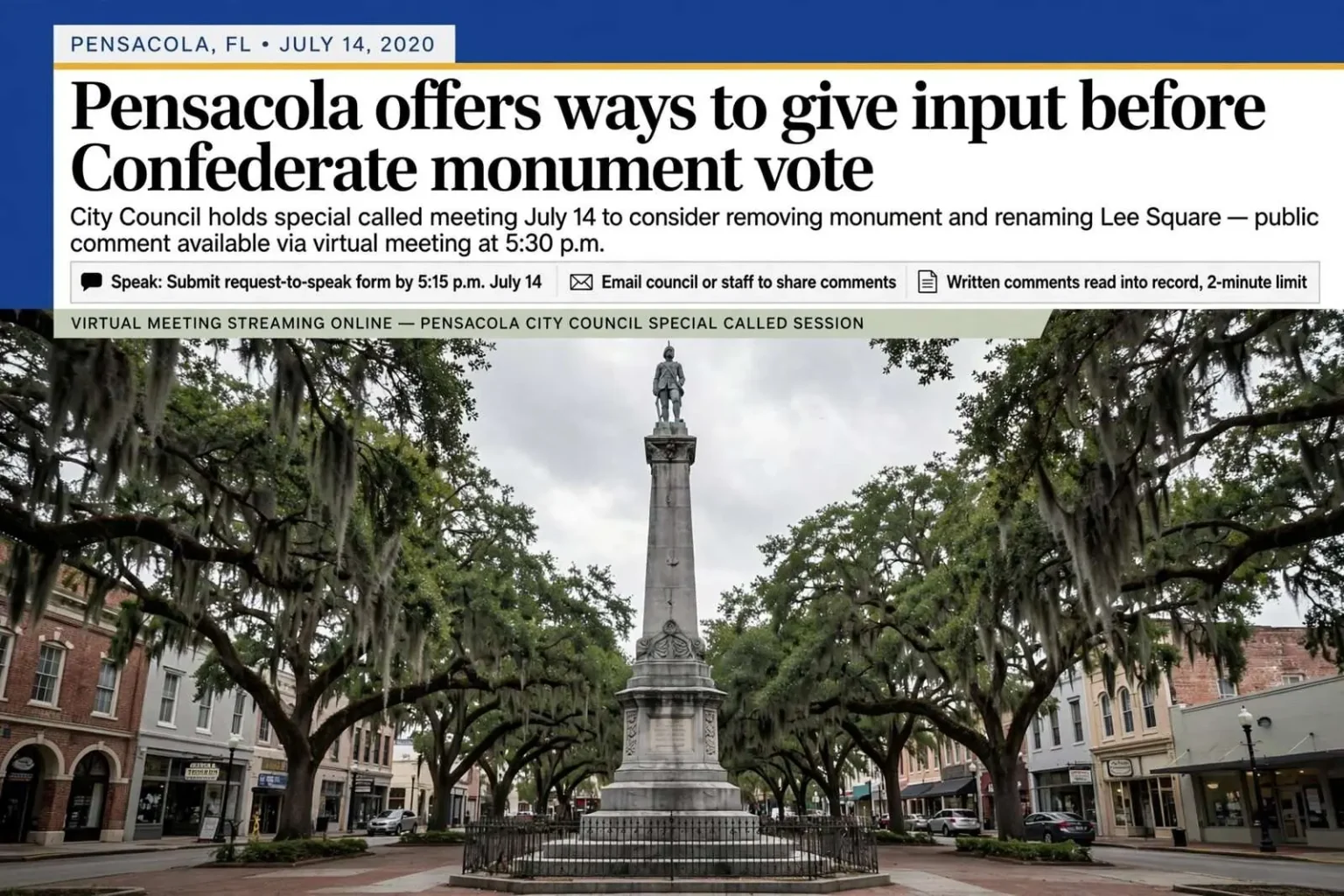
PENSACOLA, Fla. — The Pensacola City Council will hold a special called meeting Tuesday, July 14, to discuss removing the Confederate monument and renaming Lee Square, and the city wants as much public input as possible before a decision.
The meeting can be viewed online Tuesday at 5:30 p.m. The city provided several options for residents to comment: speak during the meeting by submitting a request-to-speak form by 5:15 p.m. on July 14; email council members or a city staff contact who will share thoughts with all members; or send written comments to be read into the record, subject to a two-minute time limit.
The special called meeting comes amid a wave of reconsideration of Confederate symbols across the South in the summer of 2020, when protests following the death of George Floyd in Minneapolis prompted cities from Virginia to Texas to revisit monuments, names and memorials that had stood for generations. Pensacola’s Confederate monument in Lee Square has been the subject of periodic controversy for years, but the July 14 meeting set up the most formal city deliberation on its future to date.
What the council will consider
Two questions are before the council: whether to remove the Confederate monument that stands in the plaza, and whether to rename Lee Square itself. The square sits in the heart of Pensacola’s historic district, and the monument at its center has towered over the plaza for more than a century, one of the oldest Confederate memorials in Florida.
Removal decisions involve more than a vote. Municipalities that have taken down monuments must address where the objects go — storage, relocation to a cemetery or museum, or transfer to another owner — along with the costs of crane work, preservation handling and site restoration. Legal questions can also arise where state law or deed restrictions affect municipal authority over memorials. Florida’s law governing monuments was less restrictive in 2020 than statutes adopted later, giving cities more latitude to act, though the mechanics of any removal would still require planning and expense.
Rename decisions follow a different path, typically through the city’s own naming procedures or a council vote. Lee Square’s name honors Robert E. Lee, and proposals to rename it have surfaced before; the July meeting folded the question into the same deliberation as the monument itself.
How residents can weigh in
The city’s input options are designed to reach residents whether or not they can attend the virtual meeting. Speaking during the meeting requires submitting a request-to-speak form by 5:15 p.m. on July 14 — a 15-minute buffer before the 5:30 p.m. start — so staff can assemble the speaker list and manage the queue in the order received.
Residents who prefer writing can email council members directly, or send comments to a city staff contact who will distribute them to all members — an option that guarantees every council member sees the comment rather than only the recipient. The third option, written comments read into the record, puts a resident’s words into the official proceedings verbatim, subject to a two-minute time limit that mirrors the constraint on live speakers.
The two-minute limit is standard practice for public comment periods across Gulf Coast municipalities. It constrains each speaker to roughly 300 spoken words, enough to make a single point clearly, and it prevents a meeting on a divisive topic from stretching indefinitely. Cities that hold contested votes typically adopt the limit to give every speaker a turn while preserving time for the council’s own deliberation.
The monument’s history in Pensacola
The Confederate monument in what is now Lee Square has watched over downtown Pensacola for well over a century, erected in the era when communities across the former Confederacy were memorializing the Civil War generation. The plaza sits within the city’s historic Seville-Hayward-Don tracts area, amid some of the oldest continuously occupied European settlement sites in the United States.
Debates over the monument are not new. Pensacola residents have periodically petitioned the city about the memorial for decades, with arguments on each side reframed as the national conversation over Confederate symbols has evolved. Supporters of keeping the monument have described it as history and heritage; opponents describe it as a tribute to a cause rooted in slavery whose presence in a public square alienates residents. The July 14 special meeting was the first time the city put both questions — monument and square name — on a formal council agenda together in this window of public attention.
Local context matters in Pensacola’s case more than in some others. The city is home to a diverse population tied to Naval Air Station Pensacola, the tourism economy and a long multicultural history spanning Spanish, French, British and American eras. That layered history is part of why the square’s future draws strong feelings: residents agree the plaza matters, and disagree about what should stand in it.
What happens at a special called meeting
Special called meetings differ from regular council sessions in scope rather than form. The council convenes for a defined agenda — here, the monument and the square name — and conducts the same public deliberation it would in a regular session: staff presentation, public comment, council discussion and any votes the members choose to take. The virtual format, viewable online at 5:30 p.m., reflects the public health practices of mid-2020, when councils across the country shifted meetings online while preserving public access.
Virtual meetings changed how public comment works. Rather than filling council chambers, speakers join remotely in managed order, and cities adopted forms like the request-to-speak submission Pensacola used to organize the queue. The written-comment channels the city offered — direct email to members, the staff-forwarded inbox, and comments read into the record — exist precisely because virtual formats exclude residents without reliable internet or the ability to speak live.
After the meeting, the council’s options range from voting on the spot, to directing staff to study costs and legal questions, to scheduling further hearings. Monument removals almost always require the second and third steps before a final vote, since the operational details — bids, preservation requirements, destination for the object — determine what the city is actually approving.
The wider movement of 2020
Pensacola’s deliberation unfolded within a national wave. In the weeks after late May 2020, cities across the South and beyond moved against Confederate symbols with a speed the issue had never seen: monuments came down in Birmingham, Mobile, Richmond, Jacksonville, Charleston and dozens of smaller cities, some by council vote, some by contractor’s crane ordered by mayors, and some pulled down by protesters. The Navy, NASCAR, the SEC and the Episcopal Church all announced their own reckonings with Confederate imagery during the same stretch.
Florida cities moved on varied timelines. Some acted within weeks; others convened committees, faced litigation, or ran into the state law adopted later that decade to protect existing monuments from local removal. Pensacola’s approach — a special meeting, structured public input and deliberation before any vote — placed it among the cities that chose the formal route, whatever the outcome.
For residents, the moment carried weight regardless of where they stood. Communities that had lived beside these symbols for a century or more were, within a single summer, actively deciding their future, and the input channels the city opened were the mechanism through which that decision would be made.
Why public input shapes these votes
Council members weighing a monument vote read the comment record closely, because the input is the clearest signal of what their constituents want. Turnout in the comment channels — speakers, emails and written submissions — gets tallied and cited during deliberation, and split input tends to produce compromise outcomes such as study committees, contextual signage or relocation rather than outright removal.
The structure the city chose also matters for legitimacy. A vote on a century-old monument made after documented public comment, a recorded virtual meeting and written submissions on the record is far harder to challenge procedurally than one made quickly. Cities learned during this period that monument decisions invite lawsuits and referenda, and a thorough public process is the best defense.
The two-minute limit and the 5:15 p.m. form deadline are small details with real effects. They shape who speaks — organized groups coach speakers to use the full two minutes effectively — and they determine whether the record captures hundreds of voices or only a handful. Residents who wanted a say had to work within those channels before the meeting gaveled in.
How to participate
For Pensacola residents, the mechanics were straightforward. To speak live at the virtual meeting, submit the request-to-speak form by 5:15 p.m. on Tuesday, July 14. To ensure all council members see a comment, email the city’s designated staff contact, who forwards submissions to the full council. To place comments into the official record verbatim, submit them in writing for the two-minute reading at the meeting.
The meeting itself streamed online beginning at 5:30 p.m., allowing any resident to watch the deliberation without attending in person — a format the city retained from its pandemic-era practice and one that has persisted for its accessibility benefits.
Whatever the council decides on July 14 or afterward, the meeting marks a formal turning point in a debate that has run in Pensacola for generations. The Confederate monument and the name Lee Square have stood downtown through decades of the city’s growth; on Tuesday night, with residents watching online and speaking through forms, emails and the public record, the city’s elected leaders take up whether they should stand any longer.