Pensacola police to add officers at MLK Jr. Day parade after recent shootings
Pensacola police will add officers to the MLK Jr. Day parade after five shootings in the area in the past week, the department said.
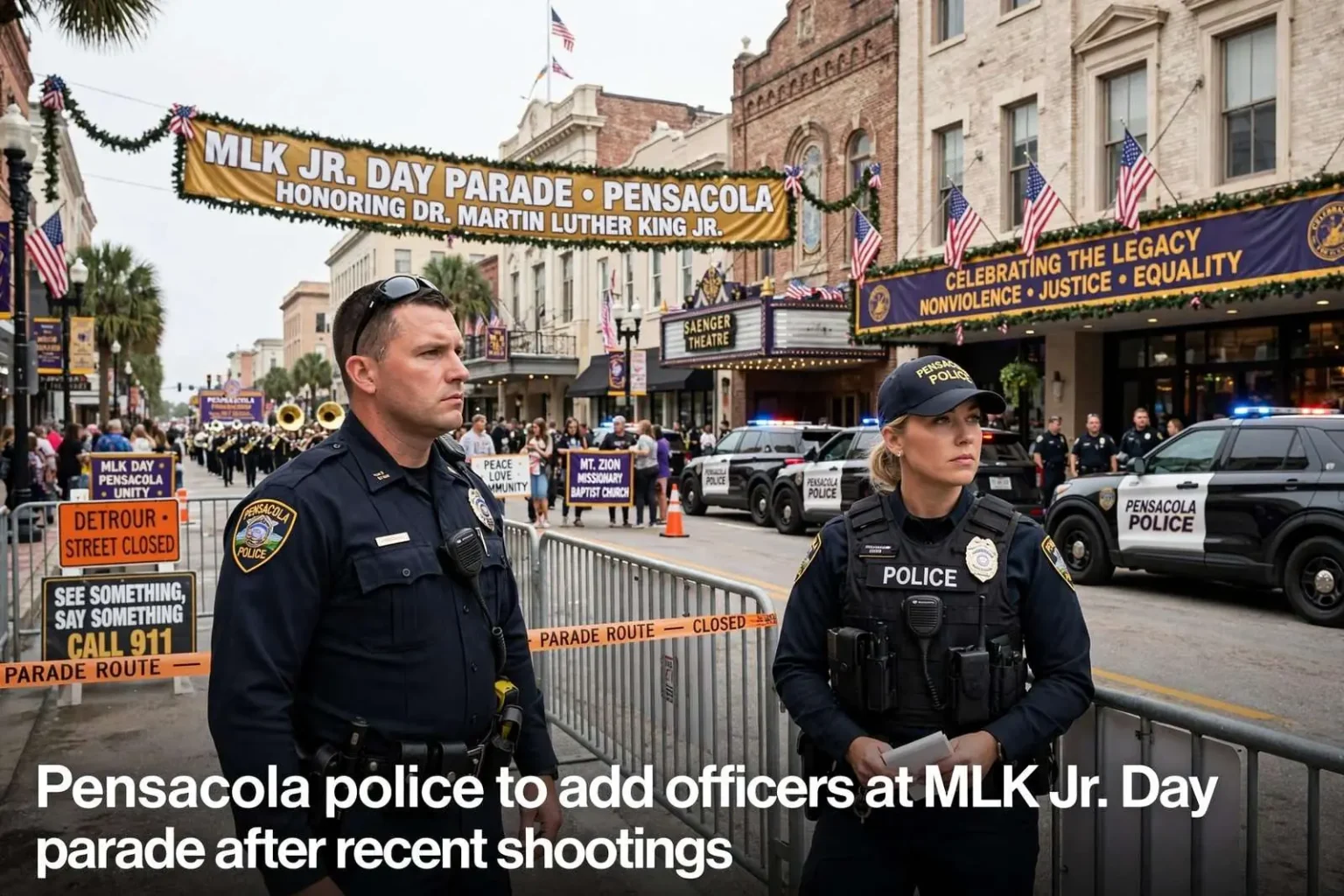
PENSACOLA, Fla. — The Pensacola Police Department says it will have more officers than usual downtown Monday for the Martin Luther King Jr. Day parade, a step the department is taking after five shootings in the Pensacola area in the past week. The increased presence is intended to ensure that the community’s celebration of the civil rights leader proceeds safely, even as the city works through a violent stretch that has put residents on edge.
Police said they are hoping for a peaceful parade as the community gathers to honor the civil rights leader who preached non-violence. The department’s message leading into the holiday combines reassurance with a call for public participation: officers are encouraging anyone who “sees something, say something” and to call 911 with a detailed description and location if they notice anything suspicious.
The Martin Luther King Jr. Day parade is a fixture of Pensacola’s civic calendar, drawing crowds downtown each January to honor Dr. King’s legacy. The holiday, observed on the third Monday of January, brings families, church groups, schools, and community organizations into the streets of the historic downtown district for a procession that celebrates both the leader’s life and the local community that carries his work forward.
A week of violence ahead of the holiday
The decision to boost the parade detail came after five shootings in the Pensacola area within a single week, a burst of gun violence that touched multiple neighborhoods and left the city’s police working to determine whether the incidents were connected. Departments across the country treat clusters of shootings as a priority, both because each one demands investigative resources and because the pattern itself — retaliatory or otherwise — poses a continuing danger to the public.
Policing a large public event during exactly such a stretch requires the department to plan for the worst while hoping for the ordinary. Extra officers assigned to the parade route provide deterrence, faster response if anything happens, and a visible reassurance to families deciding whether to attend. Commanders typically staff events like this with officers assigned to fixed posts along the route, mobile units moving through the crowd, and command oversight coordinating the whole operation.
The holiday’s meaning adds a particular weight to the department’s planning. The parade honors a leader whose message was non-violence, and organizers and police alike have long framed the event as a day when the community shows what that message looks like in practice. A shooting at or near the parade would be a blow to that purpose, which is why the department’s preparations have been extensive.
What parade-goers can expect
Residents attending Monday’s parade will see the increased presence in the form of additional officers along the route, at the staging areas, and in the downtown blocks surrounding the event. Bag checks, street closures, and controlled crossings are standard features of large parades, and the department’s posture this year adds emphasis to all of it.
The public’s role, as police described it, is straightforward: anyone who sees something suspicious should say something. Officers are asking people to call 911 with a detailed description and location if they notice anything of concern, and the specificity of that guidance matters. Descriptions of individuals, vehicles, and exact locations allow dispatchers to route officers directly to the spot, and seconds matter when a crowd is gathered.
The “see something, say something” approach has become standard practice at public events nationwide. Large gatherings depend on the thousands of eyes present in the crowd noticing what officers cannot, and experience has shown that tips from the public frequently precede and prevent incidents at events of this kind. Police departments pair the message with the reminder that reporting something suspicious is not an accusation — it is a request for officers to check, and the call itself costs nothing.
Pensacola’s downtown district, with its historic buildings, brick streets, and waterfront proximity, hosts the city’s largest public gatherings, and the MLK Day parade route threads through blocks that are easy to secure by closing streets and posting officers at intersections. The planning that goes into such an event involves coordination among the police department, city public works crews who handle closures and barriers, parade organizers, and the community groups whose floats and marchers make up the procession itself.
The timing of the holiday — a Monday in late January — means the parade runs in the middle of a workday for many, and the crowds are typically families, students whose schools are closed for the holiday, and members of the organizations that participate each year. The atmosphere is festive, and the department’s added presence is meant to preserve exactly that character.
The five shootings that preceded the holiday occurred across the Pensacola area, and police have not publicly detailed all of the circumstances or said whether they believe the incidents are linked. What is clear from the department’s posture is that commanders are not willing to assume the violence will pause for the holiday, and the parade planning reflects that caution.
Honoring King’s message in practice
Dr. Martin Luther King Jr.’s birthday became a federal holiday after years of national advocacy, first observed in 1986 and established as the third Monday of January under legislation signed in 1983. Communities across the Gulf Coast, from Pensacola to Mobile to the smaller towns of south Alabama, mark the day with parades, breakfasts, church services, and days of service, and the events serve both as celebration and as teaching, passing the history of the civil rights movement to another generation.
In Pensacola, the parade’s participants reflect the breadth of that community — churches, fraternal organizations, school bands, elected officials, and civic groups. The event has run for decades, and its continuity is itself part of the message: the community gathers each year, in peace, to honor a leader whose work changed the nation.
The call for a peaceful parade this year carries the weight of the week that preceded it. Five shootings in seven days is a grim backdrop for a holiday about non-violence, and the department’s appeal to the community frames the connection directly — the best way to honor Dr. King on his holiday is for the gathering to proceed in the spirit he preached, with neighbors looking out for one another.
If something goes wrong
Large-event policing includes planning for the scenarios everyone hopes never occur. Officers along the route are positioned so that help is never far away, medical units are staged nearby, and evacuation or redirection plans exist in case part of the route must be cleared. Families attending with children often set meeting points in advance in case anyone is separated, a practical step that applies to any large crowd.
The department’s guidance about calling 911 with a detailed description and location is the practical heart of the public’s role. In an emergency, the details that matter most are what a person or vehicle looks like, which direction it is moving, and exactly where the caller is standing. Dispatchers can pass that information to officers on the route within seconds, and the description callers provide is often what makes a rapid response possible.
The Pensacola Police Department will have more officers than usual downtown Monday for the Martin Luther King Jr. Day parade after five shootings in the Pensacola area in the past week. Officers are encouraging anyone who sees something to say something, and to call 911 with a detailed description and location if they notice anything suspicious. The department’s hope, stated plainly, is for a peaceful parade as the community honors the civil rights leader who preached non-violence.
The week of shootings also illustrates the workload pattern that police departments in mid-sized cities manage constantly. Each shooting requires a scene response, evidence collection, interviews, and follow-up investigation, and five of them in quick succession stretches a detective bureau even before special events enter the picture. Assigning more officers to a parade in the middle of that stretch means balancing the event against ongoing cases, which is why departments plan event staffing weeks in advance and adjust as conditions change.
Escal County’s emergency communication system handles the 911 calls that come in from the parade route, dispatching police, fire, and medical units across the county. During large events, call volumes spike, and dispatchers prioritize life-threatening calls while field officers relay what they see directly from the route. The system works best when callers give clear locations and descriptions, which is the core of the department’s public guidance for Monday.
Pensacola residents who attend will also notice the ordinary features of a well-run parade: barricades along the route, closed cross streets, officers at the intersections, and the flow of floats and marchers that has marked the event for decades. The added officers will blend into that picture, and commanders have framed the posture as precaution rather than alarm.
The community’s stake in a safe celebration
The organizations that march in the MLK Day parade each year put months of preparation into their participation, and the event’s meaning for them extends beyond a single morning. For the churches and community groups whose members gather each January, the parade is one of the few moments when the whole breadth of the community appears together in one place, and the desire to keep it safe is shared by everyone involved.
The department’s appeal — see something, say something — extends that shared responsibility to everyone along the route. Public safety at large events has always been a partnership between officers and the public, and the partnership works because most people in a crowd are attentive to their surroundings and willing to speak up. The call to 911 with a detailed description and location is the concrete form that willingness takes.
As the holiday arrives, the city’s attention turns to downtown, where the parade will step off under a heavier police presence than in a typical year. The five shootings of the past week have not changed the purpose of the day, and the department’s stated hope remains what organizers and participants want as well: a peaceful parade as Pensacola honors Dr. King and the message of non-violence he left to the community.