Pensacola Residents Continue Cleanup Five Days After Hurricane Sally
Pensacola residents kept clearing trees and repairing homes five days after Hurricane Sally, with fallen trees damaging cars, houses and streets across the.
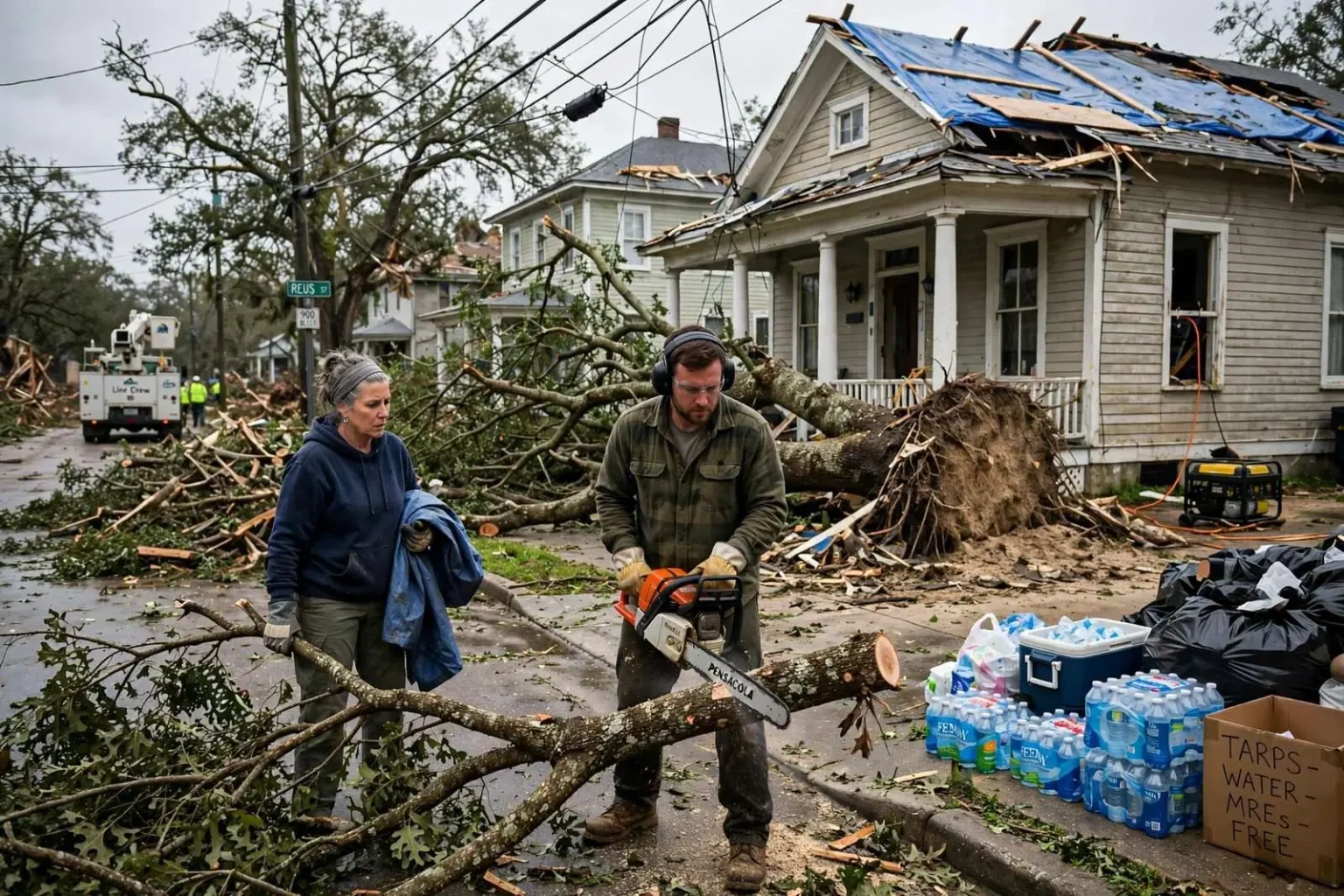
PENSACOLA, Fla. — Five days after Hurricane Sally tore through the region, residents across Northwest Florida were still clearing fallen trees from streets, cars and homes, with chainsaws running through neighborhoods from the bayfront to the county line. The storm, which came ashore in the panhandle region with slow-moving, rain-laden winds, left Escambia County with some of the worst damage of its path, toppling thousands of pines and oaks across residential streets and leaving much of the area without electricity in the days that followed.
On E Street, James Murphy said part of his living room caved in after a tree came down while he was watching television. He described the power cutting out and blue lights flashing outside the windows before he jumped up and ran. “I was just inches away,” Murphy said. “I was sitting in the living room when that tree fell.” The rest of his home was fine and his car had only minor damage.
Murphy’s close call captured the character of Sally’s damage across the Pensacola area: less a storm of flooding than a storm of trees. Because the hurricane’s winds arrived from an unusual direction and persisted for hours, root systems saturated by days of preceding rain gave way, sending mature hardwoods onto houses, power lines and vehicles in nearly every neighborhood. Emergency crews spent the days after landfall clearing routes so utility trucks could reach downed lines, a task complicated by the sheer number of blocked streets.
Unforgettable Winds in North Hill
Across town in the historic North Hill neighborhood on Reus Street, Sharon Singleton recalled winds so strong she could not close her front door after opening it, and hearing wood rubbing against wood as the roof strained. A tree was down in her backyard and water had leaked through her roof before she could get a tarp up. She said the howling winds were unforgettable.
Singleton’s experience was familiar across North Hill, one of Pensacola’s oldest and most tree-lined historic districts, where century-old oaks and magnolias form the very canopy that makes the neighborhood prized — and made it vulnerable. In the storm’s aftermath, residents emerged to find portions of that canopy lying across porches, fences and rooftops, with debris piles growing at every curb as cleanup crews and private contractors worked through the wreckage.
Five days in, the rhythm of life in the storm zone had settled into a demanding routine. Residents without power lived by generator, extension cord and ice cooler, with lines forming at fuel stations and distribution points for tarps, water and ready-to-eat meals. Roofers and tree services — many arriving from out of state, their trucks and trailers crowding the streets — moved door to door bidding on repairs. School schedules remained disrupted, and intersections where traffic signals had gone dark were being negotiated as four-way stops, a small daily reminder of how much of the region’s ordinary infrastructure remained offline.
A Slow, Soggy Storm
Sally’s trajectory had given the region only two days between a tropical storm warning and landfall, and the storm’s slow crawl — a few miles per hour at times as it approached the northern Gulf Coast — meant prolonged onshore winds rather than a brief burst. Forecasters warned repeatedly of extreme rainfall totals and storm surge before the storm’s center came ashore along the Alabama–Florida line, and the worst of the wind damage extended eastward into the Florida panhandle as the system pushed inland.
The result across Pensacola was a damage pattern residents compared to Hurricanes Ivan and Dennis, storms that had shaped the area’s memory of what Gulf storms can do. County officials urged patience as cleanup moved from emergency response to recovery, and utility crews imported from across the Southeast worked feeder lines in priority order — hospitals, shelters and critical infrastructure first, then the large residential circuits that would restore power to the greatest number of homes.
In the neighborhoods, though, recovery was personal and manual before it was institutional. Families stacked limbs into windrows along the curb, covered roof damage with blue tarps nailed against the next rain, and checked on elderly neighbors who had spent the storm alone. The work on streets like E Street and Reus Street — a saw in one hand, a phone listing repair contractors in the other — was the visible face of a region beginning, five days after the storm, the long accounting of what Sally had cost it.
What Comes After the Chain Saws
The days after a hurricane follow a predictable arc, and Northwest Florida was living through its middle chapter. First comes search and damage assessment, then route clearance, then utility restoration, and only later the permitting, contracting and insurance claims that turn a damaged house back into a home. Five days after Sally’s landfall, Escambia County was squarely in the utility-restoration phase, with percentage-restored counts ticking upward each day and residents tracking them the way coastal communities track radar during the storm itself.
Insurance adjusters had begun fanning out through the affected neighborhoods, and state officials reminded homeowners to document damage with photographs before making temporary repairs, to keep receipts for materials like tarps and lumber, and to be wary of contractors who demanded full payment upfront — advice that follows every Gulf hurricane as surely as the debris trucks do. For households like Murphy’s, where the damage was concentrated in one room, and like Singleton’s, where a tarp was holding back the weather, the claims process would determine how quickly full repairs could begin.
The tree damage carried its own long tail. Beyond the immediate hazard of trunks resting on roofs, wind-stressed trees can fail months later, and arborists in hurricane country routinely advise homeowners to have surviving canopy trees near structures inspected after a major storm. In a city like Pensacola, where the urban forest is one of the community’s defining features, the losses from a single night of wind reshape streetscapes for decades.
The Region’s Storm Memory
For long-time residents of the Pensacola Bay Area, Sally’s damage renewed a familiar conversation about trees, power lines and storm preparedness. The region’s electrical grid runs largely overhead through some of the most heavily wooded residential areas on the Gulf Coast, and every major storm reopens debate about undergrounding lines, hardening feeders and trimming canopy proactively — expensive measures weighed against the frequency of landfalls in a state that sits among the most hurricane-exposed in the nation.
Community institutions had also begun their recovery work. Houses of worship opened as supply distribution points, volunteer groups arrived with chainsaw teams for homeowners who could not afford contractors, and neighbors with working generators became informal charging stations for the block. In North Hill, where historic preservation runs deep in the neighborhood’s identity, residents swapped contractor recommendations and patched roofs with an eye toward the district’s architectural standards.
The human margin was the story that stuck. Murphy, inches from a collapsing ceiling; Singleton, pushing against a door the wind held shut — those moments, repeated across thousands of households, explained the region’s collective exhale once the storm had passed. Five days on, with trees still coming down off houses and power returning street by street, Pensacola had moved from surviving Sally to digging out from her, one curbside pile at a time.
Officials cautioned that the recovery timeline would be measured in weeks for power and in months or years for full repairs, a cadence Gulf Coast residents know well. But the days immediately after a storm are also when a community’s habits of mutual aid are most visible, and in the rows of tarps and the sound of saws through the neighborhoods, the region’s post-storm routine was already in full swing.
Emergency management officials also used the five-day mark to repeat the practical guidance that matters most in a storm’s aftermath: treat every downed line as live, run generators outdoors and far from windows to prevent carbon monoxide poisoning, and avoid cutting trees near lines still entangled with electrical wire. Chainsaw injuries and generator exhaust are recurring causes of post-storm deaths along the Gulf Coast, often claiming victims days after the weather itself has cleared, and the recovery period’s hazards are why officials plead with residents to leave the most dangerous work to professionals.
Restoration crews benefited from Sally’s relatively compact wind field compared with larger storms, but the tradeoff was intensity: the areas under the eyewall received the full force of hours-long onshore winds that tested even healthy trees. Utility personnel arrived from neighboring states under mutual aid agreements, the same dispatch networks that move thousands of line workers toward whichever Gulf state takes the hit in a given year, and staging areas around Pensacola filled with bucket trucks, pole trailers and crews waiting on circuit assignments.
For households still waiting on electricity, the days had taken on a generator-era texture — fuel runs in the morning, window units running by afternoon, and conversations with neighbors that the blackout had revived. Five days after landfall, that improvisation was working, but everyone stacking limbs at the curb knew the arithmetic: the cleanup visible in every yard was only the first season of a recovery that would run much longer.